
MANY LANGUAGES · MANY HISTORIES · 48 SONGS
Spain
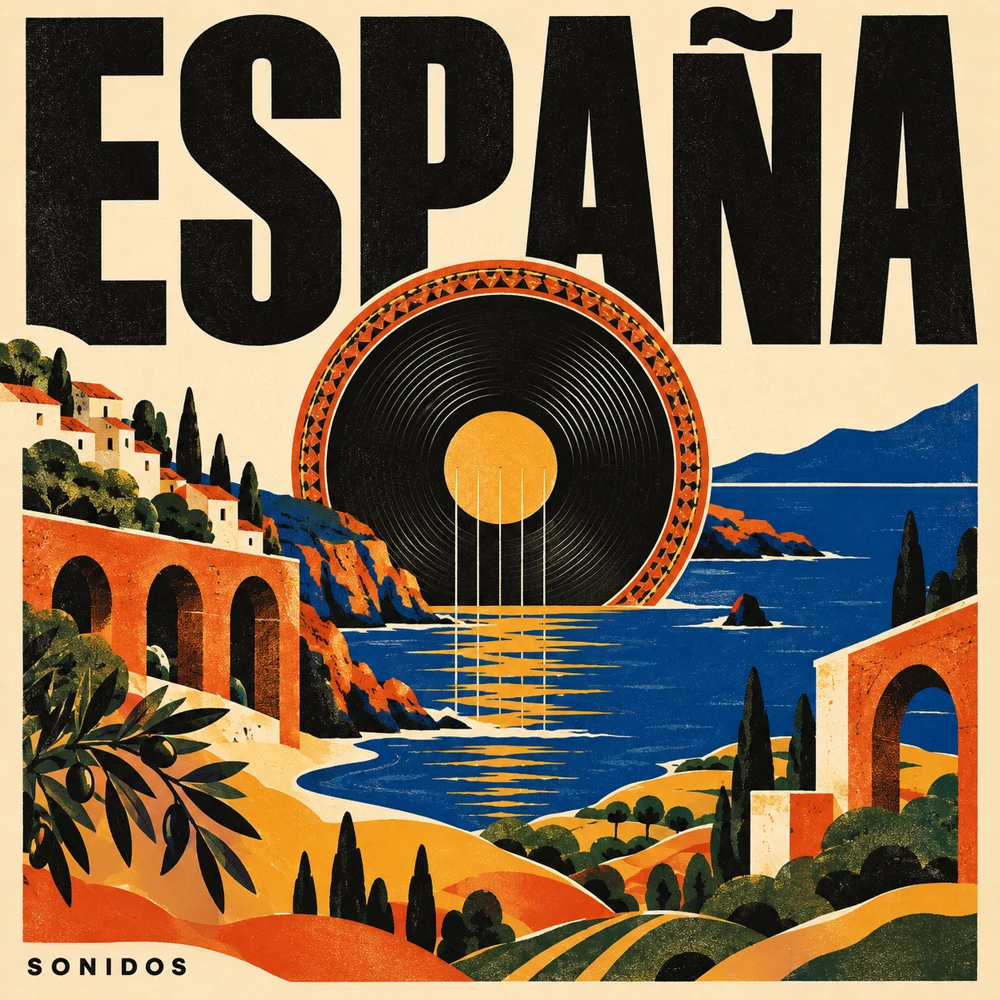
A journey from the Mediterranean shore to the last quiet hour before dawn. These 48 recordings are arranged as seven connected movements: intimate voices; belonging in many languages; tradition remade with electricity; the guitar-driven city; a shared public celebration; the walk home; and a wordless coda.
The order follows changes in emotional scale and musical texture rather than a timeline. The guitar near the opening returns in Rodrigo’s final Adagio, while Camarón and rumba connect older forms to contemporary reinvention. Turn shuffle off and let the public, outward-looking middle gradually become private again.
Listen on SpotifyThe stories in the grooves.
Read in playlist order. Listening cues are editorial guidance; references support cultural context.
A shore, then a room of voices
Serrat gives us a coastline; Paco opens its windows with guitar. Copla then brings the camera close to a single dramatic voice, before remembered pop melodies broaden into the release of Libre.
Mediterráneo
Joan Manuel Serrat
Serrat opens this journey with the Mediterranean as a place of belonging, memory and imaginative possibility.
Listen for Follow the gently unfolding vocal phrases and the way the melody seems to keep returning to the shore.
Entre dos aguas
Paco de Lucía
This instrumental rumba offers an inviting doorway into Paco de Lucía’s flamenco guitar and its openness to new musical company.
Listen for Follow the lead guitar’s changing phrases over the steady groove, hearing rhythmic precision and freedom together.
Tatuaje
Concha Piquer
Concha Piquer introduces copla’s theatrical storytelling, where a song can hold the drama of an entire life.
Listen for Follow the changing weight of each phrase and the way the voice makes the story feel immediate.
Ay, pena, penita, pena
Lola Flores
Lola Flores gives the copla chapter a commanding performance personality through a song she helped make famous.
Listen for Notice how the repeated title becomes a vehicle for emphasis, timing and emotional release.
Como una ola
Rocío Jurado
Rocío Jurado carries the dramatic scale of Spanish popular singing into a sweeping love song.
Listen for Listen for how she moves between intimacy and projection, making the refrain feel larger on each return.
La vida sigue igual
Julio Iglesias
This early Julio Iglesias song connects the route to the melodic-pop world of the Benidorm song festival.
Listen for Pay attention to the conversational phrasing and how the returning melody gives the song its reassuring continuity.
Eres tú
Mocedades
Mocedades connects the playlist to Spain’s Eurovision history through a song that places the vocal ensemble at its centre.
Listen for Listen for the relationship between the lead line and supporting harmonies as the refrain opens out.
Un ramito de violetas
Cecilia
Cecilia adds the finely observed story-song to this portrait of Spanish popular music.
Listen for Follow the unfolding narrative and listen for how a seemingly gentle melody carries emotional ambiguity.
Libre (Remastered 2016)
Nino Bravo
Nino Bravo brings the expansive emotional scale of Spanish melodic pop into the playlist. Here, Libre releases the tension built by the more intimate voices before it.
Listen for Listen for the rise from the narrative verses into the refrain and the control behind those sustained notes.
Belonging in many languages
Raimon’s urgency passes to Llach’s collective song and Laboa’s quieter tenderness. A Canarian isa turns belonging outward into a communal dance.
Al vent
Raimon
Raimon adds a Valencian voice to the songwriters’ chapter, putting the expressive power of language and delivery in the foreground.
Listen for Listen for the urgency of the repeated phrases and the way the vocal carries the song’s momentum.
L’estaca
Lluís Llach
Lluís Llach brings Catalan-language song and its tradition of critical, collective expression into the journey.
Listen for Listen to the repeated melodic shape and consider how easily a single voice could become a roomful of voices.
Txoria txori
Mikel Laboa
Mikel Laboa brings a widely shared Basque-language song into the playlist’s expanding map of voices.
Listen for Give the unhurried vocal line your attention, noticing what the spaces between phrases contribute.
Isa lagunera
Los Sabandeños
Los Sabandeños brings the Canary Islands into the journey through an ensemble rooted in La Laguna and Canarian song.
Listen for Follow the shared vocal sound and the rhythmic movement that connects this selection to a social singing tradition.
Old roots, new electricity
Triana and Camarón open the door between inherited forms and amplified music. Peret’s rumba reaches Estopa and C. Tangana; Rosalía, Tanxugueiras and Rigoberta Bandini then make transformation itself the subject.
Abre la puerta
Triana
Triana brings Andalusian rock into focus through the meeting of progressive-rock ambition and flamenco expression.
Listen for Give the arrangement time to unfold and listen for the conversation between keyboards, guitar and voice.
La leyenda del tiempo (Jaleos)
Camarón de la Isla
Recording: Remastered 2018
Borriquito
Peret
Peret brings Catalan rumba into the mix, highlighting a dance-centred strand of Spain’s popular music.
Listen for Listen for the interplay of guitar rhythm, voice and repetition that keeps the song moving.
Como Camarón
Estopa
Estopa carries rumba into a pop-rock setting, continuing a thread introduced earlier by Peret.
Listen for Listen to the rhythmic precision of the vocal and the way the guitars keep the words in motion.
Tú me dejaste de querer
C. Tangana, Niño de Elche, La Húngara
This collaboration brings different Spanish vocal personalities into one contemporary heartbreak song.
Listen for Compare the three voices and listen for how their entrances alter the colour and momentum of the refrain.
MALAMENTE
ROSALÍA
Rosalía brings flamenco-informed singing into a contemporary pop setting, continuing the playlist’s long conversation between tradition and experiment.
Listen for Listen for the handclap patterns and the contrast between intimate vocal detail and the sharply placed beat.
Terra
Tanxugueiras
Tanxugueiras brings Galicia and the visibility of Spain’s languages into the present-day chapter of the journey.
Listen for Listen to the group’s vocal interplay and the percussion, hearing how communal singing meets a modern production frame.
Ay mamá
Rigoberta Bandini
Rigoberta Bandini’s feminist pop song brings motherhood and women’s power into a shared, celebratory musical space.
Listen for Follow the progression from the opening vocal statement to the full refrain and the sense of voices gathering together.
The city turns up its guitars
Begin with Nacha Pop’s bittersweet street scene, heat up with Radio Futura and Alaska, then let concise pop hooks gather weight until Héroes del Silencio and Extremoduro reach the rock peak. Miguel Ríos’s live welcome turns the listeners into a crowd.
Chica de ayer
Nacha Pop
Nacha Pop takes the route into the remembered emotional world of Spanish pop in the eighties.
Listen for Listen for the tension between the tune’s easy familiarity and the more wistful tone of the singing.
Escuela de calor
Radio Futura
Radio Futura shifts the journey toward a more rhythm-led side of Spanish guitar pop.
Listen for Lock onto the guitar pattern and follow the way the vocal phrases lean against the groove.
A quién le importa
Alaska y Dinarama
This declaration of individuality has found a lasting place in Spain’s Pride celebrations and shared pop memory.
Listen for Listen for the directness of the refrain and the way repetition turns a personal statement into a collective one.
Black Is Black
Los Bravos
Los Bravos opens a window onto the international ambitions of Spain’s beat and pop scene.
Listen for Follow the insistent groove and the contrast between the lead vocal and the sharply defined instrumental phrases.
Devuélveme a mi chica
Hombres G
Hombres G brings the humour and headlong energy of Spain’s eighties pop phenomenon into the sequence.
Listen for Follow the clipped storytelling and the rapid arrival of a refrain designed to be shouted back.
Cien gaviotas
Duncan Dhu
Duncan Dhu offers another shade of guitar-led pop, providing a lighter counterpoint to the rock songs around it.
Listen for Listen for the melody’s lift and how the guitar accompaniment keeps the vocal line moving forward.
Insurrección (2008 Remaster)
El Último de la Fila
Entre dos tierras
Héroes del Silencio
Héroes del Silencio brings a more expansive rock sound into this journey through Spanish-language music.
Listen for Listen for the recurring guitar figure and the dramatic distance between the quieter passages and the full-band release.
So payaso
Extremoduro
Extremoduro gives the rock chapter a rougher edge and an emotionally exposed way of singing.
Listen for Listen for how the vocal moves across the guitar-led arrangement and how the shifts in intensity affect the song’s mood.
Bienvenidos
Miguel Ríos
Recording: Live recording from Rock & Ríos
Miguel Ríos’s live recording expands the guitar chapter into a concert-sized welcome, placing the listener inside a shared rock celebration.
Listen for Listen for the exchange of energy between the singer, band and audience as the opening invitation takes shape.
A square full of people
The energy becomes generous and shared: loose rumba-pop, big refrains and familiar party rhythms. Resistiré supplies the collective lift; Mi gran noche is the theatrical last burst before the room empties.
La flaca
Jarabe de Palo
Jarabe de Palo brings a familiar piece of Spanish summer-radio memory into the journey.
Listen for Follow the relaxed groove and the conversational lead vocal, then notice how the refrain changes the scale of the song.
Corazón partío
Alejandro Sanz
Alejandro Sanz adds another central voice of Spanish-language pop, turning heartbreak into an invitation to sing along.
Listen for Follow the sync between the vocal phrasing and accompaniment, especially as the refrain gathers momentum.
El talismán
Rosana
Rosana brings Lanzarote into this wider map of Spain through the song that helped launch her recording career.
Listen for Listen for the warmth of her vocal delivery and the recurring melodic hook that keeps drawing the ear back.
Ave María
David Bisbal
David Bisbal brings the exuberance of Spanish mainstream pop to this stretch of the route.
Listen for Listen for the interplay between the driving rhythm and his quick, sharply articulated vocal phrases.
Macarena
Los del Río
Recording: Original version
The original Macarena puts the Spanish song behind a worldwide dance phenomenon back at the centre of attention.
Listen for Listen to the singers’ rhythmic exchanges and the repeating hook, keeping your focus on the song beneath the familiar dance.
Cuando zarpa el amor
Camela
Camela brings technorumba into the journey, making room for a hugely recognisable strand of Spanish popular taste.
Listen for Listen for the combination of electronic rhythm and expressive singing, especially where the melody stretches over the beat.
Resistiré
Dúo Dinámico
Resistiré gained a renewed communal role during Spain’s pandemic lockdown, showing how a familiar pop song can gather new meaning.
Listen for Follow the refrain’s repeated resolve and the way the arrangement supports its sense of forward motion.
Mi gran noche
Raphael
Raphael adds the showmanship of Spanish television and stage pop with one of his enduring signature songs.
Listen for Follow the anticipation in the verses and the way his emphatic delivery makes the refrain feel like an entrance.
The walk home
Sabina’s gravelly aftermath gives way to memory, absence, the shore and the imagined road. These are increasingly inward songs, ending with Mecano’s moonlit story rather than one more dance-floor peak.
19 días y 500 noches
Joaquín Sabina
Sabina turns a breakup into a densely told story, adding the Spanish singer-songwriter tradition’s conversational edge.
Listen for Follow the phrasing as if listening to someone recount a long night, then notice how the rhythm holds the details together.
Entre mis recuerdos
Luz Casal
Luz Casal introduces a reflective moment from an artist whose work ranges across rock and more intimate song forms.
Listen for Follow the changing vocal intensity and give the quieter passages as much attention as the peaks.
Sin ti no soy nada
Amaral
Amaral brings a song with a lasting place in Spanish pop’s communal singalong repertory.
Listen for Listen for the contrast between the close, personal verses and the release of the returning refrain.
La playa
La Oreja de Van Gogh
La Oreja de Van Gogh returns the journey to the sea through the intimate scale of a pop memory-song.
Listen for Follow the vocal line and the gradual opening of the arrangement, hearing how a small recollection becomes a larger feeling.
Soldadito marinero
Fito & Fitipaldis
This song helped carry Fito & Fitipaldis to a wider public, adding a storytelling strain of rock to the playlist.
Listen for Follow the narrative voice and the gentle sway of the accompaniment, listening for the musical details around each phrase.
Copenhague
Vetusta Morla
Vetusta Morla introduces the more atmospheric side of Spain’s alternative-pop landscape.
Listen for Listen for how the instrumental layers gather around the vocal and change the emotional weight of the repeated lines.
Hijo de la luna
Mecano
Mecano adds a fable-like story to the pop chapter, showing how theatrical narrative can live inside a radio song.
Listen for Follow the circular movement of the melody and Ana Torroja’s phrasing as the story grows more dramatic.
Before the light returns
Al alba asks for close attention after the celebration. Rodrigo’s slow movement leaves words behind and returns to the guitar heard near the beginning, now surrounded by orchestra.
Al alba
Luis Eduardo Aute
Recording: Albanta recording
Concierto de Aranjuez: II. Adagio
Joaquín Rodrigo, Paco de Lucía, Orquesta de Cadaqués, Edmon Colomer
Follow the threads.
- Joan Manuel Serrat: Mediterráneo — musical context and recording
- Nino Bravo: Libre (Remastered 2016) — musical context and recording
- Paco de Lucía: Entre dos aguas — musical context and recording
- Camarón de la Isla: La leyenda del tiempo (Jaleos, Remastered 2018) — musical context and recording
- Lola Flores: Ay, pena, penita, pena — musical context and recording
- Rocío Jurado: Como una ola — musical context and recording
- Raphael: Mi gran noche — musical context and recording
- Julio Iglesias: La vida sigue igual — musical context and recording
- Peret: Borriquito — musical context and recording
- Los Bravos: Black Is Black — musical context and recording
- Mocedades: Eres tú — musical context and recording
- Cecilia: Un ramito de violetas — musical context and recording
- Lluís Llach: L’estaca — musical context and recording
- Mikel Laboa: Txoria txori — musical context and recording
- Los Sabandeños: Isa lagunera — musical context and recording
- Nacha Pop: Chica de ayer — musical context and recording
- Radio Futura: Escuela de calor — musical context and recording
- Alaska y Dinarama: A quién le importa — musical context and recording
- Mecano: Hijo de la luna — musical context and recording
- Héroes del Silencio: Entre dos tierras — musical context and recording
- Hombres G: Devuélveme a mi chica — musical context and recording
- Duncan Dhu: Cien gaviotas — musical context and recording
- El Último de la Fila: Insurrección (2008 Remaster) — musical context and recording
- Joaquín Sabina: 19 días y 500 noches — musical context and recording
- Triana: Abre la puerta — musical context and recording
- Extremoduro: So payaso — musical context and recording
- Jarabe de Palo: La flaca — musical context and recording
- Estopa: Como Camarón — musical context and recording
- Los del Río: Macarena (original version) — musical context and recording
- Alejandro Sanz: Corazón partío — musical context and recording
- Rosana: El talismán — musical context and recording
- Luz Casal: Entre mis recuerdos — musical context and recording
- Amaral: Sin ti no soy nada — musical context and recording
- La Oreja de Van Gogh: La playa — musical context and recording
- David Bisbal: Ave María — musical context and recording
- Fito & Fitipaldis: Soldadito marinero — musical context and recording
- Vetusta Morla: Copenhague — musical context and recording
- ROSALÍA: MALAMENTE — musical context and recording
- C. Tangana, Niño de Elche, La Húngara: Tú me dejaste de querer — musical context and recording
- Tanxugueiras: Terra — musical context and recording
- Rigoberta Bandini: Ay mamá — musical context and recording
- Camela: Cuando zarpa el amor — musical context and recording
- Miguel Ríos: Bienvenidos (Live, Rock & Ríos) — musical context and recording
- Dúo Dinámico: Resistiré — musical context and recording
- Luis Eduardo Aute: Al alba (Albanta recording) — musical context and recording
- Joaquín Rodrigo, Paco de Lucía, Orquesta de Cadaqués, Edmon Colomer: Concierto de Aranjuez: II. Adagio — musical context and recording
- Camarón de la Isla: recording and work details
- El Último de la Fila: recording and work details
- Luis Eduardo Aute: recording and work details
- Joaquín Rodrigo, Paco de Lucía, Orquesta de Cadaqués, Edmon Colomer: recording and work details
- València City Council: Concha Piquer exhibition
- Xàtiva Municipal Library: 60 years of Al vent