Postcards in Sound
← Back to the listening map
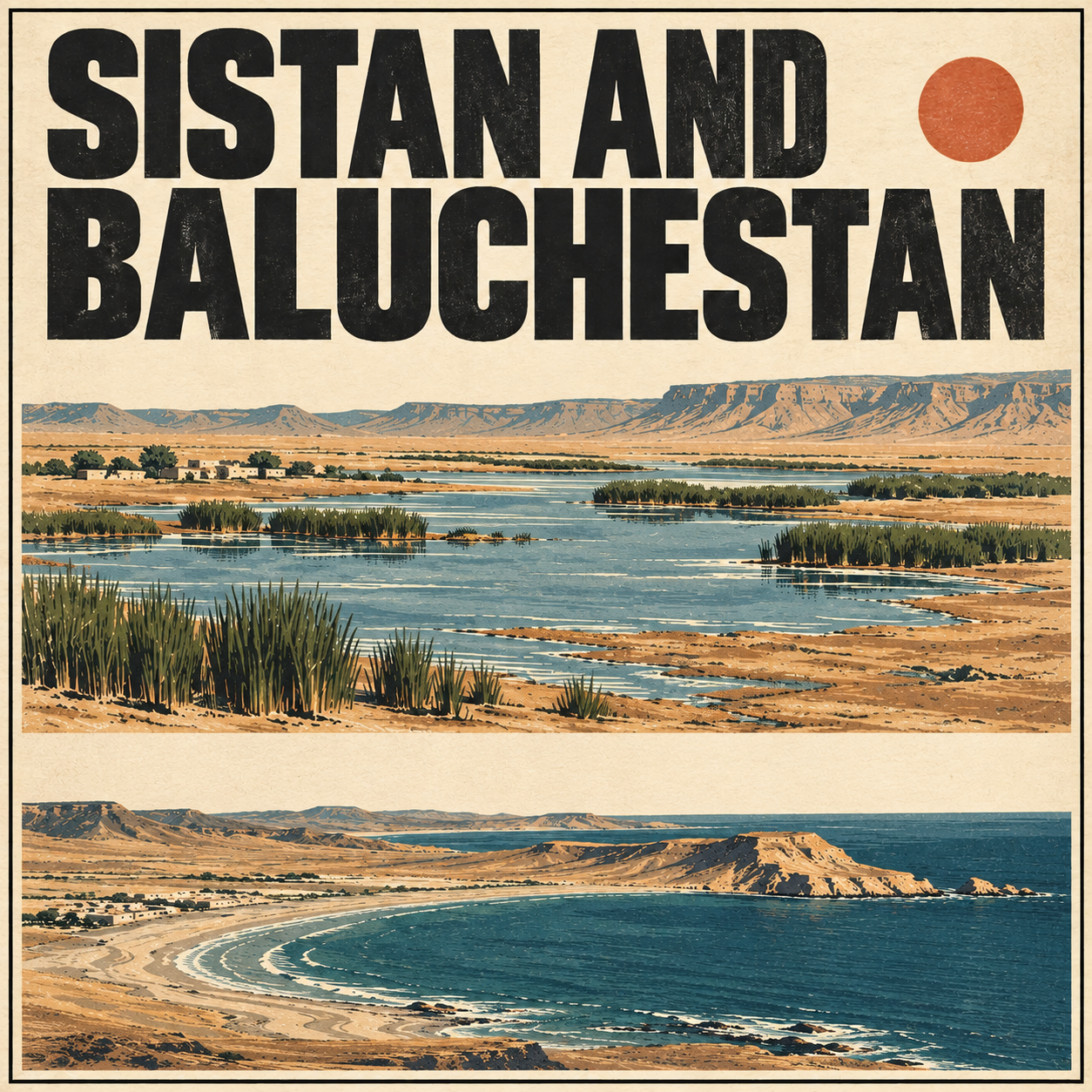
Editorial Sistan and Baluchestan cover: separate Hamoun-inspired reeds and Makran-inspired coastal panels

SISTANI · BALOCHI · NEW VOICES · NARRATIVE · 15 SONGS · 76:24.034

Sistan and Baluchestan

Begin with living Sistani songwriting, then explore seasonal and dance repertoire, regional poetry, concert composition, paired pipes, electronic collaboration and a long narrative performance. The two regional strands and their cross-border contexts remain distinct; this first route is not a survey of every community.

The saved Spotify playlist and its ordinary public page show the fifteen reviewed recordings in order, totalling 76:24.034. Use the direct playlist and exact-track links below. Spotify’s anonymous embedded preview still shows an older nineteen-track snapshot and cover, so no preview player is used here. Selection and position notes are source-informed editorial readings; audio, lyrics, playback and transitions have not been independently auditioned.

Listen on Spotify

THE COVER · PLACE AND INTERPRETATION

Behind the artwork.

Two separate illustrated water landscapes set inland Hamoun-inspired reeds above a Makran-inspired curved bay and headland. Blank paper between them rejects a fabricated connecting waterway or single panorama. This is an editorial juxtaposition, not a current water-level report, a precise coastline, a map or an ethnic emblem. The title, sun and ink palette are series design choices.

IRAN LISTENING ATLAS · CULTURAL ORIENTATION

A place with many voices.

Two regional strands, wider than a border

Sistani Persian-language traditions and Balochi traditions are distinct. Historical Sistan and Balochistan cross modern national boundaries. The guide keeps northern Sistani work visible beside Balochi practices of Sarhadd and Makran, without assigning every recording an exclusive place or language.

Women as musicians, authors and researchers

Mahoor documents Kaniz Arbabi as a singer and dayereh player; Hura Mirshekari describes setting Payam Sistani poetry; Shima Shahmohammadi is a credited qeychak soloist; Mansureh Sabetzadeh documented Balochi dance. RAAZ has women credited at album level, but individual-track placement is not established.

A coastal women-centred practice

A published study examines two mamaby songs performed by Sarok and her group in Bahukalat, sung for mothers. The proposed African musical connections are preliminary and locally scoped. Scholarship does not grant access to private ceremonies or permission to reuse restricted recordings; this practice is context, not a core-track claim.

ARTIST LINKS · EXTENDED WATCH

Keep listening.

Molana · Hura Mirshekari, N9nE, Siân Pottok

Hura Mirshekari’s later Badjens EP extends the contemporary Sistani chapter beyond the opening Stareh. A presenter links the project to Payam Sistani poems and singing; the exact poem used for this track and Siân Pottok’s precise instrumental role are not established. The 2026-04-24 date is a catalogue issue, not a session date. This is a separately linked Spotify track, not an additional core selection.

Halo Halo · Rastak

Rastak identifies this complete published song as a contemporary interpretation dedicated to Balochistan. It can sit beside Se Chap as another arrangement approach, without asserting that the two share a source tune. The 2025 album issue is not a composition or session date; the distinct Electronic Version and its conflicting dates are not substituted here. Full playback has not been independently checked.

Salounki (feat. Aida Mirlashari) · Rostam Mirlashari, Aida Mirlashari

Rostam Mirlashari’s official description identifies a Balochi wedding song newly arranged by Bamshad. This separately linked official audio opens a social-song path beyond the Bina core track. Aida Mirlashari is credited as a featured artist, but a vocal role is not established. The arranged work is not a recording of an actual wedding, and its exact master has not been auditioned.

Dâd laureates evening including Hura and Renaud · Multiple artists; Hura Mirshekari and Renaud Satre in second part

This public 96-minute multi-artist event video includes Hura Mirshekari and Renaud Satre in its second part. It gives the wider interdisciplinary setting of Hura’s Dâd rather than an isolated complete Hura track. Her precise segment timestamp remains unresolved; the earlier Leili Anvar and Amir Sharifi recital is a separate part. The event date and upload date are distinct.

The signed-in saved playlist and public direct page show fifteen exact recording IDs and the approved cover. An anonymous Spotify embed still shows an older nineteen-track snapshot and cover; its cause is unknown. Full audio, lyric, account-playback and transition checks have not been completed.

DEEPER CONTEXT · LIVING SCENES · RESEARCH LIMITS

Follow another thread.

Open a topic to explore more of this place and its music.

Kaniz Arbabi and Sistani women's practice

The Mahoor publisher documents Kaniz Arbabi’s singing and dayereh playing. A complete, officially available exact recording has not yet been verified for this route; she is not silently counted among its fifteen tracks.

Hamoun and present environmental conditions

The shallow inland waters and reed margins vary greatly. The artwork is a symbolic panel, not a record of current water levels or a permanently lush landscape.

Makran and the coastal panel

Makran’s capes and sedimentary bays inform the lower cover shape. It is an original composition, not the exact Konarak or Pozm shoreline, a current map or a performance location.

Mamaby scholarship and respectful boundaries

The specific Bahukalat research is an invitation to read, not to access a private ceremony or redistribute protected recordings. It should not stand in for all Balochi women’s practice.

Brahui and other gaps

This first route does not establish Brahui-language representation, equal time among communities or every subregional repertoire. The cross-border and diaspora links are identified as such.

The stories in the grooves.

Read in playlist order. Position notes are current editorial readings of the saved order, not a claim about original intent or an audio audition. Sources support specific cultural context; open each track’s qualifications for limits.

  1. Stareh

    Hura Mirshekari, N9nE

    Place and practice: Sistani electronic song

    Open exact recording on Spotify

    Why this track belongs: Hura’s first-person account connects her project to Payam Sistani’s poetry and Renaud Satre’s production; her separate interview singles out Stareh. Language and collaboration, not birthplace, make this a provincial listening doorway.

    Sources and limits

    Qualification: Selected Spotify issue 2024-06-28; composition and session dates unresolved. Project credits are not an exact Stareh poem transcription. Do not repeat promotional first-Sistani-woman claims; Kaniz’s documented prior work contradicts that framing. The recording, lyrics and transition have not been independently auditioned.

    Why this position in the playlist

    Role: Sistani electronic song

    Current editorial reading: Open with a living artistic practice, not a presumption that the province belongs only in an archive.

    To the next track: Then introduce an independently documented Sistani drum-dance recording; this is not claimed as Stareh’s source tune.

  2. Raghse Dohol Sistan

    Habibolah Ghader Atashgar, Mousa Mirbandani

    Place and practice: Sistani dance repertoire

    Open exact recording on Spotify

    Why this track belongs: The selected Hozeh Honari edition names Atashgar and Mirbandani and identifies Sistan in this exact dance title. It introduces a compact documented dance-repertoire item.

    Sources and limits

    Qualification: 2019-03-13 selected edition’s catalogue date on Spotify/Apple; session date unverified. Specific drums, players’ allocation, dancers, village and occasion are unverified; no entire wedding/festival reconstruction. The recording, lyrics and transition have not been independently auditioned.

    Why this position in the playlist

    Role: Sistani dance repertoire

    Current editorial reading: After Hura, distinguish new songmaking from a named local performance tradition, without ranking either as more authentic.

    From the previous track: After Hura, distinguish new songmaking from a named local performance tradition, without ranking either as more authentic.

    To the next track: Keep Atashgar in view for the seasonal-song selection while changing the catalogued social/repertoire context.

  3. Norouz & Bahar Sistan And Balouchestan

    Habibolah Ghader Atashgar

    Place and practice: Sistani seasonal song

    Open exact recording on Spotify

    Why this track belongs: Atashgar’s exact performance is issued in the Norouz and Persian Spring collection. The provincial title should not be expanded into a claim about every Balochi community’s New Year practice.

    Sources and limits

    Qualification: 2019-03-13 selected edition’s catalogue date on Spotify/Apple, not performance year. Mahoor’s separate Sistani album documents Atashgar’s Sistani practice; that supports performer context, not this exact session. Exact language/text and ceremony remain untranscribed. No blanket Nowruz claim for the province. The recording, lyrics and transition have not been independently auditioned.

    Why this position in the playlist

    Role: Sistani seasonal song

    Current editorial reading: The named Atashgar connection makes a comprehensible two-recording local chapter without assuming the same event.

    From the previous track: The named Atashgar connection makes a comprehensible two-recording local chapter without assuming the same event.

    To the next track: Then move from the issued seasonal performance to a Sistan-themed composed concert work.

  4. Maryam's Eyes - Based on Theme from Sistan

    Shima Shahmohammadi, Behzad Abdi, Ukraine National Symphony Orchestra

    Place and practice: Composed regional-theme concert work

    Open exact recording on Spotify

    Why this track belongs: The exact issued subtitle names Sistan; Pardis documents Abdi’s suite and Shahmohammadi’s soloist role. This is a specific regional-theme concert setting, not a generic classical work by someone born nearby.

    Sources and limits

    Qualification: Selected Spotify issue 2019-11-04; release year2019 supported by artist catalog. Original tune and recording date unresolved. Underlying Sistan tune/village source not identified. No claim of unchanged traditional performance or identity with a local qeychak master. The recording, lyrics and transition have not been independently auditioned.

    Why this position in the playlist

    Role: Composed regional-theme concert work

    Current editorial reading: After two local catalogued contexts, show another way regional material is interpreted.

    From the previous track: After two local catalogued contexts, show another way regional material is interpreted.

    To the next track: Next begins the Balochi dance chapter; do not imply the suite borrows the following dance tune.

  5. Se Chap - Live

    Mashallah Bameri, Khodadad Shakkalzehi Nasab, Khan Mohammad Davudi, Eyd Mohammad Davudi, Mohammad Omar Sami, Jahanbakhsh Parvin Jakas, Anvar Zangshahi, Safar Davudi

    Place and practice: Balochi dance collection

    Open exact recording on Spotify

    Why this track belongs: Mahoor names Bameri and the regional ensemble, with Mansureh Sabetzadeh responsible for recording and notes. One complete short selection gives this dance collection a clear place without reproducing three cuts.

    Sources and limits

    Qualification: Mahoor publisher year1384 (2005/06). Spotify/AppleUS selected catalogue date2005-12-15; AppleCanada’s Allah Mani Barak track says2005-10-19. Original issue day and exact session remain unresolved. Album roster not exact-cut personnel; Live suffix does not establish venue or actual wedding; no choreography inferred. The recording, lyrics and transition have not been independently auditioned.

    Why this position in the playlist

    Role: Balochi dance collection

    Current editorial reading: Make the Sistani/Balochi change explicit; similar chap terminology alone does not establish the same dance.

    From the previous track: Make the Sistani/Balochi change explicit; similar chap terminology alone does not establish the same dance.

    To the next track: Follow with a later Balochi-song project produced by a Balochi practitioner, without claiming original-and-cover equivalence.

  6. Male Baluchan - مله بلوچان

    Sima Bina

    Place and practice: Balochi repertoire reinterpretation

    Open exact recording on Spotify

    Why this track belongs: Mirlashari’s own project page embeds this exact master, and the concert presenter identifies his Balochi album production for Bina. This supports a specific interpretive collaboration beyond national celebrity.

    Sources and limits

    Qualification: Selected Spotify and Apple issue 2022-01-28; not a verified session or traditional-song origin date. Exact underlying song history/translation and track personnel unverified; 2023 Rozhnak live personnel must not be transferred. Bina does not stand for all Baloch women. The recording, lyrics and transition have not been independently auditioned.

    Why this position in the playlist

    Role: Balochi repertoire reinterpretation

    Current editorial reading: After Bameri’s collection, distinguish a later arranged-song project from field or festival documentation.

    From the previous track: After Bameri’s collection, distinguish a later arranged-song project from field or festival documentation.

    To the next track: Then give another Balochi practitioner, Dinmohammad Zangeshai, his own catalogued song space.

  7. Kapotan

    Dinmohammad Zangeshai

    Place and practice: Balochi song / regional collection

    Open exact recording on Spotify

    Why this track belongs: The artist and exact work are established by Soroush’s regional catalog. A secondary cover transcription calls the poem traditional; that attribution stays qualified rather than being converted to an invented story.

    Sources and limits

    Qualification: Catalogue-attributed release date2011-07-01 on Spotify/Apple/Amazon. Secondary cover transcription reports1387; original booklet and first issue/session remain unresolved. Do not assign the album-level gheychak/benju/doholak roster to this exact cut; no lyric translation or audible instrument description claimed. The recording, lyrics and transition have not been independently auditioned.

    Why this position in the playlist

    Role: Balochi song / regional collection

    Current editorial reading: After Bina’s interpretation, introduce a different named regional practitioner and publication history.

    From the previous track: After Bina’s interpretation, introduce a different named regional practitioner and publication history.

    To the next track: Next retain Sorud Khash’s separately credited authored-poem strand, rather than treating a common performer/album as proof of redundancy.

  8. Sorud Khash

    Dinmohammad Zangeshai

    Place and practice: Khash-named authored regional poem

    Open exact recording on Spotify

    Why this track belongs: The exact catalog title names Khash. A secondary transcription of the release cover credits its text to Samad Kord, unlike the traditional-poem attribution for Kapotan. Keep that qualification visible: it offers a potentially distinct authored regional-poetry strand, not simply another interchangeable cut.

    Further door: Salounki official full audio opens a newly arranged Balochi wedding-song branch; see the separate companion and credit limits below. Open Salounki official audio →

    Sources and limits

    Qualification: Catalogue-attributed release date2011-07-01 on Spotify/Apple/Amazon. Secondary cover transcription reports1387; original booklet and first issue/session remain unresolved. Samad Kord credit relies on a secondary cover transcription, not an inspected booklet. No lyric translation, precise subject, exact instrumentation or field session established. Sorud in the title is not proof of a fiddle solo. The recording, lyrics and transition have not been independently auditioned.

    Why this position in the playlist

    Role: Khash-named authored regional poem

    Current editorial reading: Place next to Kapotan so the same performer’s two differently credited text traditions can be considered together. The distinction is documentary and provisional, not an inferred sonic contrast.

    From the previous track: Place next to Kapotan so the same performer’s two differently credited text traditions can be considered together. The distinction is documentary and provisional, not an inferred sonic contrast.

    To the next track: Then Wadar gives an explicitly credited Balochi singer/co-composer a contemporary role. These are different histories of authorship, not the same poem or a source-and-remake pair.

  9. Wadar

    Ashavahishta, Mohammadali Delnavaz

    Place and practice: Contemporary Balochi co-authored fusion

    Open exact recording on Spotify

    Why this track belongs: The label identifies this Balochi work and credits music to Arash Adelpour and Mohammad Ali Delnavaz, text to Taj Mohammad Taher and voice to Delnavaz. His documented apprenticeship and Saravan/Zahedan practice establish a regional artistic connection beyond birthplace.

    Sources and limits
    • L01 · primary label · primary label

      The Ring issue 2025-10-31; exact Wadar music/text/vocal credits; Titanali traditional Balochi attribution; album production and personnel.

      Scope: Album instrumentation not a track-by-track roster. Marketing's Sufi/trance language cannot establish Wadar ritual function. Exclude overgeneralized national-instrument/history claims.

    • L02 · platform catalog linked by label · platform catalog linked by label

      The Ring catalog identity and 2025 issue.

      Scope: Page rendered earlier via label click; later direct open failed. Not session history or playback proof.

    • L03 · platform catalog · platform catalog

      The Ring catalogue-attributed release date 2025-10-31; Wadar/Titanali feature Delnavaz, times and track positions.

      Scope: Distribution metadata, not independent ethnography or first session evidence.

    • L04 · artist channel / reproduced artist interview · artist channel / reproduced artist interview

      Delnavaz describes study with Mohammad Jan and Gholam Rasul Dinarzehi; sustained Balochi composing, teaching and instrument work; cooperation with Ashavahishta.

      Scope: Public search extraction available, direct open later failed. First-person account, not independent biographical verification. Does not locate Wadar recording.

    • L05 · artist channel · artist channel

      Saravan benju workshop dated 19 Mehr 1397; Zahedan Adinak performance described by practitioner as Dinarzehi theme / Ali Sheyda text with wordless solo-benju treatment of a Sarhadd liku theme. Named performers and 5:35 linked upload.

      Scope: Exact standalone post/video permalink not retrieved; neither full-piece status nor audio heard. Do not infer that Wadar uses this theme.

    • L06 · artist channel · artist channel

      Adinak Saravan rehearsal and concert project; repertoire includes Dinarzehi, Delnavaz and traditional Balochi works.

      Scope: Event/program context, not precise studio-track personnel. Not proof of current 2026 residence.

    • L27 · direct platform public data · direct platform public data

      Wadar and Titanali exact IDs/durations and displayed artist names.

      Scope: Public metadata only; cached JSON; no playback/account assurance.

    • SP09 · Wadar — exact Spotify public record · public platform catalog

      Exact public recording ID, title, displayed credits and millisecond duration. This is catalogue identity evidence, not audition.

      Scope: Public metadata not intended-account listing, complete playback, lyric review or auditory validation.

    Qualification: Selected album issue2025-10-31 supported by label/Apple/Amazon. Composition, vocal session and mastering chronology unresolved. International project, not a Saravan field recording. No proof Wadar uses the Sarhadd liku discussed in Delnavaz’s separate Adinak account. Trance/fusion is album-project description, not a gwati ceremony, religious function, or medical claim. Instruments remain album-level credits. The recording, lyrics and transition have not been independently auditioned.

    Why this position in the playlist

    Role: Contemporary Balochi co-authored fusion

    Current editorial reading: After the Khash-named authored poem, foreground a contemporary Balochi performer expressly credited as both singer and co-composer. Do not infer shared texts or melody.

    From the previous track: After the Khash-named authored poem, foreground a contemporary Balochi performer expressly credited as both singer and co-composer. Do not infer shared texts or melody.

    To the next track: Ahu Jan next returns explicitly to Sistan and a different arrangement practice, preventing the province from becoming one uninterrupted Balochi block.

  10. Ahu Jan (Sistan)

    Keivan Pahlavan, Pouyan Azadeh

    Place and practice: Sistani melody piano arrangement

    Open exact recording on Spotify

    Why this track belongs: Azadeh’s own catalog labels this exact Ahu Jan as Sistan and names his piano arrangement. Its regional link is more specific than a general Persian wedding-song label.

    Sources and limits

    Qualification: Spotify/Apple catalogue attribution2006-01-01. Treat2006 as edition year, not a verified New Year session. Not evidence the arranged recording captures a wedding; exact original tune source/village and session not documented. The recording, lyrics and transition have not been independently auditioned.

    Why this position in the playlist

    Role: Sistani melody piano arrangement

    Current editorial reading: Return to the Sistani strand after the Balochi co-authored work, allowing a separate arrangement method rather than a single north-then-south block.

    From the previous track: Return to the Sistani strand after the Balochi co-authored work, allowing a separate arrangement method rather than a single north-then-south block.

    To the next track: Next, Espandar opens the paired-pipe repertoire chapter; the connection is a change of documented practice, not a claimed audible transition.

  11. Liku Dalgâni I

    Shir-Mohammad Espandar

    Place and practice: Balochi paired-pipe repertoire

    Open exact recording on Spotify

    Why this track belongs: The album’s documented paired-pipe practice and the exact Dalgani-named first version earn one focused Espandar selection. The two Liku versions are not collapsed.

    Sources and limits

    Qualification: Selected Spotify/Qobuz date2000-11-09; physical library listing says1983. First issue and session date unresolved. Liku family association does not prove these exact lyrics, voice, locality of recording or ritual. Do not assign a singer from form name; source describes instrumental donali collection. The recording, lyrics and transition have not been independently auditioned.

    Why this position in the playlist

    Role: Balochi paired-pipe repertoire

    Current editorial reading: After the explicit Sistani return, reopen the Balochi chapter with a named form and specialist.

    From the previous track: After the explicit Sistani return, reopen the Balochi chapter with a named form and specialist.

    To the next track: RAAZ follows as a different documented approach to Balochi materials—not a remix of this Liku or an assertion that Espandar appears on it.

  12. Yə'k

    Hooshyar Khayam, Bamdad Afshar

    Place and practice: Collaborative prepared-piano/electronic reworking

    Open exact recording on Spotify

    Why this track belongs: 30M’s project credits name Balochi musicians, including Khodadad Shakkal Zehi, Davoud and Hamed Bameri, Omar Sami and Sogol Khojasteh, alongside prepared piano/electronics and the Scheherazade Quartet. This is documented collaboration, not a generic electronic bonus.

    Sources and limits

    Qualification: Label and selected Spotify issue2020-11-20. Tehran studios documented at album level; exact session dates unresolved. Names and instruments are album credits, not all proved on Yek. Pilley’s account of the track is attributed criticism, not our audition. Sogol’s exact placement is unverified. The recording, lyrics and transition have not been independently auditioned.

    Why this position in the playlist

    Role: Collaborative prepared-piano/electronic reworking

    Current editorial reading: After Espandar, compare ways Balochi material is presented without inventing a direct sample lineage.

    From the previous track: After Espandar, compare ways Balochi material is presented without inventing a direct sample lineage.

    To the next track: Then RAZZ offers a separately described electronic-vocal setting from the same project. Their adjacency is a documented comparison to test by listening, not a claim of seamless flow.

  13. RAZZ

    Hooshyar Khayam, Bamdad Afshar

    Place and practice: Collaborative electronic-vocal setting

    Open exact recording on Spotify

    Why this track belongs: Pilley’s review specifically describes Balochi singers paired with electronically treated atmospherics in this part of RAAZ, distinct from his account of Yə’k’s prepared piano/quartet setting. The project’s credited collaboration supports comparison of two contrasting settings, not a second claimed scene.

    Sources and limits

    Qualification: Label and selected Spotify issue2020-11-20. Tehran studios documented at album level; exact session dates unresolved. Pilley calls this passage Raaz; the selected catalog title is RAZZ. No specific singer or instrumental roster has been assigned to this exact master. Critical description is not our audition; no gwati ritual or healing claim. Pilley’s pitch-shifted female-voice example is Noh, not RAZZ; no processing of the RAZZ voices themselves is asserted. The recording, lyrics and transition have not been independently auditioned.

    Why this position in the playlist

    Role: Collaborative electronic-vocal setting

    Current editorial reading: Keep the two RAAZ works adjacent as a listening question about different settings within one project. Their difference is attributed to the review until actual audition; do not promise a sonic transition.

    From the previous track: Keep the two RAAZ works adjacent as a listening question about different settings within one project. Their difference is attributed to the review until actual audition; do not promise a sonic transition.

    To the next track: Then allow the longer narrative recording its own time. A2:17 issued piece beside a12:27 issued narrative is a factual change of scale, not evidence of an energy curve.

  14. Mir Ghanbar

    Lal Bakhsh Peik, Ali Mohammad Baluch, Mohammad Eshagh Baluch

    Place and practice: Balochi narrative epic

    Open exact recording on Spotify

    Why this track belongs: A substantial Peyk performance makes narrative time part of the route instead of reducing storytelling to a preview. The historical program separately documents his Mir Qanbar repertory; this selected three-artist issue has its own identity.

    Sources and limits

    Qualification: Publisher issue2007; selected edition’s catalogue date 2020-08-25. The 1974 program is earlier repertoire evidence, NOT this master’s recording date. 12:27 is the complete issued track, not proved complete epic or unedited session. Verses/episode not transcribed; do not equate MirGhanbar master to1974 performance. The recording, lyrics and transition have not been independently auditioned.

    Why this position in the playlist

    Role: Balochi narrative epic

    Current editorial reading: After the short RAZZ item, invite a deliberate long-form narrative chapter. This is a curatorial change of scale, not a claim about sonic energy.

    From the previous track: After the short RAZZ item, invite a deliberate long-form narrative chapter. This is a curatorial change of scale, not a claim about sonic energy.

    To the next track: Surizehi’s Rakhshani love-song/benju setting closes with another circulation of Balochi practice, not an asserted continuation of the story.

  15. Bya Bya

    Abdulrahman Surizehi

    Place and practice: Rakhshani love-song / benju practice

    Open exact recording on Spotify

    Why this track belongs: The label explicitly locates this repertoire across national borders; Broughton’s review specifically identifies Bya Bya’s benju. Surizehi is a practitioner in diaspora, not a proxy for an exclusively Iranian village session.

    Sources and limits

    Qualification: Label EM58/2010; selected Spotify issue2011-01-24, contemporaneous review May/June2011. Session date/location unverified. Review’s sonic descriptions remain attributed; exact poem/translation unverified. Do not call the whole two-disc release trance or Iranian-local. The recording, lyrics and transition have not been independently auditioned.

    Why this position in the playlist

    Role: Rakhshani love-song / benju practice

    Current editorial reading: After Peyk’s long narrative, offer the love-song/benju strand as a distinct final encounter rather than another epic or gwati cut.

    From the previous track: After Peyk’s long narrative, offer the love-song/benju strand as a distinct final encounter rather than another epic or gwati cut.

    Closing note: End with continuing cross-border circulation. The optional doors are further directions, not a claim this closes every provincial tradition.

Follow the threads.

These earlier reading lists offer broader context. The per-track source notes identify what each reference supports and where verification remains open.