
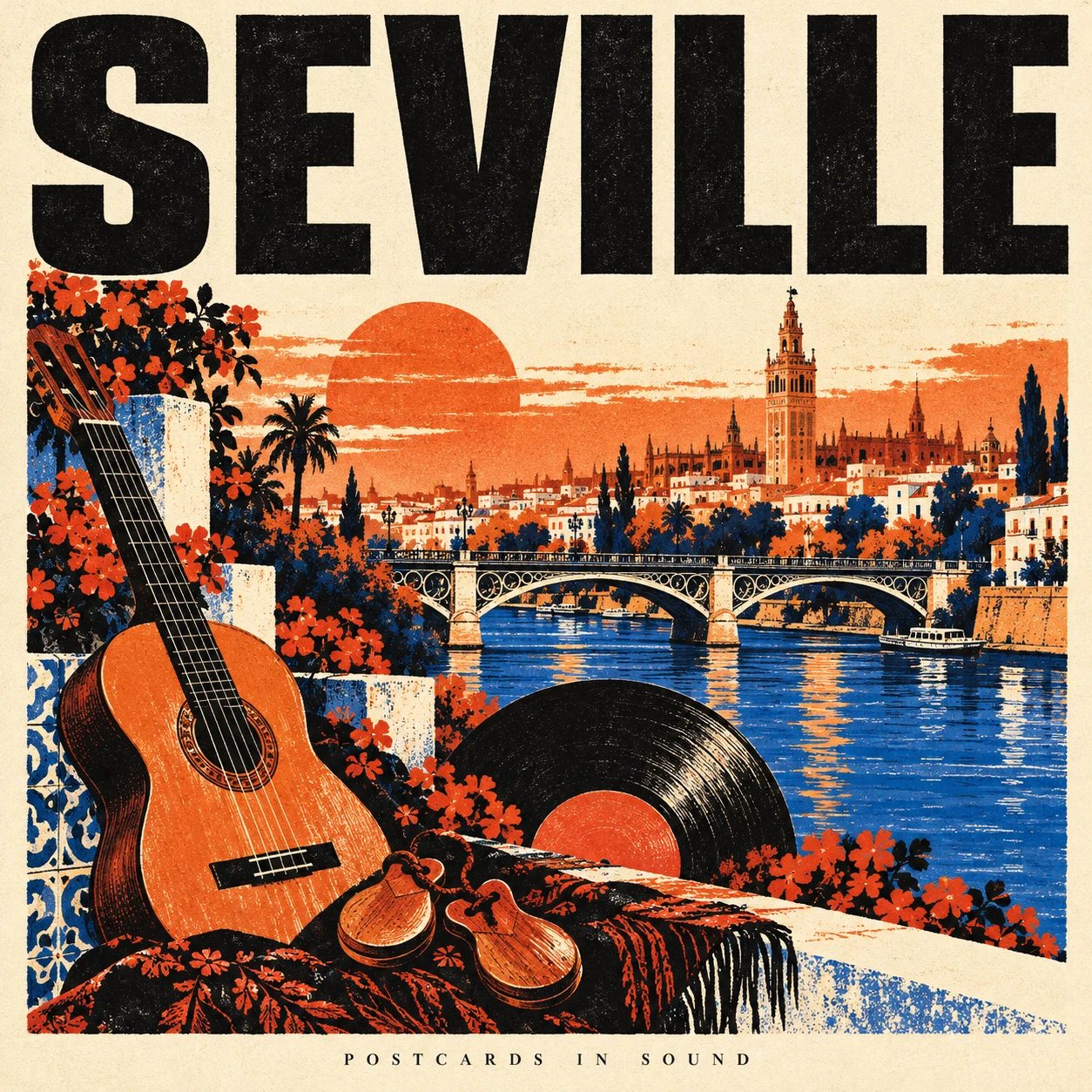
CANTE · STREET SONGS · ELECTRIC ROOTS · 19 SONGS
Seville
Seville's guide begins with named flamenco and song repertoires, then follows documented Triana, Alameda, rock, blues and contemporary creative networks. Lebrija and other Andalusian guests are identified by their own connections rather than recast as city natives.
The preserved order moves between these practices and projects, with a reason for each selection and position. Sources document the stated work or scene; they do not turn another performance into this exact recording.
Listen on SpotifyThe stories in the grooves.
Read in playlist order. Position notes are current editorial readings of the saved order, not a claim about original intent or an audio audition. Sources support specific cultural context; open each track’s qualifications for limits.
An open door
Begins with Entre Dos Aguas (A familiar wider-Andalusian doorway) and reaches Nuevo día (First local anchor and future closing callback). Open the track notes for the documented connections and the editorial reasons for this order.
Why this track belongs: Paco de Lucía’s Entre Dos Aguas is included as an explicitly wider-Andalusian guest, not a Sevillian composition claim. His foundation identifies the work as the Fuente y Caudal rumba that reached a much wider public: a documented meeting of flamenco practice and popular circulation.
Sources and limits
- Fundación Paco de Lucía: Fuente y Caudal
Public source text inspected on 2026-10-26. Names Entre dos Aguas as the album’s rumba and its role in reaching a wider public; work/project evidence, not this audio master.
Scope: exact-work
- Retained prior guide context
Retained for provenance only; not newly relied on as support for the revised claims. A source bundle is not claim-level proof.
Scope: unclassified
- Retained prior guide context
Retained for provenance only; not newly relied on as support for the revised claims. A source bundle is not claim-level proof.
Scope: unclassified
Qualifications:
- Algeciras/Cádiz and Seville are not interchangeable. No Seville composition/session or exact Fuente y Caudal master claim is made.
Why this position in the playlist
Role: A familiar wider-Andalusian doorway
Proposed editorial rationale: At 1, use a widely circulated work to invite a newcomer in, then move immediately to Lole y Manuel’s documented Seville creative project. The guest opening is declared rather than allowing the city to claim all Andalusian music as its own.
To the next track: From the declared wider-Andalusian guest, move to Lole y Manuel’s documented Seville creative project: a change of geographical focus, not a claimed seamless mix.
- Fundación Paco de Lucía: Fuente y Caudal
Why this track belongs: Nuevo día introduces Lole y Manuel’s Seville flamenco-renewal project. The provincial cultural account places their poetic approach in an interaction between inherited Gitano flamenco and the wider creative changes around them; that practice, rather than birthplaces alone, is the connection.
Sources and limits
- Diputación de Sevilla: Lole y Manuel
Public source text inspected on 2026-10-26. Documents the duo’s Seville flamenco renewal, poetic project and Nuevo Día; not exact-cut instrumental or tempo analysis.
Scope: artist-project
- Retained prior guide context
Retained for provenance only; not newly relied on as support for the revised claims. A source bundle is not claim-level proof.
Scope: unclassified
Qualifications:
- Project-level accounts do not verify this cut’s bulerías classification, pulse, instruments or selected master; previous sonic descriptions are withheld.
Why this position in the playlist
Role: First local anchor and future closing callback
Proposed editorial rationale: At 2, establish the duo immediately after the wider-Andalusian guest. Their return at 19 will frame the route; moving next to Pastora Pavón introduces historical memory rather than pretending this is a chronological survey.
From the previous track: From the declared wider-Andalusian guest, move to Lole y Manuel’s documented Seville creative project: a change of geographical focus, not a claimed seamless mix.
To the next track: Follow the first local renewal project with historical recorded memory; this is a deliberate backward look rather than chronological sequencing.
- Diputación de Sevilla: Lole y Manuel
Voices and memory
Begins with Al Gurugú (Historical recorded memory) and reaches Dame La Libertad (Province-to-Maghreb collaboration). Open the track notes for the documented connections and the editorial reasons for this order.
Al Gurugú
La Niña de los Peines
Recording: La Niña de los Peines - Éxitos Inolvidables, Vol. 1
Open exact recording on SpotifyWhy this track belongs: La Niña de los Peines brings Seville’s recorded flamenco memory into view. Pastora Pavón’s corpus received formal Andalusian heritage recognition, and her monument on the Alameda provides a specific local act of remembrance. The selected Al Gurugú is a catalog entry into that repertoire, not proof that this transfer was individually examined in the decree.
Sources and limits
- Junta de Andalucía: 1999 recorded-heritage decree
Public source text inspected on 2026-10-26. Pastora Pavón’s historical recorded corpus and Andalusian heritage recognition. Does not authenticate this Spotify transfer.
Scope: repertoire
- Ayuntamiento de Sevilla: Alameda monuments
Public indexed extract inspected on 2026-10-26. Municipal preservation of monuments to Pastora Pavón and Manolo Caracol on the Alameda; concrete civic reception, not proof of a recording venue.
Scope: community-scene
- Retained prior guide context
Retained for provenance only; not newly relied on as support for the revised claims. A source bundle is not claim-level proof.
Scope: unclassified
- Retained prior guide context
Retained for provenance only; not newly relied on as support for the revised claims. A source bundle is not claim-level proof.
Scope: unclassified
Qualifications:
- The heritage decree concerns a historical corpus, not authentication of this digital transfer. Exact recording date and the old guide’s tangos classification have not been verified here.
Why this position in the playlist
Role: Historical recorded memory
Proposed editorial rationale: At 3, step back from the newer Lole y Manuel project before moving to theatrical repertoire at 4. This deliberately changes the historical viewpoint and places a foundational woman’s creative legacy early, without claiming one voice represents all Seville.
From the previous track: Follow the first local renewal project with historical recorded memory; this is a deliberate backward look rather than chronological sequencing.
To the next track: Move from Pastora Pavón’s recorded legacy to a named theatrical zambra and another Alameda-commemorated artist, joining two distinct forms of local memory.
- Junta de Andalucía: 1999 recorded-heritage decree
La salvaora
Lola Flores, Manolo Caracol
Recording: Leyendas Del Siglo Xx
Open exact recording on SpotifyWhy this track belongs: La salvaora connects a documented Quintero–León–Quiroga zambra in the Lola Flores–Manolo Caracol repertoire with Seville’s public remembrance of Caracol on the Alameda. It adds a theatrical popular-song practice to the portrait, while the duet’s wider Andalusian associations are not reduced to a single city.
Sources and limits
- Fundación SGAE: Siempre a la verita tuya
Public source text inspected on 2026-10-26. Publication identifies La salvaora as a Quintero–León–Quiroga zambra in the Flores–Caracol repertoire; not master authentication.
Scope: exact-work
- Ayuntamiento de Sevilla: Alameda monuments
Public indexed extract inspected on 2026-10-26. Municipal preservation of monuments to Pastora Pavón and Manolo Caracol on the Alameda; concrete civic reception, not proof of a recording venue.
Scope: community-scene
- Retained prior guide context
Retained for provenance only; not newly relied on as support for the revised claims. A source bundle is not claim-level proof.
Scope: unclassified
Qualifications:
- Full catalog credits are preserved; they are not an independent identification of who sings each passage. The SGAE repertoire source does not establish this selected session.
Why this position in the playlist
Role: Theatrical repertoire and civic memory
Proposed editorial rationale: At 4, follow Pastora’s historical recorded legacy with a named theatrical work and different credited partnership. El Lebrijano at 5 then widens the frame again, from city commemoration to a cross-cultural project rooted in the province.
From the previous track: Move from Pastora Pavón’s recorded legacy to a named theatrical zambra and another Alameda-commemorated artist, joining two distinct forms of local memory.
To the next track: From theatrical repertoire and city remembrance, widen to El Lebrijano’s provincial and Tangier collaboration rather than staying with one performance tradition.
- Fundación SGAE: Siempre a la verita tuya
Why this track belongs: Dame La Libertad brings El Lebrijano’s Encuentros project into the guide’s provincial frame. Canal Sur links the named work to a Caballero Bonald poem and collaboration with the Andalusi orchestra of Tangier. Its place connection is a documented artistic encounter, not the claim that flamenco belongs to one city alone.
Sources and limits
- Canal Sur archive: Dame la libertad
Public source text inspected on 2026-10-26. Named song, Caballero Bonald poem, Encuentros project and Tangier Andalusi orchestra collaboration; described video is a 1993 performance, not the selected master.
Scope: exact-work
- Retained prior guide context
Retained for provenance only; not newly relied on as support for the revised claims. A source bundle is not claim-level proof.
Scope: unclassified
Qualifications:
- The archive documents a 1993 presentation and the Encuentros project, not this Spotify master. No orchestra personnel or recording date are imported into the selected recording.
Why this position in the playlist
Role: Province-to-Maghreb collaboration
Proposed editorial rationale: At 5, finish the opening voices-and-memory group by looking outward through an actual collaboration. Smash at 6 begins another kind of cross-cultural experiment in Seville’s underground, so the comparison is between documented creative approaches rather than assumed sonic similarity.
From the previous track: From theatrical repertoire and city remembrance, widen to El Lebrijano’s provincial and Tangier collaboration rather than staying with one performance tradition.
To the next track: Compare two documented cross-cultural routes: El Lebrijano’s named collaboration and Smash’s Seville underground practice, without assuming a common sonic transition.
- Canal Sur archive: Dame la libertad
The city turns electric
Begins with El Garrotin (Opening the electric-roots chapter) and reaches Stand By Me Rezare (Local reworking of an international song). Open the track notes for the documented connections and the editorial reasons for this order.
El Garrotin
Smash
Recording: Agujetas: Historia, Pureza y Vanguardia Del Flamenco
Open exact recording on SpotifyWhy this track belongs: El Garrotin introduces Smash’s documented Seville underground practice. Canal Sur situates the named work within the band’s early exchange between rock and flamenco and a locally encountered international musical environment; the city connection is a creative scene, not just members’ origins.
Sources and limits
- Canal Sur Memoranda: El Garrotín, Smash
Public source text inspected on 2026-10-26. Named 1971 work and Seville underground cross-cultural band practice; archive presentation is not certified as selected audio.
Scope: exact-work
Qualifications:
- The archival presentation is not verified as the selected audio. No claim that Smash invented all flamenco fusion, or that every arrangement detail transfers to this ID, is made.
Why this position in the playlist
Role: Opening the electric-roots chapter
Proposed editorial rationale: At 6, turn from El Lebrijano’s named cross-cultural collaboration to a different Seville experiment. Triana at 7 then develops the rock-and-flamenco chapter through another documented project, while the later Derby Motoreta selection can refer back to both without a consecutive nostalgia block.
From the previous track: Compare two documented cross-cultural routes: El Lebrijano’s named collaboration and Smash’s Seville underground practice, without assuming a common sonic transition.
To the next track: Smash opens the rock-and-flamenco question; Triana supplies a different named project and a longer catalog-duration stop, not a claimed rise in intensity.
- Canal Sur Memoranda: El Garrotín, Smash
Why this track belongs: Abre la puerta represents Triana’s El Patio project, documented by RNE as the work of a Seville trio bringing progressive-rock and flamenco practices into dialogue. The inclusion rests on that named project and repertoire, not on a genre label detached from the city.
Sources and limits
- RNE Documentos: Triana, 50 años de El Patio
Public source text inspected on 2026-10-26. Seville trio, El Patio project and named Abre la puerta; program text, no audio playback.
Scope: exact-work
- Retained prior guide context
Retained for provenance only; not newly relied on as support for the revised claims. A source bundle is not claim-level proof.
Scope: unclassified
Qualifications:
- El Patio work association does not prove the current compilation master or session. Duration is metadata; energy, structural peaks and keyboard/guitar handoffs were not auditioned.
Why this position in the playlist
Role: An extended statement within the electric-roots chapter
Proposed editorial rationale: At 7, give this chapter its longest catalog-duration stop, 9:50, after Smash’s compact entry. Veneno at 8 then shifts the focus from one extended work to the personnel network developed across 8–10; duration is documented, whereas a supposed musical climax is not.
From the previous track: Smash opens the rock-and-flamenco question; Triana supplies a different named project and a longer catalog-duration stop, not a claimed rise in intensity.
To the next track: After Triana’s extended work, begin a personnel-led three-stop account with Veneno; the change is in curatorial organization, not presumed tempo.
- RNE Documentos: Triana, 50 años de El Patio
Why this track belongs: Los Delincuentes belongs through Veneno’s documented Kiko Veneno, Raimundo Amador and Rafael Amador collaboration. RNE places the named work within that project; the Amador brothers’ Seville creative network provides a concrete link beyond a generic Andalusian-rock category.
Sources and limits
- RNE Círculos excéntricos: Veneno, antes, durante y después
Public source text inspected on 2026-10-26. Veneno’s Kiko/Raimundo/Rafael network and named Los Delincuentes, Pasa la Vida and Echo de Menos repertoire. Not a catalog-master crosswalk.
Scope: artist-project
- RNE El Sótano: Guitarras callejeras, Pata Negra
Public source text inspected on 2026-10-26. Tres Mil Viviendas/Seville Amador network and Pasa la Vida on Blues de la Frontera; no remaster authentication.
Scope: exact-work
- Retained prior guide context
Retained for provenance only; not newly relied on as support for the revised claims. A source bundle is not claim-level proof.
Scope: unclassified
Qualifications:
- This is project/personnel continuity, not proof that all named members perform audibly in every selected passage. A later band-name influence is not needed or claimed.
Why this position in the playlist
Role: Beginning a traceable collaborator chain
Proposed editorial rationale: At 8, begin a three-stop personnel thread: Veneno, Pata Negra, then Raimundo with B.B. King. This explains the consecutive placement through documented relationships, after Triana’s longer statement and before later returns to Kiko at 12 and 18.
From the previous track: After Triana’s extended work, begin a personnel-led three-stop account with Veneno; the change is in curatorial organization, not presumed tempo.
To the next track: Follow the documented Amador collaboration from Veneno into Pata Negra, so the adjacent projects have an explicit human connection.
- RNE Círculos excéntricos: Veneno, antes, durante y después
Pasa la Vida - Remasterizada
Pata Negra
Recording: Blues de la Frontera (Remasterizada)
Open exact recording on SpotifyWhy this track belongs: Pasa la Vida follows the Amador brothers into Pata Negra. RNE connects the band to Seville’s Tres Mil Viviendas and places this work on Blues de la Frontera, making the song a documented part of a local creative history rather than merely a blues-flamenco label.
Sources and limits
- RNE El Sótano: Guitarras callejeras, Pata Negra
Public source text inspected on 2026-10-26. Tres Mil Viviendas/Seville Amador network and Pasa la Vida on Blues de la Frontera; no remaster authentication.
Scope: exact-work
- Retained prior guide context
Retained for provenance only; not newly relied on as support for the revised claims. A source bundle is not claim-level proof.
Scope: unclassified
Qualifications:
- The source supports repertoire and scene; it does not authenticate the selected remaster or establish recording location.
Why this position in the playlist
Role: Middle link in the Amador network
Proposed editorial rationale: At 9, keep Pata Negra between Veneno and Raimundo’s later credited collaboration so a newcomer can follow the people as their projects change. The remaster qualifier is preserved as catalog identity, not used as evidence of a particular sound.
From the previous track: Follow the documented Amador collaboration from Veneno into Pata Negra, so the adjacent projects have an explicit human connection.
To the next track: Follow Pata Negra into Raimundo’s credited B.B. King collaboration, extending the same creative network beyond the city.
- RNE El Sótano: Guitarras callejeras, Pata Negra
Bolleré - En Directo
Raimundo Amador, B.B. King
Recording: Noche De Flamenco Y Blues
Open exact recording on SpotifyWhy this track belongs: Bolleré joins Raimundo Amador’s local creative thread to a documented international collaboration. Cathy Claret’s label biography identifies her authorship and the work’s Amador/B.B. King association; the exact catalog entry credits both musicians and labels this selection live.
Sources and limits
- Subterfuge: Cathy Claret
Public source text inspected on 2026-10-26. Label names Cathy Claret’s authorship of Bolloré/Bolleré and its Raimundo Amador/B.B. King association. Does not identify the selected live event.
Scope: exact-work
- RNE El Sótano: Guitarras callejeras, Pata Negra
Public source text inspected on 2026-10-26. Tres Mil Viviendas/Seville Amador network and Pasa la Vida on Blues de la Frontera; no remaster authentication.
Scope: exact-work
- Retained prior guide context
Retained for provenance only; not newly relied on as support for the revised claims. A source bundle is not claim-level proof.
Scope: unclassified
- Retained prior guide context
Retained for provenance only; not newly relied on as support for the revised claims. A source bundle is not claim-level proof.
Scope: unclassified
Qualifications:
- The live venue, date and session have not been established. No distinct guitar parts or performers’ phrasing have been identified by ear.
Why this position in the playlist
Role: International extension of the collaborator chain
Proposed editorial rationale: At 10, complete the Veneno–Pata Negra–Raimundo sequence without treating Seville as musically isolated. At 11, a different ensemble interrupts that family/project chain, broadening the portrait rather than adding another Amador selection immediately.
From the previous track: Follow Pata Negra into Raimundo’s credited B.B. King collaboration, extending the same creative network beyond the city.
To the next track: End the consecutive Amador network with a different Seville ensemble, Mártires del Compás, to avoid treating one family’s history as the whole portrait.
- Subterfuge: Cathy Claret
Why this track belongs: La pera brings another Seville ensemble into the portrait: Mártires del Compás and their Flamenco Billy project. The city’s performance directory documents the band/project connection, while the exact current Spotify ID is catalog-associated with FLAMENCO BILLY.
Sources and limits
- Escena en Sevilla: Mártires del Compás
Public source text inspected on 2026-10-26. Seville band and Flamenco Billy project. Later reunion personnel are not treated as recording credits.
Scope: artist-project
- Spotify catalog: exact La pera ID
Public indexed extract inspected on 2026-10-26. Exact current ID catalog-associated with FLAMENCO BILLY and 3:31. Catalog release metadata is not the original album’s release history or audio authentication.
Scope: exact-work
- Retained prior guide context
Retained for provenance only; not newly relied on as support for the revised claims. A source bundle is not claim-level proof.
Scope: unclassified
Qualifications:
- The catalog’s 2002 release metadata is not asserted as the original project’s debut year. Later reunion personnel are not used as this recording’s credits; lyrics and sonic street-life imagery are not inferred.
Why this position in the playlist
Role: Breaking the consecutive collaborator block
Proposed editorial rationale: At 11, change ensemble after three connected Amador projects, then return to Kiko under his own name at 12. That brief separation makes the historical network intelligible without making it the entire city’s story.
From the previous track: End the consecutive Amador network with a different Seville ensemble, Mártires del Compás, to avoid treating one family’s history as the whole portrait.
To the next track: After three intervening tracks since Veneno at 8, return to Kiko under his own name; Mártires also breaks the consecutive Amador-network block before this callback.
- Escena en Sevilla: Mártires del Compás
Why this track belongs: Echo de Menos is a named part of Kiko Veneno’s Échate un Cantecito repertoire. RTVE documents his sustained creative and cultural work in Seville, including the Veneno collaboration already represented here, so this is a practice-based connection rather than a birthplace test.
Sources and limits
- RTVE: Kiko Veneno, National Current Music Prize
Public source text inspected on 2026-10-26. Names Echo de Menos in Échate un Cantecito and documents sustained Seville creative/cultural work, beyond birthplace.
Scope: exact-work
- RNE Círculos excéntricos: Veneno, antes, durante y después
Public source text inspected on 2026-10-26. Veneno’s Kiko/Raimundo/Rafael network and named Los Delincuentes, Pasa la Vida and Echo de Menos repertoire. Not a catalog-master crosswalk.
Scope: artist-project
- Retained prior guide context
Retained for provenance only; not newly relied on as support for the revised claims. A source bundle is not claim-level proof.
Scope: unclassified
Qualifications:
- No detailed lyric narrative, vocal intimacy or tempo is claimed from unauditioned audio. Album/work association does not establish this master.
Why this position in the playlist
Role: Return to a collaborator as an individual songwriter
Proposed editorial rationale: At 12, revisit Kiko after a contrasting ensemble, far enough from Veneno at 8 to show a changed project rather than a repeat. Silvio at 13 then introduces an explicitly adapted song and local devotional references, changing the cultural mechanism of connection.
From the previous track: After three intervening tracks since Veneno at 8, return to Kiko under his own name; Mártires also breaks the consecutive Amador-network block before this callback.
To the next track: Change from Kiko’s named authored repertoire to Silvio’s documented local adaptation of an international song.
- RTVE: Kiko Veneno, National Current Music Prize
Stand By Me Rezare
Silvio y Sacramento
Recording: Dos Estilos, Silvio y Sacramento & Medina Azahara
Open exact recording on SpotifyWhy this track belongs: Stand By Me Rezare connects an international song’s adaptation history with Seville’s devotional culture. RNE describes Silvio’s route through Celentano’s version and references to Sevillian Marian devotion: an example of a borrowed song becoming locally meaningful, not of a melody originating here.
Sources and limits
- RNE Píntalo de negro: Stand by me — Rezaré
Public source text inspected on 2026-10-26. Silvio’s adaptation via Celentano and Sevillian Marian devotional references. No claim that this exact master has been heard.
Scope: exact-work
- Retained prior guide context
Retained for provenance only; not newly relied on as support for the revised claims. A source bundle is not claim-level proof.
Scope: unclassified
- Retained prior guide context
Retained for provenance only; not newly relied on as support for the revised claims. A source bundle is not claim-level proof.
Scope: unclassified
Qualifications:
- No claim that the melody originated in Seville or that this selected master was recorded at a religious event. The scope of devotional references is not generalized to all residents.
Why this position in the playlist
Role: Local reworking of an international song
Proposed editorial rationale: At 13, follow Kiko’s authored repertoire with a different form of cultural translation. Pony Bravo at 14 then offers another explicitly documented act of reinterpretation, allowing two very different approaches to local inheritance to sit together.
From the previous track: Change from Kiko’s named authored repertoire to Silvio’s documented local adaptation of an international song.
To the next track: Place Silvio’s adaptation beside Pony Bravo’s explicitly described reinterpretation; the shared question is how music is made locally meaningful, not a shared sonic texture.
- RNE Píntalo de negro: Stand by me — Rezaré
Roots in the present tense
Begins with El Rayo (A documented reinterpretation and backward reference) and reaches Martes (Intergenerational meeting before the closing return). Open the track notes for the documented connections and the editorial reasons for this order.
El Rayo
Pony Bravo
Recording: Si Bajo De Espalda No Me Da Miedo (y Otras Historias)
Open exact recording on SpotifyWhy this track belongs: El Rayo has unusually specific artist-supplied evidence: Pony Bravo describe the work as a free interpretation of flamenco and Andalusian rock, with inspirations including Manolo Caracol and Beni de Cádiz. Their Seville project thus engages a named repertoire rather than simply borrowing a regional label.
Sources and limits
- Pony Bravo: El Rayo artist notes
Public source text inspected on 2026-10-26. Artist account describes a free interpretation of flamenco/rock and inspiration from Manolo Caracol and Beni de Cádiz; Sevilla project. Artist description, not our audition.
Scope: exact-work
Qualifications:
- The artist’s description is attributed, not an audition result. Referenced traditional material is not quoted, and the Bandcamp item is not authenticated as identical to this Spotify master.
Why this position in the playlist
Role: A documented reinterpretation and backward reference
Proposed editorial rationale: At 14, extend the adaptation question introduced by Silvio, while Caracol’s named influence points back to 4. Derby Motoreta at 15 then places another contemporary Seville project beside it; this is a comparison of documented relationships, not a claimed same-sound transition.
From the previous track: Place Silvio’s adaptation beside Pony Bravo’s explicitly described reinterpretation; the shared question is how music is made locally meaningful, not a shared sonic texture.
To the next track: Move from Pony Bravo’s named Caracol/Beni references to Derby Motoreta’s scene dialogue with Smash and Triana, connecting different historical callbacks.
- Pony Bravo: El Rayo artist notes
El Salto Del Gitano
Derby Motoreta’s Burrito Kachimba
Recording: Derby Motoreta's Burrito Kachimba
Open exact recording on SpotifyWhy this track belongs: El Salto Del Gitano introduces Derby Motoreta’s Burrito Kachimba through their Seville underground network and documented debut repertoire. In interview they welcome listeners discovering Smash and Triana through their music, while resisting a simple revivalist label; the guide preserves that distinction.
Sources and limits
- Derby Motoreta’s Burrito Kachimba interview
Public source text inspected on 2026-10-26. First-person interview documents Seville underground scene, El Salto del Gitano debut and listeners’ discovery of Smash/Triana. Does not prove direct imitation of either group.
Scope: artist-project
- Retained prior guide context
Retained for provenance only; not newly relied on as support for the revised claims. A source bundle is not claim-level proof.
Scope: unclassified
Qualifications:
- The interview does not prove this exact track imitates a particular earlier song. No riff, psychedelic intensity or production claim is inferred from genre publicity.
Why this position in the playlist
Role: Contemporary scene in dialogue with earlier chapters
Proposed editorial rationale: At 15, place this newer band after Pony Bravo and let the documented Smash/Triana references reconnect with 6–7. Rosario La Tremendita at 16 changes from a band’s scene history to an individual artist’s inherited-and-reworked Triana practice.
From the previous track: Move from Pony Bravo’s named Caracol/Beni references to Derby Motoreta’s scene dialogue with Smash and Triana, connecting different historical callbacks.
To the next track: Change from a band’s underground-scene narrative to Tremendita’s individual Triana practice and project; no claim about comparative vocal energy is required.
- Derby Motoreta’s Burrito Kachimba interview
Why this track belongs: Tremenda Valeriana connects Rosario La Tremendita’s Triana flamenco family/practice with her Tremenda project. The official artist description names the work within that project; the cultural-program account documents her role as a creator extending an inherited practice, rather than presenting tradition as static.
Sources and limits
- Centro Botín: Rosario La Tremendita program
Public indexed extract inspected on 2026-10-26. Indexed program documents Triana flamenco family/practice and the Tremenda project. Concert lineup is not imported as this recording’s lineup.
Scope: artist-project
- Rosario La Tremendita official artist channel: Tremenda Valeriana
Public indexed extract inspected on 2026-10-26. Indexed official description identifies this work as part of Tremenda. Listed video musicians belong to that live presentation, not automatically this Spotify master. No video played.
Scope: exact-work
- Retained prior guide context
Retained for provenance only; not newly relied on as support for the revised claims. A source bundle is not claim-level proof.
Scope: unclassified
Qualifications:
- Program and official video descriptions were read as indexed extracts. Their live-performance lineup is not imported into this Spotify recording; no bass, electronics or specific passage is asserted from listening.
Why this position in the playlist
Role: A creator’s individual reworking of inherited practice
Proposed editorial rationale: At 16, shift from Derby Motoreta’s band network to a named artist’s own project before a collective’s self-described electronic fandango at 17. This expands the forms of authorship represented; it is not a quota or an invented claim about a change in vocal intensity.
From the previous track: Change from a band’s underground-scene narrative to Tremendita’s individual Triana practice and project; no claim about comparative vocal energy is required.
To the next track: Place an individual renewal project beside a collective’s artist-described electronic fandango, distinguishing authorship and approach rather than guessing a mix.
- Centro Botín: Rosario La Tremendita program
Why this track belongs: Fandangô de Carmen Porter belongs through Califato ¾’s own account of a contemporary Seville project working with inherited forms. The artist describes this named work as an electronic fandango; that is a documented creative proposition, not an external claim that one hybrid genre defines the whole region.
Sources and limits
- Califato ¾: Fandangô de Carmen Porter artist notes
Public source text inspected on 2026-10-26. Seville artist account calls this work an electronic fandango; description is attributed to artist rather than claimed from audition.
Scope: exact-work
- Retained prior guide context
Retained for provenance only; not newly relied on as support for the revised claims. A source bundle is not claim-level proof.
Scope: unclassified
Qualifications:
- Artist descriptions are evidence of stated intention, not independent sonic analysis. A particular pulse, emotional suspension or tempo change remains unknown; Seville artist context is not a claim every member or influence comes from the city.
Why this position in the playlist
Role: Collective reinterpretation of a named form
Proposed editorial rationale: At 17, place the artist-described electronic fandango beside Tremendita’s different renewal project. Martes at 18 then changes the organizing idea from formal reinterpretation to an explicit collaboration across generations, preparing the return to Lole y Manuel.
From the previous track: Place an individual renewal project beside a collective’s artist-described electronic fandango, distinguishing authorship and approach rather than guessing a mix.
To the next track: Turn from a self-described formal reinterpretation to Vera Fauna’s explicit Kiko collaboration, making people and generations the organizing link.
- Califato ¾: Fandangô de Carmen Porter artist notes
Why this track belongs: Martes documents Vera Fauna’s Seville project in an actual collaboration with Kiko Veneno. The artist notes frame the song around routine, time and an intergenerational perspective; this brings the earlier Kiko thread into a newer project rather than choosing a recent track solely for novelty.
Sources and limits
- Vera Fauna: Martes artist notes
Public source text inspected on 2026-10-26. Seville band’s named Kiko Veneno collaboration and account of routine/time and intergenerational perspective; work-level evidence.
Scope: exact-work
Qualifications:
- The artist’s thematic account is not a lyric transcription or audio observation. Exact performers, instrumentation and session remain unauthenticated beyond the catalog display credit.
Why this position in the playlist
Role: Intergenerational meeting before the closing return
Proposed editorial rationale: At 18, make the distant returns to Kiko at 8 and 12 explicit through the current collaboration. Then leave the final slot to Lole y Manuel, so the ending can return to the early local anchor and a song naming Seville rather than introducing one more new act.
From the previous track: Turn from a self-described formal reinterpretation to Vera Fauna’s explicit Kiko collaboration, making people and generations the organizing link.
To the next track: After Kiko’s intergenerational return, bring back Lole y Manuel from 2 with a named river song, giving the guide a clear circular frame.
- Vera Fauna: Martes artist notes
Back to the river
El río de mi Sevilla carries this closing chapter. The track note explains its documented connection and why it occupies this position.
Why this track belongs: El río de mi Sevilla supplies a work-specific place connection: Canal Sur identifies Lole y Manuel’s song with the Guadalquivir, Seville and Triana. It returns to the duo’s creative practice while allowing the named river and city to carry the final geographical image.
Sources and limits
- Canal Sur archive: Lole y Manuel, Río de mi Sevilla
Public source text inspected on 2026-10-26. Named song’s Guadalquivir, Seville and Triana connections; 1990 TV performance is distinct from selected master.
Scope: exact-work
- Diputación de Sevilla: Lole y Manuel
Public source text inspected on 2026-10-26. Documents the duo’s Seville flamenco renewal, poetic project and Nuevo Día; not exact-cut instrumental or tempo analysis.
Scope: artist-project
- Retained prior guide context
Retained for provenance only; not newly relied on as support for the revised claims. A source bundle is not claim-level proof.
Scope: unclassified
- Retained prior guide context
Retained for provenance only; not newly relied on as support for the revised claims. A source bundle is not claim-level proof.
Scope: unclassified
Qualifications:
- Canal Sur’s cited 1990 television performance is work/context evidence, not identification of the selected recording. A river subject does not imply an outdoor field recording.
Why this position in the playlist
Role: Return to the opening local anchor
Proposed editorial rationale: At 19, close by returning to the duo introduced at 2, now with a direct geographical song. After Martes’s new collaboration, the reprise ties the route together as an editorial frame; no claim of a quieter ending or particular emotional effect is needed.
From the previous track: After Kiko’s intergenerational return, bring back Lole y Manuel from 2 with a named river song, giving the guide a clear circular frame.
- Canal Sur archive: Lole y Manuel, Río de mi Sevilla
Follow the threads.
These earlier reading lists offer broader context. The per-track source notes identify what each reference supports and where verification remains open.
- Seville tourism: Triana and Los Remedios
- Seville City Council: the Alameda
- Diputación de Sevilla: Lole y Manuel
- Canal Sur archive: Dame la libertad
- Algeciras City Council: Paco de Lucía route
- Cultura Inquieta: Fandangô de Carmen Porter
- RTVE: Entre dos aguas at fifty
- Canal Sur: Lole performs Nuevo día
- Junta de Andalucía: protected recordings of La Niña de los Peines
- MusicBrainz: recording catalogue for Al Gurugú
- Qobuz: Al Gurugú recording credits
- Fundación SGAE: repertoire notes for La Salvaora
- Seville City Council: Caracol and Pastora Pavón monuments
- Jerez City Council: Centro Lola Flores
- RTVE: Encuentros track listing
- Canal Sur archive: El garrotín by Smash
- RTVE: documentary on Triana and El patio
- RTVE: anniversary release of Abre la puerta
- RTVE: Veneno, before and after
- RTVE interview: how Los Delinqüentes chose their name
- RTVE: Pata Negra's street guitars
- Seville Bienal: Noche de flamenco y blues
- Apple Music: live Bolleré personnel
- RTVE: Chico Ocaña explains flamenco billy
- Escena en Sevilla: Mártires del Compás
- RTVE: Kiko Veneno's National Music Award
- RTVE: Échate un cantecito reissue
- RTVE: Stand by Me and Rezaré
- Canal Sur: Silvio y Sacramento's Rezaré
- Canal Sur archive: Silvio
- Pony Bravo: official El Rayo notes and credits
- Fantasticmag: Derby Motoreta interview
- Mondo Sonoro: 2019 band interview
- Rosario La Tremendita: official Tremenda Valeriana performance
- Centro Botín: Tremenda artist and album programme
- Apple Music: Tremenda Valeriana studio track
- Califato ¾: official song description
- Vera Fauna: official Martes notes
- University of Seville: the river and the city
- Apple Music: El río de mi Sevilla