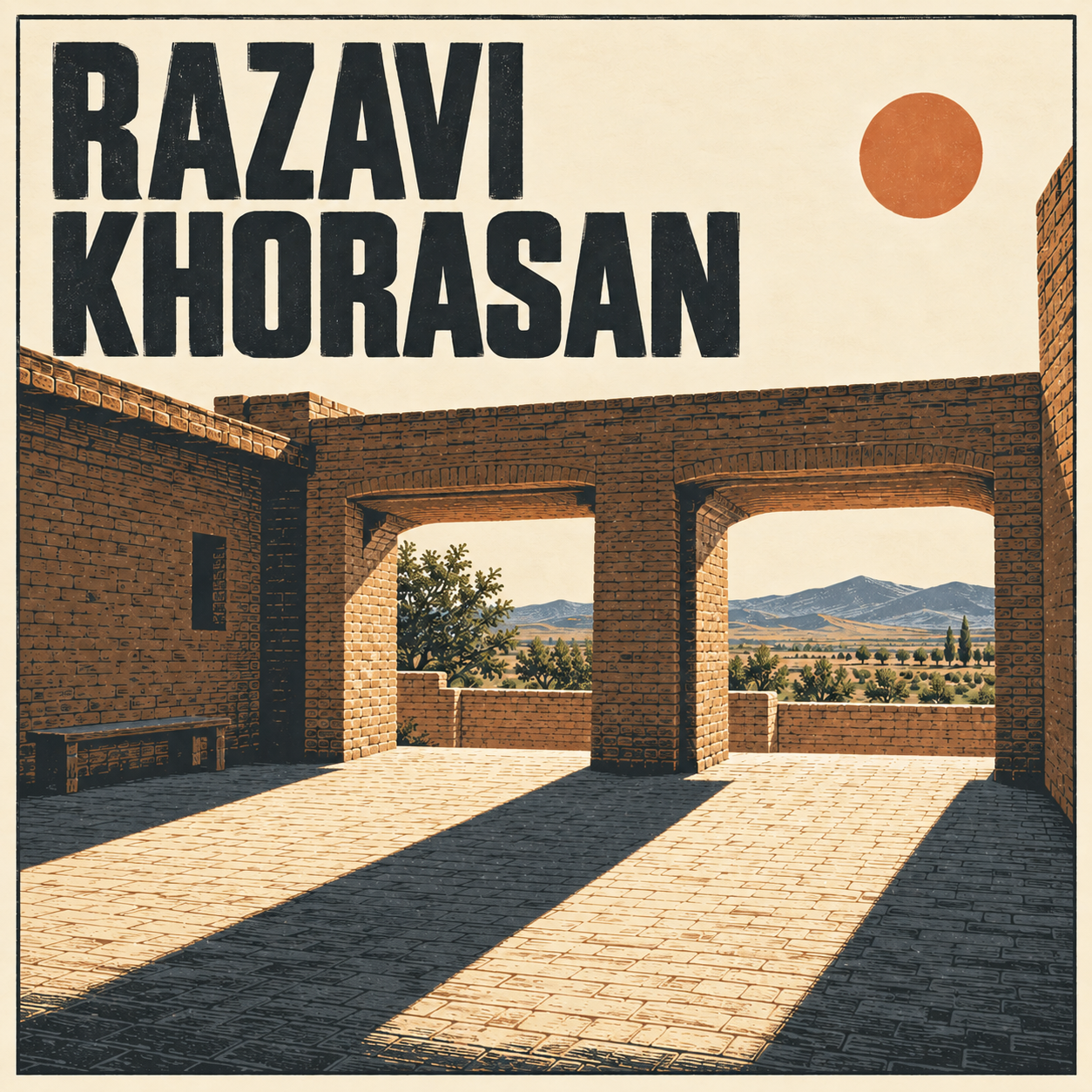
TORBAT-E JAM · KHAF · QUCHAN · LIVING PRACTICE · 10 SONGS · 52:59.612
Razavi Khorasan
A selective route through distinct modern Razavi Khorasan connections: Torbat-e Jam practice and its contemporary reinterpretation, a Khaf-labeled song, northern dotar repertory, and collaboration beyond the province. Documented place and work connections matter more than a broad Greater Khorasan label.
Follow the ten saved recordings through direct Spotify links, then explore full artist and archive companions. Exact IDs, order and the factual playlist description are verified. The track and position notes are source-informed editorial readings; full audio, lyrics and transitions have not been independently checked. The approved cover is shown here while some anonymous Spotify preview metadata still associates the older image.
Use this direct playlist link and the exact recording links below. An embedded third-party player is omitted here while its public preview metadata is inconsistent.
THE COVER · PLACE AND INTERPRETATION
Behind the artwork.
Two bands of light cross a generic courtyard toward separate landscape openings. They are a poetic visual cue for distinct listening paths within the modern province, not a reconstruction of a named building, documented viewpoint or musical performance.
Razavi Khorasan is a modern province within wider musical areas. Torbat-e Jam, Khaf and Quchan provide documented anchors; a generic Greater Khorasan label or an artist's birthplace does not establish a work's local connection.
The Torbat-e Jam chapter distinguishes singers, dotar players, collected recordings and later arrangements. Where a source documents only an album or project, the guide does not transfer every credit to the exact selected master.
Badieh's documented project and Abdi Behravanfar's work offer named contemporary transformations alongside archival practice. Issue dates are kept separate from composition and session dates.
The ten recordings form a selective first pass. Taybad and several other localities remain research leads rather than represented by an unverified substitute.
The arts journal names Borna on voice and dayereh; a field researcher explicitly cites the published performance. This adds a distinct local performer practice, not a generic female-vocal quota. After Bina’s Khaf-labeled interpretation, distinguish an artist’s regional rearrangement from a separately documented local woman’s voice/frame-drum practice. Neither is a proxy for the other. Qualification: Full published upload, not proved complete unedited session or full song. Recording 2018; publication 2023. No fresh consent audit, lyric transcription or audio audition. Linking does not grant portrait/footage reuse.
Sheikh Ahmad e Jam · Badieh, Yoohanna Alavi, Michel Gasco
The artist release and presenter program establish a traditional Jam-associated work arranged by this Mashhad-connected project; exact track credits include Yoohanna Alavi on zarb. Beside Allah Madad, compare two documented references to Ahmad-e Jam. A shared saint is not proof of shared tune, liturgy, or ritual function. Qualification: Same Badieh album already represented by a more work-specifically sourced core track. Do not inflate contemporary count or import live 2024 trio credits into 2023 master.
Concerto for String Quartet and Chamber Orchestra · Mehdi Hosseini et al.
The composer booklet explicitly traces the 2008 concerto to Mashq-e Paltan as played by Sarvar Ahmadi. It earns an international compositional branch through repertoire, not composer birthplace. Offer after the Sarvar Ahmadi panel while explicitly stating Allah Madad is NOT the source tune. Its16:34 scale belongs in a deliberate extended session, not forced into the concise route. Qualification: Composition 2008; first album 2011; selected digital issue 2020-09-24 on Spotify and Apple Classical. International/Russian orchestral performance, not evidence of a current Mashhad ensemble. No audition.
Rag Sohni — Afghan Music in Exile: Mashhad 2022 · Vahid Delahang, rubab; Kenan Delahang, tabla
The producer documents the Mashhad session and attributes this composition to Delahang; musician interviews establish an actual Mashhad/Herat professional community rather than a birthplace or historic-map rationale. After the Mashhad-connected opening, widen the city chapter to Afghan musicians’ own named practice. The full album preserves community context without adding another closely related project to the core. Qualification: Afghan identity remains explicit.2022 session/2023 release does not date the composition or prove 2026 residence. Exact Spotify ID unresolved in this bounded pass, not a platform-absence claim.
The saved public Spotify route contains the ten exact recordings in this order and totals 52:59.612. This page uses direct playlist and exact-recording links because third-party preview metadata has shown an older cover. That external association remains unresolved. Full audio, lyrics, account playback and nine audible transitions have not been independently verified; optional companions are outside the playlist runtime.
DEEPER CONTEXT · LIVING SCENES · RESEARCH LIMITS
Follow another thread.
Open a topic to explore more of this place and its music.
Work, recording and date
Selected catalog IDs and release dates identify the digital issues. They do not by themselves verify an original session date, the exact edit of another video or a sung text.
The optional producer-linked album documents Afghan musicians' own practice in Mashhad. Their identity and cross-border work are named directly, not absorbed into a single provincial tradition.
A Taybad ensemble lead remains outside this concise core because its exact original media and date still need verification. A documented lead is not a verified saved recording.
The saved ten-track order and description were verified through public metadata. The position notes are present editorial judgments; full audio, lyrics, successful playback and audible transitions were not independently verified.
Read in playlist order. Position notes are current editorial readings of the saved order, not a claim about original intent or an audio audition. Sources support specific cultural context; open each track’s qualifications for limits.
Why this track belongs: Gasco identifies a Torbat-e Jam performance as the source of this arrangement; the artist release documents the Mashhad project and names both vocalists, Ehsan Nasibi and Golnaz Hariri. That work-level path earns the opening, rather than a Greater Khorasan tag or birthplace.
Album recorded at Art Home Studio, Mashhad; arrangements by Michel Gasco and Mohammad Miraghazadeh; Ramin Ahmadi tabla.; Track 1 Yar Golakom features Ehsan Nasibi and Golnaz Hariri vocals, Erfan Homayouni bass tar, Puriya Bahrami daf. Track 3 Sheikh Ahmad e Jam features Yoohanna Alavi zarb.; Artist frames repertoire as Greater Khorasan, not modern Razavi alone.
Scope: Bandcamp credits date 2023-11-15 conflicts with release prose 2023-11-17; Spotify/Apple digital edition independently supports Nov 17.; Label framing does not prove every album tune is Razavi repertoire; composition dates and identical mastering across platforms not proved.
Gasco directly identifies his source for Yar Golakom as a video of young musicians in Torbat-e Jam singing and playing dotar.; Article locates video scenery near Neyshabur and performance in a caravanserai.
Scope: Page date has 2022/2023 template conflict; not used to establish a release date.; Transmission via Torbat-e Jam performance does not prove exclusive origin, an ancient date, or identity of the source performers.; Do not import reviewer sound impressions as our listening results.
Gasco describes meeting Miraghazadeh while studying rubab in Mashhad, choosing repertory from both sides of the Iran–Afghanistan border, and deliberately changing instrumentation.; Recorded at Studio Avaye Pardis Mashhad and Estudio Siglo XXI Madrid.
Scope: 2021 project history supports sustained collaboration, not identical sessions/arrangements for 2023 album.
Qualification: Credits of the official work are documented; no claim of identical audio edit across video/Bandcamp/Spotify, of exclusive tune origin, or of an auditioned transition. Selected album digital issue 2023-11-17 on Spotify/Apple. Single 2023-10-20; Bandcamp 2023-11-15 field conflicts with its Nov17 prose. Original tune/arrangement dates unknown.
Why this position in the playlist
Role: Torbat-e Jam source performance / Mashhad-recorded arrangement
Open with a documented contemporary interpretation so living creation is present from the first track, not relegated to an appendix.
To the next track: Next, Dorpur gives the eastern chapter a different interpreter and an archival research context. This is not the source performance used by Badieh and is not claimed to share its melody.
02
Sabze Pari
Nur-Mohammad Dorpur
Recording: Regional Music of Iran 66 (Music of Torbat Jam)
Place and practice: Torbat-e Jam / singer in Darvishi research collection
Why this track belongs: The publisher identifies the researched Torbat-e Jam collection; its catalog assigns this concise performance to Dorpur. He is not interchangeable with Pourataei, whose work appears later.
End-of-page publisher post identifies regional series 66, Puratayi, Neynavaz, Dorpur and Sarvar Ahmadi; research, recording and accompanying text by Mohammad-Reza Darvishi; publisher year 1395.
Scope: The retrieved page does not supply individual session dates or track-level instruments. Media is a 1:43 promotional clip, not the complete album. mahoor.com and direct shell Telegram access failed; web-indexed publisher page was readable.
2004 administrative provinces do not align with musical areas; Quchan/Dargaz fall within modern Razavi.; Eastern area connects Torbat-e Jam, Taybad, Khaf, Kashmar with Herat; singer and dotar player may be different people.; Contrasts sung poetry, dance/social entertainment, Mashhad shrine ensemble and transmission.
Scope: Not exact-master documentation for every selected track.; Do not repeat dated generalizations as a census of women performers today.; Specific ritual, language, text and instrument attribution requires track evidence.
Qualification: Exact lyric, language and devotional/secular function are untranscribed; the title alone does not establish them. Mahoor publisher year 1395 / scholarly discography 2016. Selected Spotify digital issue 2017-04-11; session date unverified.
Why this position in the playlist
Role: Torbat-e Jam / singer in Darvishi research collection
After Badieh, introduce a separate eastern practitioner without claiming a simple original-and-cover pair.
From the previous track: After Badieh, introduce a separate eastern practitioner without claiming a simple original-and-cover pair.
To the next track: Khaf is next: change locality and interpreting practice, rather than allowing Torbat-e Jam alone to stand for the east.
03
Gol Asa (Khaf)
Sima Bina
Recording: Nawai
Place and practice: Khaf-labeled repertoire / researched reinterpretation
Why this track belongs: The artist-label catalog names Khaf in this exact song. The label biography documents Bina’s collecting and reworking of regional material; this belongs as an interpretation of a specific locality, not because she is a woman or was born in Khorasan.
Research, collecting and recomposing Khorasan folk material as part of her practice.
Scope: Biography does not prove selected Gol Asa personnel or session.; Do not confuse separate QTCD-1002 Navai 1995 Vienna concert with selected Nawai album.
Scope: Amazon displays 2017-10-25; treat date as platform-specific digital metadata, not original recording date.; Do not turn composer field into proof that she originated the underlying traditional melody.
Nawai track4,6:27, Sima Bina Records, title specifically labels Khaf. Catalog date 2017-10-25.
Scope: Only repertoire-place label and performance identity established; not recording site, local ensemble personnel or collection history.
Qualification: No exact session, instrumental personnel or traditional-source attribution proved. The separate QuarterTone Navai concert must not be conflated with this Nawai master. Selected Apple/Spotify digital date 2017-11-22; Amazon 2017-10-25. Use 2017 digital issue only in reader prose; original issue/session unresolved.
After Dorpur, widen the eastern repertoire to a Khaf-named song and a different form of interpretive authorship.
From the previous track: After Dorpur, widen the eastern repertoire to a Khaf-named song and a different form of interpretive authorship.
To the next track: Before Allah Madad, offer the linked Khaseh Borna voice/dayereh performance as a distinct local women’s practice; then turn to a precisely documented devotional recording. Bina does not stand for every woman’s musical role.
04
Allah Madad
Abdollah Sarvar and M. Salar Ahmadi
Recording: The Silk Road: A Musical Caravan
Place and practice: Torbat-e Jam / separate singer and dutar roles
Why this track belongs: Smithsonian names M. Salar Ahmadi on voice and Abdollah Sarvar Ahmadi on dutar and documents Jean During’s 1980 Torbat-e Jam recording. Its religious text has no particular ritual function assigned by the label. This precision improves the older core’s generic Allah entry.
SFW40438_221 from The Silk Road: A Musical Caravan; 2002 release. M. Salar Ahmadi lead vocal, Abdollah Sarvar Ahmadi dutar, Iranian Persian, 3:22. Label describes the song as religious without a specific ritual function, connected to Ahmad-e Jam and circulation across the Iran-Afghanistan border.
Scope: Label mistakenly calls Ahmad-e Jam a 15th-century saint; omit that erroneous date. Separately catalogued from Mahoor vol.66 Allah; whether they use the same underlying performance/master is unverified.
Disc2 track21: Jean During recorded the two Ahmadi performers in Torbat-e Jam, Iran, 1980. Confirms vocal/dutar roles. Booklet lists 3:19, whereas present digital track lasts 202800 ms.
Scope: Do not claim byte-identical CD/digital mastering. Same erroneous saint century as track page. Local PDF saved; web fetch timed out but direct public download succeeded.
Public embed exact Allah Madad track67LYksmpably3nY4MxekBy, credited Abdollah Sarvar and M. Salar Ahmadi, duration 202,800 ms, playable flag true. Album release 2002-04-23.
Scope: Public metadata not intended-account playback or audition.
Qualification: Separately catalogued Folkways issue, not a title correction for the Mahoor ID; underlying performance/master relationship is unverified. Do not repeat Folkways’ erroneous saint-century claim; no bit-identical CD/digital assertion. 1980 field session; 2002 compilation; selected digital duration 202,800 ms differs from booklet3:19.
Why this position in the playlist
Role: Torbat-e Jam / separate singer and dutar roles
After a Khaf-labeled song and optional women’s performance, let a named devotional text and two clearly separated musical roles have their own space.
From the previous track: After a Khaf-labeled song and optional women’s performance, let a named devotional text and two clearly separated musical roles have their own space.
To the next track: The next Hatan item introduces a dance-repertoire family. Religious song and dance are distinct documented contexts; no claim is made that they form one ceremony.
05
Hatan Bakharzi
Gholam-Ali Neynavaz
Recording: Regional Music of Iran 66 (Music of Torbat Jam)
Place and practice: Bakharz-named Hatan / eastern dance-repertoire family
Why this track belongs: This Bakharz-named item brings Neynavaz into the Torbat-e Jam research collection. Hatan’s dance-family context broadens a route otherwise dominated by sung poetry and dotar-linked lineages.
Eastern practice spans Torbat-e Jam, Taybad, Khaf and Kashmar and has historical Herat connections. Singer and dotar player may be separate people. Allah-madad addresses Ahmad-e Jam; Navayi has different regional realizations. Darvishi’s vol.66 is Mahoor CD-487 (2016). Neynavaz appears in the separate 2003 Torbat-e Jam dances edition; do not transfer those session credits to vol.66.
Scope: Regional context is not exact-track transcription or proof of master identity. Older statements about male bakhshis do not mean all music-making was male.
End-of-page publisher post identifies regional series 66, Puratayi, Neynavaz, Dorpur and Sarvar Ahmadi; research, recording and accompanying text by Mohammad-Reza Darvishi; publisher year 1395.
Scope: The retrieved page does not supply individual session dates or track-level instruments. Media is a 1:43 promotional clip, not the complete album. mahoor.com and direct shell Telegram access failed; web-indexed publisher page was readable.
Identifies Hatan as an eastern-Khorasan circle-dance family; references practitioner Kiani, personal communication 2019.
Scope: Not the vol.66 recording notes. Does not prove the exact Hatan Bakharzi master’s instruments, choreography, ceremony or gender composition. Do not reproduce speculative ancient-symbolism claims as established history.
Qualification: Exact instruments, partner, dance choreography and occasion in this master remain unverified. Separate dance-album credits cannot be transferred to it. Hatan-family source is supplementary, not exact-master proof. Publisher 1395 / scholarly discography 2016; selected digital issue 2017-04-11, not proven session year.
Why this position in the playlist
Role: Bakharz-named Hatan / eastern dance-repertoire family
After Allah Madad, change documented repertoire family and interpreter rather than treating the province as exclusively devotional.
From the previous track: After Allah Madad, change documented repertoire family and interpreter rather than treating the province as exclusively devotional.
To the next track: Next, travel conceptually to the Quchan bardic world. This is a change in cultural area, not an invented drop in tempo or guaranteed instrumental contrast.
06
Gerâili
Haj Ghorban Soleimani
Recording: Music Of The Bards From Iran
Place and practice: Quchan-area home recording / bardic practice
Why this track belongs: Kereshmeh locates the album recording at Soleimani’s home near Quchan. One focused selection anchors the province’s northern musical area without reproducing three cuts from the same archive album.
Home recording near Quchan.; Haj Qorban voice/dotar, Alireza Soleimani dotar at album level.; Official streaming smartlink https://orcd.co/7zgv456 lists exact titles.
Scope: Do not assign all album personnel to each track.; No exact session date or lyric/story established by this page.; Avoid label's unqualified antiquity/quality claims.
KCD-106 Music of the Bards from Iran explicitly listed1995.
Scope: Not an exact session date.
Qualification: Album credits name Haj Qorban and Alireza but are not track-specific. No exact story, sung language or lyric assigned. Label catalog 1995. Platform day-level dates differ; no session date established.
Why this position in the playlist
Role: Quchan-area home recording / bardic practice
After the eastern Hatan chapter, introduce Quchan’s different transmission world, inside today’s Razavi despite its northern musical classification.
From the previous track: After the eastern Hatan chapter, introduce Quchan’s different transmission world, inside today’s Razavi despite its northern musical classification.
To the next track: Abdi follows with an expressly documented Khorasani maqam transformation. Geraili is NOT Sardar Eyvaz, the maqam named in Abdi’s work; this compares creative practices, not the same tune.
07
Pesar Amou Joon
Abdi Behravanfar
Recording: Kokheo & Kalakhet
Place and practice: Mashhad MUD history / Quchan-area apprenticeship / Sardar Eyvaz transformation
Why this track belongs: Behravanfar specifically connects this work to Sardar Eyvaz and Hey Joe. Actual Mashhad band activity and learning near Quchan support the regional relationship; the artist’s exact track credits name Sattar Tizgush on ghoshme. This is a substantive folk-rock/blues branch, not a generic rock artist from Mashhad.
Artist explicitly says Pesar Amoo Joon joins the Khorasani maqam Sardar Eyvaz with Hendrix’s Hey Joe.; Interview introduces newly released Kokheo & Kalakhet, establishing availability by 2009; album recording began 1387.; Artist identifies Ali Akbar Bahari of Chenaran as collaborator across the album.
Scope: Do not repeat unsupported antiquity claims in interview.; Bahari album-level credit must not replace exact Pesar qoshme player Sattar Tizgush in artist Bandcamp credit.; No exact original-release day established; November 26 is interview date.
First-person history of actual Mashhad rehearsal network and MUD performances at Golestaneh and Helal Ahmar halls.; Artist recounts learning dotar with Ali Gholamrezaei Almajughi in Almajugh near Quchan.
Scope: Historical local scene, not evidence that artist currently lives or works in Mashhad.; Age/ancient-story assertions not adopted. Original PBS URL could not be retrieved in this pass.
Exact title 04-PESAR AMOU JOON; credits Abdi music/vocal/guitar, Navid Arbabian bass, Ali aghfar drums (source spelling), Masoud Fayazzade guitar and Sattar Tizgush ghoshme.
Scope: Bandcamp entry date is later than historical album release.; Matching title/duration supports catalog identity; bit-identical mastering remains untested.
Exact fourth track and duration 267.819 seconds; current Bandcamp album field says 2023-03-01.
Scope: This is an issue/platform date, not original album date. Several other track durations differ from Spotify; do not assume complete cross-platform master equivalence.
Artist directly links selected Spotify album 0T1eiYNi82WbmWvLmBJdYJ.; Artist notes for Gap explicitly mention deliberately selected Mashhadi dialect and MUD collaborators.
Scope: Channel excerpts contain several tracks; do not mix their individual credits or accounts.; Telegram source may require application for full media.
2020-05-10 digital issue and Pesar Amou Joon at track 4, 4:27.
Scope: Issue date only.
Qualification: Historical Mashhad scene, not a claim of 2026 residence. Do not replace exact Sattar credit with album collaborator Bahari. Full lyrical/genre suitability and level contrast still require audition. Album existed by 2009-11-26 interview. Selected digital issue 2020-05-10; Bandcamp issue 2023-03-01. Do not call this a 2020 composition.
After the Quchan anchor, show a documented alternative compositional response without calling it a cover of Geraili.
From the previous track: After the Quchan anchor, show a documented alternative compositional response without calling it a cover of Geraili.
To the next track: Follow with Khezri’s separately documented tarane: a different approach to learning and presenting repertoire, not a return from modern to supposedly purer music.
08
Leyli o Leylâne
Hamid Khezri
Recording: Iran: Le dotar du Khorassan / The Dotar of Khorassan
Place and practice: Quchan learning network / tarane
Why this track belongs: The publisher identifies this exact piece as tarane and dates the recording project to 2000. Khezri’s study with regional masters, including Yeganeh, gives a transmission-based reason beyond birthplace.
Review in volume 38 (2006), pages 161–162 identifies the issue as 2005, AIMP 76 / VDE CD-1170. Historically separate corroboration of the issue year.
Scope: Cambridge online posting date 2019 is not the review or recording date. Public bibliographic record read; full review text not read.
Qualification: Not labeled new fusion merely because the performer belongs to a later generation. Exact lyric/language unverified. Label recording credit Wolfgang Obrecht 2000; 2005 issue year corroborated by Spotify/Apple catalog and Stephen Blum’s 2006 review. Apple’s January 1 is not treated as an exact historical release day. Other distributors use later issue dates.
Why this position in the playlist
Role: Quchan learning network / tarane
After Abdi’s explicit transformation, give a short, separately labeled regional song its own space. Neither is offered as the only legitimate form of continuity.
From the previous track: After Abdi’s explicit transformation, give a short, separately labeled regional song its own space. Neither is offered as the only legitimate form of continuity.
To the next track: Next, Pourataei begins a deliberate two-setting comparison leading into the Radha collaboration. Similar Leyli titles elsewhere in the archive are not assumed to be this tune.
09
Sayyad
Gholam-Ali Pur'atayi
Recording: Regional Music of Iran 66 (Music of Torbat Jam)
Place and practice: Torbat-e Jam research collection / Pourataei
Why this track belongs: One four-minute Pourataei item preserves his regional practice and prepares a purposeful artist connection to the following collaboration. It is not necessary to retain both this and Leyli Majnun in the concise core.
End-of-page publisher post identifies regional series 66, Puratayi, Neynavaz, Dorpur and Sarvar Ahmadi; research, recording and accompanying text by Mohammad-Reza Darvishi; publisher year 1395.
Scope: The retrieved page does not supply individual session dates or track-level instruments. Media is a 1:43 promotional clip, not the complete album. mahoor.com and direct shell Telegram access failed; web-indexed publisher page was readable.
Scope: Digital issue date not session/original release. Generic composer tags are not enough to establish authorship of inherited repertoire.
Qualification: No invented narrative translation, exact instruments, or session chronology. Publisher 1395 / scholarly discography 2016; selected digital issue 2017-04-11; not recent composition evidence.
Why this position in the playlist
Role: Torbat-e Jam research collection / Pourataei
After Khezri, return to a distinct eastern interpreter; this is a geographical/repertorial change, not a claimed shared melody.
From the previous track: After Khezri, return to a distinct eastern interpreter; this is a geographical/repertorial change, not a claimed shared melody.
To the next track: Place the same documented performer’s Radha project next. Sayyad and Navaei are different works, but the interpreter link makes the longer collaboration legible.
10
Navaei
Gholamali Poor Ataee, Radha Band
Recording: Navaei
Place and practice: Torbat-e Jam master in a documented ensemble collaboration
Why this track belongs: The band’s own release account names Pourataei’s voice/dotar and the ensemble project, establishing actual collaboration rather than a vague regional tag. Its album credits also give Sogand Abbasi a substantive percussion role, with track-specific personnel limits retained.
Navaei album credits Pourataei voice/dotar; Hossein Rezaeinia daf; Hassan Khodayinia kamancheh; Sogand Abbasi tombak/percussion; Morteza and Majid Yeganeh Rad project.; Band provides legal Apple album link 1351995233.
Scope: Album credits must not become unverified track-specific roster.; Official band website dates/translations contain irregularities; do not infer precise session chronology.
Track catalog displays 20 February 2018 and expanded featured credit including Sogand Abbasi. Corroborates Spotify date attribution, not a historical session date.
Scope: Relation of current Apple edition to the selected Spotify issue is not audio-tested; featured credit does not assign an instrument. Amazon editions have different issue dates.
Five-track catalog dated 20 April 2021; opening Navaei 11:04 and same five-duration outline as the 2022 catalog, with some differing titles.
Scope: Edition complexity is retained. No assertion of identical mastering or equivalence of all translated titles.
Qualification: Album-level credits not automatically exact-track credits. Not proof that Radha is a Mashhad-local ensemble; no electronic-subgenre claim. No audible finale or transition claim. Spotify and current Apple track catalog attribute the work to 2018-02-20; official release post 2018-02-26. Amazon editions dated 2021 and 2022 have matching five-track duration outlines, not proof of identical mastering. Original recording/session date unverified.
Why this position in the playlist
Role: Torbat-e Jam master in a documented ensemble collaboration
After Sayyad, allow one extended 11-minute project rather than representing every tradition by a short extract. The link is the performer, not identical repertoire or mastering.
From the previous track: After Sayyad, allow one extended 11-minute project rather than representing every tradition by a short extract. The link is the performer, not identical repertoire or mastering.
Closing note: Close with collaboration as one ongoing way repertoire circulates. Do not imply that this is the newest recording or that modern arrangement supersedes local practice; optional doors remain available.
Follow the threads.
These earlier reading lists offer broader context. The per-track source notes identify what each reference supports and where verification remains open.