BAKHSHI · KURMANJI · LIVING PRACTICE · 10 SONGS · 49:20.828
North Khorasan
A selective route through North Khorasan’s linked but distinct practices: Molabaqer–Shirvan bakhshi singing, a new setting of Kurmanji verse, a named Shirvan lullaby singer, poet-associated and heroic repertoire, asheq dance, and a cross-provincial chamber collaboration. Documented place and work connections matter more here than a performer’s birthplace or a broad folk tag.
Follow the verified ten-recording Spotify order, then use the direct artist and archive companions for fuller encounters. The track and position notes are source-informed editorial readings. They do not claim a full audio audition, a seamless transition or that one route represents every community in the province.
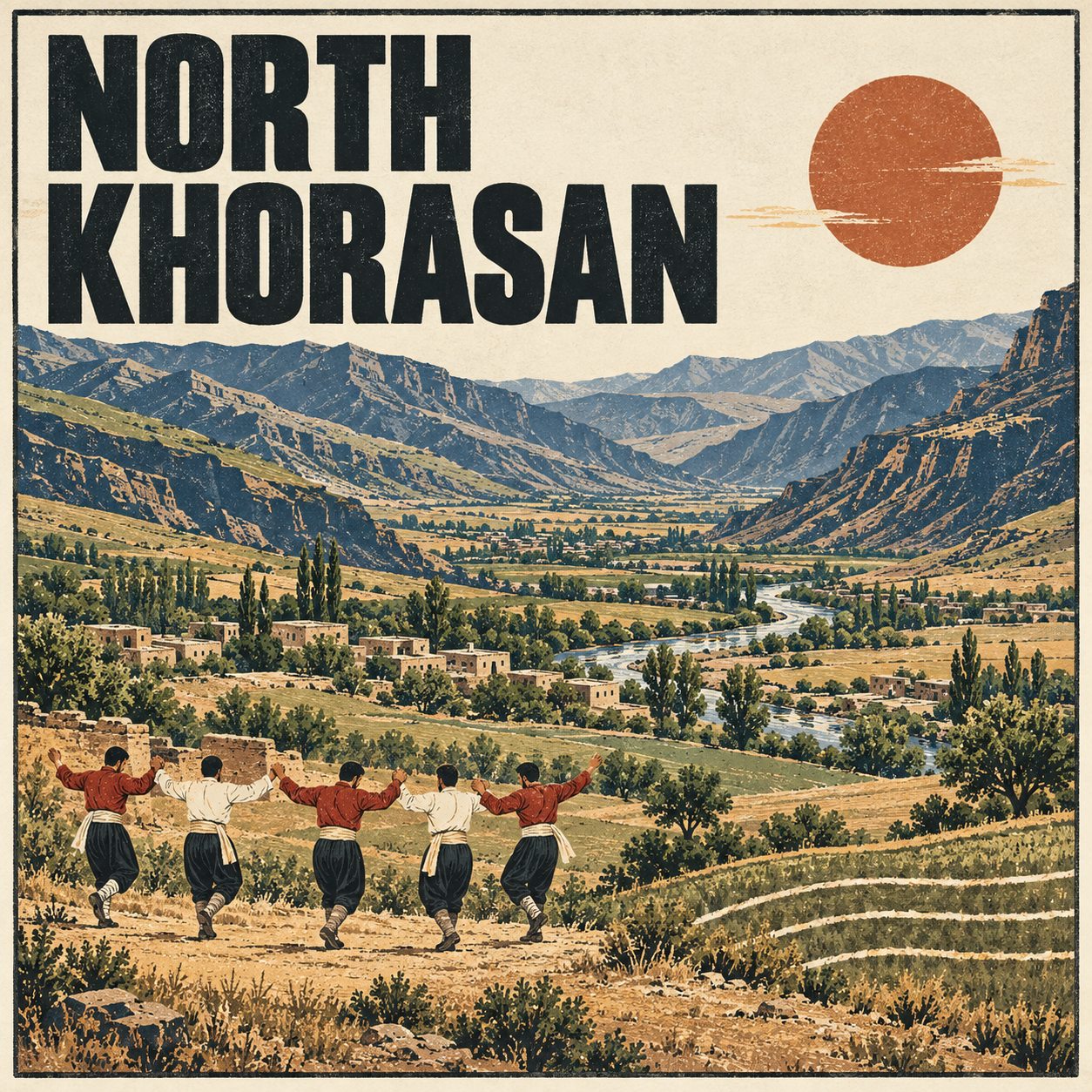
An inhabited upland valley, river and small stepping arc of Kurmanji dancers reference the Bojnurd-linked Chiksay practice. Three pale foreground bands are an editorial visual analogy to se-kheshti verse. This is a poetic composite, not a documented viewpoint, performance location, costume record or transcription. The illustrated figures are symbolic, not portraits of the credited performers.
North Khorasan is a modern province; “northern Khorasan” in music histories can describe a wider cultural area. Shirvan, Molabaqer, Bojnurd, Ashkhaneh and Khanloq provide concrete anchors here. Quchan and other places in Razavi Khorasan do not automatically establish a connection to this province. Repertoire crosses administrative borders, and a performer’s local practice does not prove that a selected recording session happened inside the province.
Bakhshi describes a bearer of narrative and poetic knowledge often singing with dotar; the broad UNESCO tradition is multilingual and not owned by one province. Maqam or ahang can name a melodic framework or type here. Asheq is a distinct professional practice associated with social occasions and dance, not a synonym for bakhshi. A dastan may combine spoken prose and sung verse, so a short catalog item need not contain a whole story. Se-kheshti is a three-line Kurmanji verse form used as textual material in the contemporary work Zirav.
Soudabeh Shamlou’s Mahoor item names a Shirvan Kurmanji lullaby, a social and oral function rather than a mood tag. An optional Bojnurd-labeled recording by Ordak Rahimi offers comparison without claiming one voice represents all women. Azam Kargar Fallah’s Shirvan dotar interpretation, Golnabat Atai’s documented professional performance, and Yalda Abbasi’s chamber collaboration occupy different musical roles. Their exact texts, teacher relationships or session locations are not inferred.
Zirav is a released composed setting of folkloric se-kheshti words linked by the label and participating Bojnurd group to Chiksay. The official Dorna video documents a local ensemble and a negotiated arrangement in Ghamsari’s Iranian Tar project. These are substantive present-day connections. Metadata alone does not prove how a digital master sounds, that it is experimental or fusion, or that a separately issued video and audio track use the same edit.
Dorna dotar ensemble, directed by Mohsen Mohammadi, with Ali Ghamsari. A local ensemble participates in a negotiated arrangement: maqams and melodies are retained while expression, repetition, form and instrumental roles change. This is a full artist-direct example of living work rooted in place. Where it fits: A full-video listening stop after core track 7 (Choob Bazi), before the cross-provincial chamber branch. Limit: No exact source maqam identified; Spotify digital 25 equivalence unproved. Full audio not auditioned. Public source date: 2021-07-19.
Fexan and Haşim Ferhadî. The label attributes words and music to Cafer Qolî Zengilî (Ja’far Qoli), with a separately credited arrangement by Reza Saeedi and named piano/cello players. This gives a concrete present-day treatment of northern-Khorasan literary-musical repertoire, not a generic recent-release or birthplace argument. Where it fits: Optional full-video stop beside core track 4, Sohrab Mohammadi’s Ashkhaneh-associated Ja’far Qoli: compare two presentations of poet-associated repertoire, not a proved same poem or melody. Limit: Label attribution is not independent proof of historical authorship. Northern-Khorasan circulation is the claim, not province-exclusive origin. The 30 July 2026 digital issue (227,997 ms) and 1 August 2026 video upload (230 seconds) are distinct dates and versions; creation and session dates are unknown. No sonic genre claim, audio audition or verified Spotify ID is implied. Public source date: 2026-08-01.
Azam Kargar Fallah. Women’s instrumental interpretation is a distinct role beyond lullabies or one international singing star. The producer names the Koroglu cycle and Shirvan performer; this is a purposeful optional comparison beside Eslami, not a forced second core item. Where it fits: Beside core track 5, with an invitation to compare two named interpreters of a widespread heroic-cycle repertory, not a claim of identical tune or master. Limit: Not new-composition or fusion evidence. Full audio not auditioned. Production season and upload date are different. Public source date: 2022-11-18.
Chiksay Group. Bojnurd-based dance/music practice and transmission, not merely a catalog genre. Indexed caption credits Tohid Qadimi on santur and Amir Hesari on dayereh. Where it fits: Supplementary dance-context example beside the Qarseh/Choob Bazi chapter; Zirav at core position 2 now supplies the stronger exact released-work connection. Limit: Exact post permalink not recovered; channel archive is stable retrieval target. One-minute clip is not a complete released composition. Current 2026 activity not verified.
Ordak Rahimi. A second named, locality-labeled lullaby lets a listener compare Shirvan and Bojnurd without claiming one track represents all women or all Kurmanji practice. Where it fits: Beside Shamlou rather than automatically adding another song to the core. Limit: Original session date and text unverified. Do not imply a documented teacher relationship.
Torghe Ensemble. Documented regional ensemble and Bojnord activity; a living group beyond solo celebrity profiles. Where it fits: Beside Dorna under “Local ensemble encounters”. Limit: Public previews only; no exact complete release/date or 2026 activity established.
Golnabat Atai; Golnabat Atai with Barat Mohammad Moqimi. Professional Bojnurd women’s performance and a named duet are a different role from lullabies and Yalda’s chamber work. Where it fits: Beside the women’s-voices note, not claimed to be on Spotify. Limit: The archive identifies the recordings; an exact playable Spotify candidate has not been verified.
The public Spotify page and embed show the ten exact selected recordings in this order, totalling 49:20.828, with the approved artwork. Full recordings and all nine audible transitions have not been independently auditioned. Source qualifications apply to each work and master; optional videos and archive records are outside the playlist runtime. Availability can vary by listener and territory.
DEEPER CONTEXT · LIVING SCENES · RESEARCH LIMITS
Follow another thread.
Open a topic to explore more of this place and its music.
Why this exact route is selective
The ten saved recordings form a selective first visit, not a demographic inventory or a literal journey. The current order contrasts professional poetic, domestic, dance and contemporary contexts without calling the older practices obsolete. The position explanations are current editorial readings, not recovered original curator intent or heard acoustic transitions. Further Raz/Jargalan Turkmen, Persian/Tati, urban, work and ritual practices remain underrepresented.
Rowshan Golafruz’s documented Molabaqer–Shirvan practice anchors Navayi at the opening and Shahkhatayi at the close. UNESCO describes these as named repertoire categories. The separate Haray field example locates the practitioner but is not the selected digital master; the source dates also do not settle the master’s recording day.
The label video credits traditional words, music by Haşim Ferhadî and arrangement by Hamid Golshani. Chiksay identifies the northern-Khorasan se-kheshti material and collaboration. Those work and video credits are not a complete Spotify master sheet. July 2023 is digital issue and September 2023 is video publication, not demonstrated composition or first-performance dates. Matching work identity does not prove an identical edit.
Shamlou’s exact release names Shirvan and Kurmanji. Tavahodi’s account documents the singer and locality independently. Rahimi’s Bojnurd-labeled item is a separate optional comparison. No lyric translation, teacher relationship, original session date or claim to represent every Kurmanji woman follows from those labels.
Sohrab Mohammadi’s Ja’far Qoli title and Alireza Eslami’s Jangname-Ye Kuroghli introduce distinct poet-associated and heroic-cycle paths. Eslami’s Shirvan release has a local teacher-network connection. A short catalog track is not the full dastan, and an untranscribed title is not proof of its exact scene, verse or historical authorship. Milwarî and Azam Kargar Fallah’s full producer video are optional comparisons, not identified as the same tune or master.
Ramezanali Azizi’s documented Khanloq connection and the asheq/dance release bring social movement into the core through Qarseh and Choob Bazi. CREM documents related musicians and repertoire; it does not identify every player, instrument or session detail on the exact selected digital masters. Chiksay’s short channel clip provides an optional dance context and is not represented as a complete single.
Yalda Abbasi’s documented Khorasan repertoire practice and maternal transmission support the cross-provincial connection beyond birthplace. The project video credits voice/dotar, violin, cello and piano. Its duration differs from the selected digital edit, so exact master equivalence, arrangement and the source tune’s specific modern-province locality remain open.
The complete Iranian Tar episode 21 video names Dorna dotar ensemble, Mohsen Mohammadi and Ghamsari in a Bojnurd encounter and explains its creative process. A separate Iranian Tar-25 (Bojnourd) digital track exists, but matching city and near-matching runtime do not prove it is the same audio master or carry the filmed ensemble’s credits. Follow the artist video for this companion, without transferring its personnel to the Spotify item.
The exact saved Spotify IDs and order were verified on the ordinary public page and embed. Full-track listening and all nine audible transitions have not been independently checked. Artist identity, named local practice, release metadata and documented collaboration support the editorial connections; they do not establish a sung text, a recording location, a genre heard by ear or universal platform availability.
Read in playlist order. Position notes are current editorial readings of the saved order, not a claim about original intent or an audio audition. Sources support specific cultural context; open each track’s qualifications for limits.
01
Navayi
Rowshan Golafruz
Place and practice: Molabaqer–Shirvan bakhshi practice
Why this track belongs: A full Rowshan catalog track introduces a documented local interpreter and a widely used maqam before any comparison. His local practice and label notes, not the generic word folk, earn the opening.
2003 documentation: Rowshan’s narrative practice; Golnabat Atai and Barat Mohammad Moqimi in Bojnurd
Scope: Historical account, not present residence or current artist status.
Why this position in the playlist
Role: Voice and dotar threshold
Opening: establish voice/dotar practice through one performer, not a four-track archive block.
To the next track: Zirav follows immediately as a documented new setting of inherited poetic material with a local ensemble connection. This is a change in creative process, not a claimed shared melody, tempo match or progression from old to superior new music.
02
Zirav
Haşim Ferhadî
Recording: Zîlan
Place and practice: Northern-Khorasan se-kheshti setting / Bojnurd Chiksay collaboration
Why this track belongs: This exact released work is linked by its label and participating Chiksay group to a composed setting of folkloric se-kheshti verses drawing on northern-Khorasan music. Farhadi and the Bojnurd ensemble have a documented music/dance collaboration beyond the video location. The label video credits traditional lyrics, music by Farhadi and arrangement by Hamid Golshani. These are work/video credits, not yet a Spotify master credit sheet. It is a substantive contemporary creation candidate, not an inference from birthplace, folk tags or a claim that it audibly belongs to an experimental genre.
Exact track ID 4LBpYZCFSj7civMhFio7DT; 186386 ms; track artist Haşim Ferhadî; album 2LRli09bQzLO6sy5ExruBL, catalog artist variant Haṣim Feryadî; public playable
Scope: Authenticated availability, full audio audition, Chiksay digital artist credit, detailed master personnel or identical video edit.
Exact new setting: Farhadi composed drawing on northern-Khorasan music and folkloric se-kheshti verses; Golshani arrangement. Musician list separated from film crew: kamancheh Majid Mazaheri, dotar Farhadi/Ali Dehghan, percussion Qodrat Qodrati, tar Saeid Rahmani. Chiksay collaboration led by Hamed Mataranluei.
Scope: Not a digital master credit sheet; no specific inherited tune named; no original date proved. Do not adopt the caption’s exclusionary judgments about neighboring musical influences.
2023-09-24 interview links Zirav and Zîlan, dotar/Khorasan practice, Chiksay collaboration and filming around Bojnurd
Scope: Prose blurs composition/arrangement role split compared with label and Chiksay; privilege explicit label/participant credits, not this prose for rights roles. Filming site alone would be insufficient locality evidence.
Chiksay Arts Group / Khorasan appears in programme
Scope: Not proof of 2026 activity.
Not established: Official label video and participant caption support the work/project. Digital catalog credits Ferhadî; Chiksay personnel and video edit identity are not imported into Spotify metadata. 2023-07-28 digital issue; 2023-09-01 label video publication. Composition, first performance and original video dates unknown. Older Telegram context must not be dated 2023 by inference. Album-level artist appears as Haṣim Feryadî; track artist is Haşim Ferhadî. Preserve exact track ID and label/album cross-check rather than resolving by spelling alone. same work/project supported, identical audio edit/master not verified
Why this position in the playlist
Role: A composed se-kheshti setting
After the full Navayi catalog track, introduce locally grounded creative work immediately. The comparison is how inherited material can support different kinds of authorship and collaboration, not a claimed shared tune or old-to-new evolutionary ladder.
From the previous track: After the full Navayi catalog track, introduce locally grounded creative work immediately. The comparison is how inherited material can support different kinds of authorship and collaboration, not a claimed shared tune or old-to-new evolutionary ladder.
To the next track: Before Shamlou’s locality-labeled lullaby, distinguish a deliberately composed setting of folkloric words from a separately documented oral performance function. Both are active forms of cultural transmission, not modern versus obsolete.
Why this track belongs: Mahoor’s exact locality/language label and Tavahodi’s independent documentation make Shamlou a stronger addition than a generic Kurdish lullaby. The oral genre expands the program beyond professional bardic and concert repertoire.
Women’s Kurmanji lullaby research and Shamlou’s named contribution
Scope: Not a transcript or translation of the selected song.
Why this position in the playlist
Role: Shirvan lullaby and a named woman singer
After Zirav’s composed setting of folkloric verses, attend to a distinct named woman and a locality-labeled lullaby. The social function, not an invented mood or softer sound, earns the transition.
From the previous track: After Zirav’s composed setting of folkloric verses, attend to a distinct named woman and a locality-labeled lullaby. The social function, not an invented mood or softer sound, earns the transition.
To the next track: Before Ja’far Qoli, compare two ways Kurmanji words circulate: named women’s oral repertoire and a poet-associated professional repertoire. Do not claim either selected lyric has been translated.
Why this track belongs: One focused Sohrab selection preserves the Ashkhaneh anchor and the place of Ja’farqoli-associated poetry without retaining an uninterrupted five-track artist block. Exact verses/authorship remain untranscribed.
Exact selected Mahoor edition; baseline IDs for Ja’far Qoli and Lo; catalog credit/duration independent of field context
Scope: Original recording date, exact lyric transcription and every instrument not audited.
Why this position in the playlist
Role: Ja’farqoli-associated poetry
After the locality-labeled lullaby, bring a distinct named poetry tradition into view rather than treating all Kurmanji singing as one genre.
From the previous track: After the locality-labeled lullaby, bring a distinct named poetry tradition into view rather than treating all Kurmanji singing as one genre.
To the next track: Next, Eslami’s Jangname-Ye Kuroghli changes from a poet-associated title to a heroic narrative cycle. Only one Kuroghli item is required in the core; a separately sourced woman instrumentalist offers a more meaningful optional comparison than an unexplained second same-artist title.
Why this track belongs: The explicitly Shirvan release and Eslami’s teacher network give a locality-based route into Kuroghli. A short album item is not the full dastan; the exact scene remains unverified.
Shirvan album identity and the two Kuroghli titles, timings; 2019 digital edition
Scope: Not original session/release date; blanket composer metadata is not proof of new authorship.
Why this position in the playlist
Role: Kuroghli heroic narrative
After Ja’far Qoli, change both interpreter and narrative emphasis deliberately; do not describe the two recordings as the same story.
From the previous track: After Ja’far Qoli, change both interpreter and narrative emphasis deliberately; do not describe the two recordings as the same story.
To the next track: Next, the Qarseh dance suite changes the documented performance function from heroic/narrative presentation to social movement. Heroic repertoire and stick dance must not be called the same ritual.
Why this track belongs: Azizi’s documented locality and the release’s asheq/dance program prevent dotar alone from representing provincial music. The named dance suite gives social movement its own chapter.
Exact selected 2020 digital edition; Azizi dance-track identities/durations; distinct from 2007 edition
Scope: Related 2007 program credits do not prove identical 2020 master instrumentation or location.
Why this position in the playlist
Role: Asheq dance enters
After a single heroic-cycle selection, give the asheq dance tradition its own chapter. This is a documented function change, not an auditioned tempo or ensemble-size claim.
From the previous track: After a single heroic-cycle selection, give the asheq dance tradition its own chapter. This is a documented function change, not an auditioned tempo or ensemble-size claim.
To the next track: Keep Choob Bazi next: a different named dance and a different partner within Azizi’s documented performance world, not an arbitrary second festival track.
07
Choob Bazi
Ramezanali Azizi, Ghorbanali Dastyar
Place and practice: Khanloq-linked stick-dance repertoire
Why this track belongs: Stick-dance repertoire adds a distinct movement context. Related edition credits and separate field documentation support the tradition/personnel, not the exact 2020 session or instruments.
Exact selected 2020 digital edition; Azizi dance-track identities/durations; distinct from 2007 edition
Scope: Related 2007 program credits do not prove identical 2020 master instrumentation or location.
Why this position in the playlist
Role: Stick-dance repertoire
After the Qarseh suite, retain the lead musician but change named dance and partner. This comparison has a cultural purpose even before audio audition.
From the previous track: After the Qarseh suite, retain the lead musician but change named dance and partner. This comparison has a cultural purpose even before audio audition.
To the next track: The next selected master, Şivan, changes from dance repertoire to a credited chamber collaboration. The guide offers the separate Dorna/Ghamsari full video at this junction to hear another locally negotiated collaboration; it is not silently substituted for an unverified Spotify master.
08
Şivan
Yalda Abbasi, Trio Sêreng, Laia Genc, Beate Wolff, Nurê Dilovanî
Place and practice: Shirvan–Quchan transmission / international chamber branch
Why this track belongs: Retain the same-named, independently credited chamber collaboration. Yalda’s Khorasan repertoire practice and maternal transmission support a cross-provincial connection beyond birthplace. The official project video credits voice/dotar, violin, cello and piano; its 6:31 duration differs from the 6:03 digital edit, so identical mastering and exact arrangement/source-tune credits are not claimed.
Voice/dotar, violin, cello, piano credits; video dated 2023-07-04
Scope: Video is 391 s versus selected digital 363024 ms. Same named collaboration, not identical edit/master established; exact arranger and source melody/locality unproved.
363 sec, released 2023-06-25 PanoTunes; all five selected artists plus Traditional; mastering engineer Markus Braun. Better duration match to Spotify 363024 ms than 391 sec official project video.
Scope: Traditional does not identify a North-Khorasan source tune. No exact arrangement credits or audio equivalence inferred solely from duration.
Why this position in the playlist
Role: Cross-provincial chamber branch
After the dance pair and the optional locally anchored Dorna video, widen the frame to an explicitly cross-provincial chamber collaboration. The route has already established documented Bojnurd-linked creation through Zirav, so this branch is not asked to prove a local alternative scene on its own.
From the previous track: After the dance pair and the optional locally anchored Dorna video, widen the frame to an explicitly cross-provincial chamber collaboration. The route has already established documented Bojnurd-linked creation through Zirav, so this branch is not asked to prove a local alternative scene on its own.
To the next track: Before Lo, invite a comparison between a contemporary collaborative presentation and a named Kurmanji vocal category by the Ashkhaneh-associated Sohrab Mohammadi. No same melody, text, lineage or sonic compatibility is asserted.
Why this track belongs: Preserve a named Kurmanji repertoire category distinct from the earlier poet-title. It returns the route to a locally anchored vocal vocabulary after the chamber branch, without implying that one category or performer represents every Kurmanji community.
Exact selected Mahoor edition; baseline IDs for Ja’far Qoli and Lo; catalog credit/duration independent of field context
Scope: Original recording date, exact lyric transcription and every instrument not audited.
Why this position in the playlist
Role: Return to a named Kurmanji category
After the cross-provincial chamber branch, return to an Ashkhaneh-associated interpreter and a named Kurmanji vocal category. The geographical and repertorial return, not a presumed drop in energy, makes this position purposeful.
From the previous track: After the cross-provincial chamber branch, return to an Ashkhaneh-associated interpreter and a named Kurmanji vocal category. The geographical and repertorial return, not a presumed drop in energy, makes this position purposeful.
To the next track: Before Shahkhatayi, keep the ending plural: another repertoire category and a different interpreter, not an assertion that Lo and the next performance share lyrics or theology.
10
Shahkhatayi
Rowshan Golafruz
Place and practice: Molabaqer–Shirvan / religious-repertoire category
Why this track belongs: A documented religious maqam category belongs alongside narrative, domestic, dance and contemporary contexts. No exact theological reading or ritual function is assigned to this untranscribed master.
Rowshan; Molabaqer–Shirvan; Khorasani Turkish; March 2004
Scope: Separate field performance, not selected Mahoor master.
Why this position in the playlist
Role: Religious-repertoire close
After Lo, close on a different named category and return to the opening performer; the return frames the route as a set of conversations rather than a linear old-to-modern evolution. End: let the selected catalog track finish. No invented fade, meditative effect, key compatibility, or sacred-ceremony claim.
From the previous track: After Lo, close on a different named category and return to the opening performer; the return frames the route as a set of conversations rather than a linear old-to-modern evolution.
Follow the threads.
These earlier reading lists offer broader context. The per-track source notes identify what each reference supports and where verification remains open.