
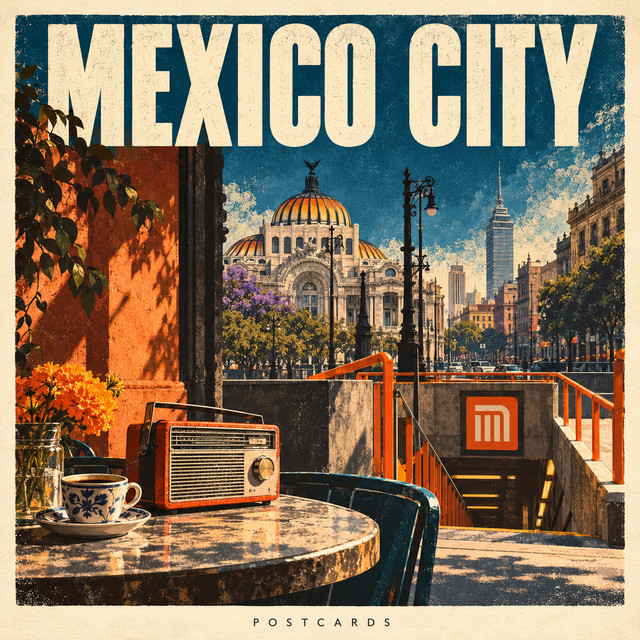
DANCE HALLS · METRO · COUNTERCULTURES · 22 SONGS · 89:09
Mexico City
A cultural route through dance halls, markets, Metro stories and independent scenes. These 22 existing selections describe a metropolis through both songs about places and communities that make music, not a claim to represent every sound of Mexico City.
Mexico City plus its wider metropolitan musical networks. Naucalpan is in the State of Mexico, outside the administrative territory of CDMX. Cuban-rooted genres and Colombian collaborations are identified as exchanges, not recast as Mexican inventions.
This guide preserves the existing playlist. Cultural connections are source-backed; listening questions invite your own response and do not claim an audio audition. Spotify availability may vary by territory and change over time. Historical cultural sources are not current event schedules.
Listen on SpotifyThe stories in the grooves.
Read in playlist order. Position notes are current editorial readings of the saved order, not a claim about original intent or an audio audition. Sources support specific cultural context; open each track’s qualifications for limits.
Dance halls, adopted rhythms
Begin with social dancing, university pride and a concert-hall visitor. Danzón and mambo have Cuban roots; their life in Mexico City is a story of migration and adaptation, not a claim that they originated here.
Why this track belongs: A Mexican composition by Amador Pérez “Dimas” in a Cuban-rooted dance tradition. Acerina’s orchestra was established at Salón México, connecting this selection to the capital’s social-dance history rather than making danzón Mexican in origin.
Listening question: What kind of movement does the recurring melody suggest to you?
Why this position in the playlist
Role: Social dancing as the entrance
First, it establishes the dance hall as a place where the city makes culture together, and names danzón’s Cuban roots before the route presents its local adaptations. Starting with the later orchestral portrait would let a visitor’s representation precede that social history.
To the next track: Mambo Universitario keeps the connection to Cuban-rooted dance vocabulary but moves its social use into UNAM and Pumas identity.
Why this track belongs: Pérez Prado’s Cuban mambo vocabulary became part of UNAM’s sporting identity. This piece connects the dance floor with Pumas pride and the capital’s university culture, rather than simply serving as generic tropical atmosphere.
Listening question: How does the music turn team spirit into an invitation to dance?
Why this position in the playlist
Role: Dance vocabulary becomes civic identity
Second, it extends the opening dance-hall connection into a specific city institution before the broader public celebration of La Boa. This makes adoption and local use the opening argument rather than grouping the tracks as generic tropical music.
From the previous track: Nereidas introduces a Mexican composition in a Cuban-rooted dance tradition; Mambo Universitario supplies a different Cuban-rooted vocabulary tied to a named university community.
To the next track: La Boa broadens the social frame from Pumas identification to the intergenerational dancing documented at Jardín Allende.
Why this track belongs: A signature Santanera number that still links generations on local dance floors. Coyoacán’s account of a Jardín Allende concert describes La Boa bringing dancers together and recalling earlier social dances: a city connection through use, not an exclusive origin claim.
Listening question: Does the music make you imagine a private celebration or a shared public space?
Why this position in the playlist
Role: Public dance before the visitor portrait
Third, it completes a three-track entrance through music used by city communities before El Salón México changes the vantage point to a concert work inspired by the city. Keeping that contrast adjacent makes the difference between participation and representation explicit.
From the previous track: Mambo Universitario locates music in a particular institution; La Boa widens the invitation through a documented public dance event and shared repertoire.
To the next track: El Salón México shifts to an outsider’s orchestral interpretation of a dance-hall atmosphere, not another documented example of music danced at that hall.
El Salón México
Aaron Copland, Eduardo Mata, Dallas Symphony Orchestra
Open exact recording on SpotifyWhy this track belongs: Copland’s orchestral portrait was inspired by the atmosphere of Mexico City’s Salón México. It draws on Mexican popular melodies, not a transcription of the danzones danced there: a visitor’s interpretation alongside the dance tradition itself.
Listening question: How does imagining a dance hall change the way you hear a concert piece?
Why this position in the playlist
Role: An outsider portrait after lived dance contexts
Fourth, the 11:41-scale concert work comes after three shorter, concrete social-dance introductions, so it is a contextualized extended encounter rather than the opening hurdle. Its position at the chapter boundary also lets the next track answer a visitor’s portrait with a local chronicler’s everyday city.
From the previous track: La Boa has supplied evidence of people dancing together; Copland offers an orchestral response to a city dance hall, a deliberately different relationship to the place.
To the next track: Sábado Distrito Federal turns from the visitor’s concert-hall portrait to Chava Flores’s comic account of everyday urban life.
The barrio talks back
Street corners, markets and cabaret turn everyday life into a public stage. These selections move between affectionate neighborhood observation and performances that question the stories a nation tells about itself.
Why this track belongs: Chava Flores turns the former Distrito Federal’s everyday bustle into comic urban chronicle. The national sound archive identifies this song as an emblem for the city’s residents; its specificity lies in ordinary life, not monuments.
Listening question: Which everyday activity becomes most vivid in your imagination?
Why this position in the playlist
Role: The resident city replaces the visitor gaze
Fifth, it opens the neighborhood chapter immediately after Copland by changing perspective from an orchestral visitor to a chronicler of the city’s everyday bustle. It also establishes a wide view that the next Chava Flores song can deliberately narrow.
From the previous track: El Salón México represents a visitor’s imaginative encounter with the city; this makes ordinary routines and the former Distrito Federal itself the subject.
To the next track: La Esquina de mi Barrio keeps the chronicler but moves from citywide bustle to the smaller social world of a corner.
Why this track belongs: The neighborhood corner becomes a small social world of commerce, encounters and familiar routines. UNAM’s historical study treats the song as a portrait of barrio life, making it a useful close-up after the wider city bustle.
Listening question: What makes a street corner feel like a community rather than just a crossing?
Why this position in the playlist
Role: A deliberate close-up with the same chronicler
Sixth, the second consecutive Chava Flores selection is purposeful: it changes the scale from the wider city to one neighborhood corner while preserving the observer. Separating the pair would lose that clear wide-shot-to-close-up relationship; keeping more such songs together would delay other voices.
From the previous track: Sábado Distrito Federal has established the larger field of urban activity; La Esquina de mi Barrio concentrates on commerce, encounters and familiar routines at a corner.
To the next track: A Su Merced expands that everyday sociability into the named La Merced market and changes interpreter and performance context.
Why this track belongs: A playful market portrait that the Centro Histórico’s own musical history places under La Merced. Eugenia León and La Danzonera Dimas connect danzón with the language and sociability of the market; the city source links this exact Spotify track.
Listening question: How does the performance make an everyday market feel theatrical?
Why this position in the playlist
Role: Market life reconnects with the opening dance thread
Seventh, it follows the barrio corner with a larger named place of exchange, then brings danzón back inside the route as part of a market portrait. That recurrence connects neighborhood storytelling to the opening chapter and prepares the move from everyday life into cabaret.
From the previous track: La Esquina de mi Barrio supplies a small social world of commerce; A Su Merced makes the market the next scale of city sociability.
To the next track: La Tequilera moves from a theatrical market portrait to Hadad’s cabaret reinterpretation of wider Mexican repertoire.
Why this track belongs: This is a connection through interpretation, not a claim that La Tequilera belongs only to CDMX. Hadad’s cabaret practice and long relationship with the Chopo museum bring popular Mexican repertoire into a city space of theatrical reinvention and social criticism.
Listening question: What changes when you imagine this song as cabaret rather than as a straightforward confession?
Why this position in the playlist
Role: Cabaret opens the door to counterculture
Eighth, it closes the neighborhood chapter by turning the public stage toward theatrical reinvention and criticism. Placing Hadad between the market portrait and the Metro chapter makes a bridge through city cultural spaces, rather than treating national repertoire as exclusively local.
From the previous track: A Su Merced has connected everyday commerce with performance; Hadad shifts the focus to cabaret’s interpretive practice and its Chopo connection.
To the next track: Metro Balderas makes a named transit setting central to a different urban fable, carrying the route from a performance space into daily movement.
Metro lines and countercultures
The Metro becomes a setting for urban fables; street speech and alternative venues create other ways to belong. Some songs name the city directly, while others represent the scenes that made room for different voices.
Why this track belongs: Rockdrigo turns Balderas station and its crowds into a fable of lost love. It is a specific urban story, not a literal report of a journey; the song’s emotional geography has become inseparable from this Metro interchange.
Listening question: Does the crowd feel like a setting, an obstacle or a character?
Why this position in the playlist
Role: A named station launches the Metro chapter
Ninth, it begins the transit and counterculture chapter with a specific station and a story rather than an abstract scene label. The immediately following Metro satire can then present a second use of the same everyday infrastructure, while El metro later closes the chapter’s transit thread.
From the previous track: La Tequilera connected a song through a city performance network; Metro Balderas changes to a work whose named urban setting is central to its story.
To the next track: Heavy Metro stays with crowded transit but changes the treatment from the lost-love fable to satire associated with Pino Suárez.
Why this track belongs: Botellita de Jerez makes crowded Metro travel into satire. The Centro Histórico’s musical history reads the song through Pino Suárez and the pressures of sharing public transport: a grounded city connection, not merely a pun in the title.
Listening question: How can humor make a frustrating commute easier to describe?
Why this position in the playlist
Role: An adjacent transit comparison rather than repetition
Tenth, it stays directly beside Metro Balderas so the visitor can compare two ways of making stories from crowded transport; its shorter catalog duration also changes scale before the route turns to scene connections. Moving it away would make that comparison less immediate.
From the previous track: Metro Balderas has introduced transit through a lost-love fable; Heavy Metro approaches shared public transport through satire.
To the next track: En Esta Ciudad moves from a song with a documented transport setting to an interpreter’s connection with the capital’s alternative-performance network.
Why this track belongs: Cecilia Toussaint belongs here through the capital’s alternative-performance network, including the Chopo museum. This selection introduces a major interpreter and independent artist within that community; it is not being presented as a verified map of named city locations.
Listening question: What sort of relationship between a person and a city does the performance invite you to imagine?
Why this position in the playlist
Role: The bridge from city subjects to city-made scenes
Eleventh, it follows two explicitly transit-related works by making a different admission principle visible: a song can belong through a documented artistic community without mapping a landmark. It leads into Santa Sabina’s related but separately documented venue history.
From the previous track: Heavy Metro has a specific transport subject; this selection is grounded instead in Toussaint’s alternative-performance network, including Chopo.
To the next track: Azul Casi Morado adds another documented network of city venues and a song’s life in collective memory, broadening the scene account beyond one interpreter.
Why this track belongs: Santa Sabina developed through Mexico City venues such as Tutti Frutti, L.U.C.C. and Rockotitlán. Azul Casi Morado also persists in shared memory: audiences sang along at a UNAM screening honoring the band, linking the song to an alternative cultural community.
Listening question: What emotional color would you give the song if you did not know its title?
Why this position in the playlist
Role: A scene becomes shared memory
Twelfth, it extends the preceding performer-network connection with a documented band, venues and public memory of this particular song. It sits before Pachuco so the chapter can move from communities sustaining music to an explicit dispute over youth identity.
From the previous track: En Esta Ciudad introduces an interpreter’s city network; Azul Casi Morado shows a band’s venue history and the song’s documented communal afterlife.
To the next track: Pachuco turns to generational arguments about youth style while retaining a connection to the capital’s alternative-music institutions.
Why this track belongs: The song stages a dispute between generations about youth style. Maldita Vecindad’s place in the Chopo’s alternative-music history connects that argument to the capital; its pachuco reference is not a claim that the wider border-crossing culture began in CDMX.
Listening question: Which generation’s point of view feels more persuasive to you, and why?
Why this position in the playlist
Role: Youth style before the language of belonging
Thirteenth, it turns the scene discussion into a specific argument about generations and youth style, then hands the question of belonging to Chilanga banda’s documented language play. It is placed here as a thematic hinge, not as evidence that pachuco culture originated in the capital.
From the previous track: Azul Casi Morado has located belonging in venues and audience memory; Pachuco makes a dispute about youth style the documented subject.
To the next track: Chilanga banda changes the identity question from generational style to chilango speech and metropolitan perspective.
Why this track belongs: Café Tacvba’s version of Jaime López’s song foregrounds chilango speech; UACM has used it to explore language and identity. The band comes from Naucalpan, State of Mexico, so this is metropolitan culture speaking about the capital, not a strict-CDMX birthplace claim.
Listening question: How much character can you follow through the sound of the words, even before knowing every expression?
Why this position in the playlist
Role: Urban speech before a transit tale by the same band
Fourteenth, it follows Pachuco by shifting from the language of style to the identity carried by speech, then pairs directly with El metro to show two distinct city connections within Café Tacvba’s repertoire. The repeat artist is a comparison, not an artist quota.
From the previous track: Pachuco presents generational youth identity; Chilanga banda foregrounds chilango expressions and language as a different form of belonging.
To the next track: El metro retains Café Tacvba but changes from urban speech to a documented Line 2 fable, making the two connections distinguishable.
Why this track belongs: A passenger unable to get off the Metro turns ordinary crowding into an absurd urban tale. UNAM explicitly connects the song to Line 2; Café Tacvba’s Naucalpan roots remind us that the capital’s daily culture extends beyond its administrative border.
Listening question: When does a familiar commute start to feel like an endless loop?
Why this position in the playlist
Role: The Metro thread closes before a shared dance chapter
Fifteenth, it completes the Café Tacvba comparison and recalls the transit stories at slots 9 and 10, giving this chapter a recognizable return rather than an unrelated ending. The next track then shifts from a story about a crowd to a scene where people gather around music.
From the previous track: Chilanga banda has foregrounded the city’s speech through the same metropolitan band; El metro makes a named public-transport line the subject of an absurd tale.
To the next track: La Dosis Perfecta changes the place connection from lyrical urban narrative to the independent ska circuit and Multiforo Alicia.
A metropolitan dance floor
Ska, sonidero cumbia and psychedelic reworkings connect venues, family celebrations and international exchange. The route reaches Naucalpan in the State of Mexico: part of the metropolis, but not inside CDMX’s administrative boundary.
Why this track belongs: The connection is the independent ska circuit, not a claim that this love song names CDMX. Panteón Rococó’s history is tied to Multiforo Alicia, a capital venue whose archive documents music, community and counterculture beyond the mainstream stage.
Listening question: What happens when an intimate subject becomes music for a crowd?
Why this position in the playlist
Role: Alicia connects counterculture to gathering around music
Sixteenth, it opens the metropolitan dance chapter through a venue-linked independent scene, preserving continuity with the preceding countercultures before widening to Reforma’s public celebration. Its love-song subject also sets up a useful comparison with the next romantic song’s documented communal use.
From the previous track: El metro connected city life through narrative; La Dosis Perfecta belongs through Panteón Rococó’s independent ska circuit and Alicia history instead.
To the next track: El Listón De Tu Pelo retains a romantic subject but changes the evidence of public life from an independent venue circuit to a citywide Reforma celebration.
Why this track belongs: Iztapalapa’s Los Ángeles Azules link cumbia sonidera to citywide celebration. The CDMX culture department records this song in their New Year performance on Reforma: local musical identity opening onto a shared public dance floor, not a song about one neighborhood.
Listening question: What makes a romantic song work as a communal celebration?
Why this position in the playlist
Role: A romantic song on a civic dance floor
Seventeenth, it follows the venue-rooted ska selection with a documented citywide celebration, broadening the chapter’s social setting without abandoning popular music’s communal use. It precedes two different reinventions so a locally established dance practice is present before those transformations are discussed.
From the previous track: La Dosis Perfecta connects an intimate subject with an independent performance community; El Listón De Tu Pelo connects another romantic song to a documented Reforma gathering.
To the next track: Mambo Egipcio changes from the documented public performance of a shared song to Sonido Gallo Negro’s tropical-psychedelic project and its wider exchanges.
Why this track belongs: Sonido Gallo Negro’s Aragón-based project reworks tropical psychedelia, including Peruvian cumbia and mambo. Mambo Egipcio belongs to that imaginative metropolitan exchange; its title is not evidence of an Egyptian folk origin.
Listening question: What imagined place does the title suggest, and does the music confirm or complicate it?
Why this position in the playlist
Role: Imaginative exchange before a named inherited tune
Eighteenth, it introduces one form of present-day tropical reinvention after the public cumbia example, then sits beside a different kind of reinvention with an explicitly identified sonidero lineage. The pair distinguishes imaginative stylistic exchange from the reworking of a particular inherited song.
From the previous track: El Listón De Tu Pelo has shown a documented civic dance use; Mambo Egipcio changes the focus to a metropolitan project drawing on tropical psychedelia and cross-border vocabularies.
To the next track: Pájaro Cenzontle gives the next transformation a named sonidero antecedent and a family marimba practice, not simply another vague fusion label.
Why this track belongs: Son Rompe Pera brings a family marimba tradition from Naucalpan, State of Mexico, into the cumbia-punk world. Their label identifies this selection as a reworking of a Mexican sonidero classic associated with Super Grupo Colombia: inheritance and reinvention, not a new local composition.
Listening question: What might a familiar dance tune gain when another generation takes it on?
Why this position in the playlist
Role: Family inheritance extends the metropolitan map
Nineteenth, after the imaginative geography of Mambo Egipcio, it makes reinvention concrete through a named inherited tune, a family practice and Naucalpan. It comes before El Antídoto so local sonidero inheritance can lead into an explicitly binational collaboration rather than a single-origin story.
From the previous track: Mambo Egipcio foregrounds a project’s tropical exchanges; Pájaro Cenzontle identifies a particular sonidero lineage and the musicians’ family marimba tradition.
To the next track: El Antídoto extends the sonidero thread through an artist-described tribute involving Colombia’s La Perla, a collaboration rather than the same tune or tradition.
Why this track belongs: Camilo Lara describes this collaboration with Colombia’s La Perla as a tribute to the old D.F.’s sonideros. It connects Mexico City’s sound-system culture with a Colombian partner; the shared cultural route matters more than claiming a single national origin.
Listening question: How would hearing this with other people change its effect compared with listening alone?
Why this position in the playlist
Role: An explicit exchange closes the dance chapter
Twentieth, it closes the chapter by making collaboration across borders explicit after several metropolitan forms of inheritance and reinvention. That position also echoes the opening warning against treating adopted music as purely local origin before the final pair turns to independent artistic communities.
From the previous track: Pájaro Cenzontle has traced a named sonidero inheritance through a Naucalpan family practice; El Antídoto offers a separately documented sonidero tribute with a Colombian collaborator.
To the next track: Bestia shifts from an explicit tribute to the old D.F. into a work included through its place in the city’s independent alternative scene.
Independent futures
End with two different paths through independent music: Hello Seahorse!’s alternative-song world and Austin TV’s instrumental-rock identity. The connection is cultural infrastructure and artistic community, not a claim that every track describes a city landmark.
Why this track belongs: Bestia represents the city’s independent alternative scene rather than a literal city portrait. The Cervantino’s CDMX program presented Hello Seahorse! in that role and identified Bestia among the songs that brought their work wider attention.
Listening question: Does the song invite you inward, toward a crowd, or somewhere between?
Why this position in the playlist
Role: A penultimate song points beyond geographic illustration
Twenty-first, it starts the short closing pair by returning to the principle introduced at slot 11: a documented city scene can matter even when a track is not a literal place portrait. Its position beside Austin TV lets the ending show two distinct independent practices instead of finishing with another landmark song.
From the previous track: El Antídoto has an explicit D.F. tribute and collaborative account; Bestia’s connection is the CDMX independent scene documented by the Cervantino program.
To the next track: Ella No Me Conoce follows with Austin TV’s self-described instrumental-rock identity and Alicia connection, a different independent practice rather than a claim of shared mood.
Why this track belongs: Austin TV’s self-described instrumental rock adds a different strand of the capital’s independent culture. Their documented presence at Multiforo Alicia anchors the connection in a real venue and community, rather than requiring the track to describe a particular street.
Listening question: What kind of story can you construct without relying on a sung narrator?
Why this position in the playlist
Role: An instrumental community-based ending
Twenty-second, it closes after Hello Seahorse! with a different documented independent practice, leaving the city represented by creative communities rather than only named streets or a national anthem. The instrumental-rock identity permits an open-ended listening invitation, but no fade, calm ending or sonic resolution is claimed.
From the previous track: Bestia supplies the alternative-song side of the closing pair; Austin TV’s instrumental-rock identity supplies a different way to make a musical narrative within the city’s independent culture.
Follow the threads.
These earlier reading lists offer broader context. The per-track source notes identify what each reference supports and where verification remains open.
- INAH: Las mil y una rumbas. Cuatro cubanas en México (p. 106)
- Gaceta UNAM: Mambo and Pumas sporting identity
- UNAM Global: Dámaso Pérez Prado in Mexico City
- Alcaldía Coyoacán: Sonora Santanera at Jardín Allende
- Secretaría de Cultura: Sonora Santanera on its repertoire and legacy
- Orquesta Filarmónica de la Ciudad de México: El Salón México
- Archivo General de la Nación: Chava Flores, city chronicler
- Fonoteca Nacional: Chava Flores listening archive
- UNAM Instituto de Investigaciones Históricas: Barrio, conflict and melodrama (p. 233)
- Fideicomiso Centro Histórico: Una crónica sonora del Centro Histórico (Memo Bautista and Sonia Yáñez)
- Museo Universitario del Chopo: Astrid Hadad, Fiesta cabaretera
- Secretaría de Cultura: Astrid Hadad and La Tequilera
- UNAM Global: Metro crowding and songs by Rockdrigo and Café Tacvba
- Museo Universitario del Chopo: Forty years as a meeting place
- Secretaría de Cultura / SIC: Cecilia Toussaint
- Museo Universitario del Chopo: Santa Sabina and the dark scene
- Gaceta UNAM: Santa Sabina, cinema and collective memory
- Secretaría de Educación Pública: Pachuco and generational conflict
- UACM Palabrijes 02: La Chilanga banda rola en la universidad
- Congreso del Estado de México: Café Tacvba among Naucalpan rock groups
- Secretaría de Cultura: Museo Nacional de Culturas Populares exhibition on Multiforo Alicia
- Secretaría de Cultura: Panteón Rococó, independent music and La dosis perfecta
- Secretaría de Cultura CDMX: Los Ángeles Azules at New Year on Reforma
- Glitterbeat: Sonido Gallo Negro and Mambo Cósmico
- Sonido Gallo Negro: Mambo Egipcio
- ZZK / AYA Records: Son Rompe Pera, Naucalpan and family performance traditions
- AYA Records: Pájaro Cenzontle and its sonidero lineage
- Mexican Institute of Sound: El Antídoto credits
- Camilo Lara interview with UnoTV: Distrito Federal, track by track
- Festival Internacional Cervantino 50 catalogue: CDMX: Hello Seahorse! (p. 57)
- Festival Internacional Cervantino: Hello Seahorse! performance and Bestia
- Austin TV: Ella No Me Conoce