Language and locality
Mazandarani or Tabari usage varies across the province. Western Kojur, central forms and eastern practices should not be collapsed into one sound. A practitioner’s origin alone does not prove a particular recording’s language.

TABARI POETRY · REED · ROOTS ROCK · 12 SONGS · 58:26
Mazandaran spans coastal plains, Alborz routes, towns and villages. Poetry, reed repertoires, work and travel songs, women’s musical knowledge and seasonal visiting traditions carry different histories.
This 12 recording route places a new rock setting of Mazandarani poetry near the beginning and keeps complete vocal and occupational forms. Artist direct performances by Moghimi and Sara Alizadeh extend the route. The verified desktop playlist runs 58:26; availability may vary.
Listen on SpotifyTHE COVER · PLACE AND INTERPRETATION
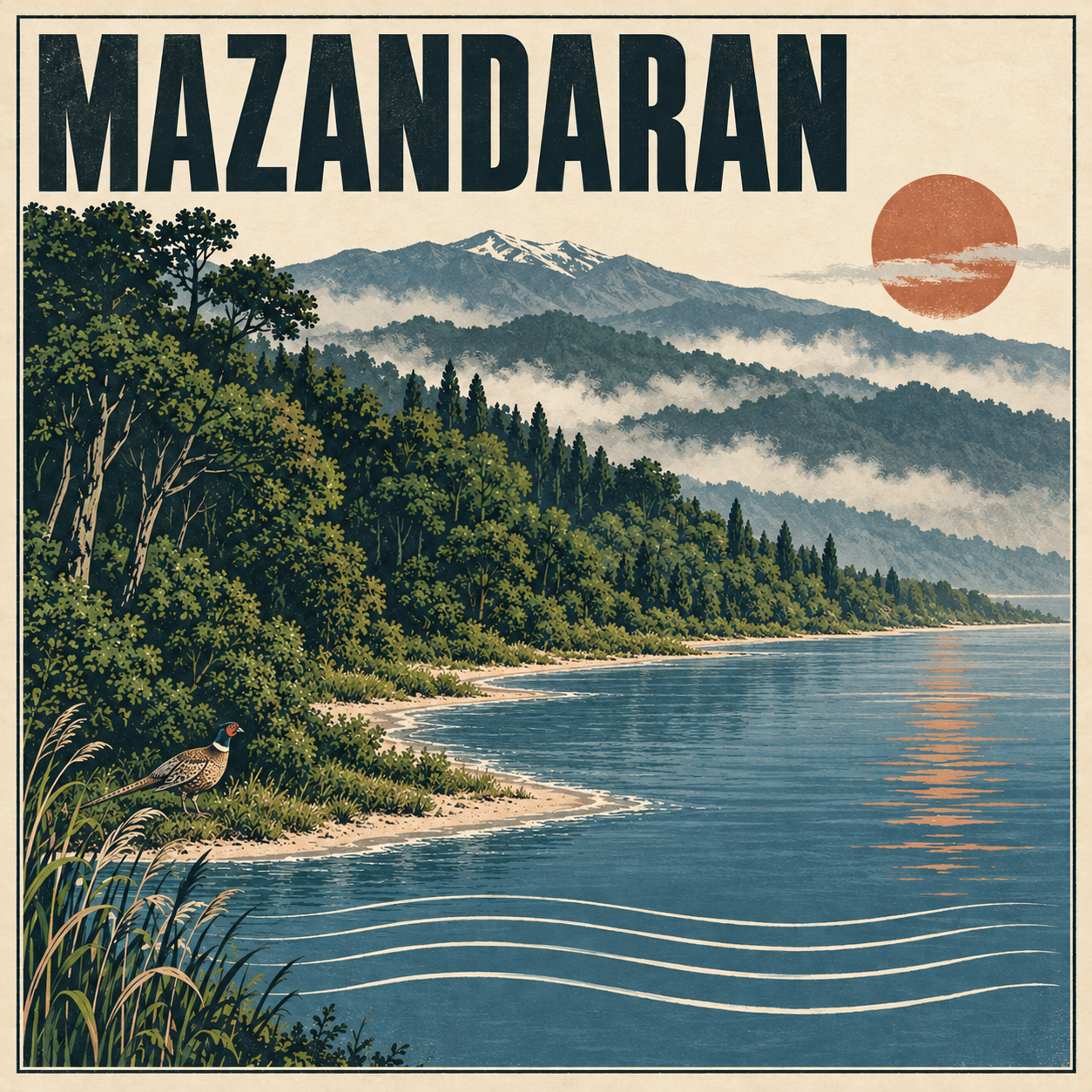
Wooded mountains meet the Caspian shore in this illustrated postcard. Four light lines across the water are an editorial nod to the four-line amiri verses sung in Mazandaran. A pheasant near the shore echoes a bird in a documented example of that poetry. The image is a symbolic regional composite, not an identified viewpoint, a field recording, or a literal scene from one song.
IRAN LISTENING ATLAS · CULTURAL ORIENTATION
Mazandarani or Tabari usage varies across the province. Western Kojur, central forms and eastern practices should not be collapsed into one sound. A practitioner’s origin alone does not prove a particular recording’s language.
Amiri and Taleba are related but different forms. The annotated central recording marks their transition at about 2:40. Old poetry also enters new work, as in Chelchela.
Research links Charbidari with pack-carrier routes and records a disagreement about the category. Mohsenpour’s words and music for Bozak Te Namir have separate authorship evidence. The selected paired track should not be presented as wholly anonymous field sound.
Women appear here as singers, researchers, collaborators and ensemble leaders. The laleva reed, western repertoire and Behshahr Nowruzkhani each have their own occasion or musical role.
ARTIST DIRECT · BEYOND SPOTIFY
The producer-published concert presents Moghimi leading regional folk and avaz. Her practice is a living companion, with no invented Spotify track match.
Her official channel presents a narrative reconstruction in parts and complete audio. These artist-direct recordings are distinct from an unresolved later digital catalog.
Saved route and desktop duration verified 25 October 2026. Notes are source-led; no full audio audition is claimed.
DEEPER CONTEXT · LIVING SCENES · RESEARCH LIMITS
Open a topic to explore more of this place and its music.
Ehsan Imani’s Chelchela sets older Mazandarani poetry in a new rock-folk composition. The exact-work TEDx account, official studio video and licensed single support this selection. The official video identifies collaborators, while the selected Spotify recording has its own catalog identity. A rock or independent label by itself would not establish the language or regional relationship.
Ajam’s Tayyebeh Jan connects a contemporary roots ensemble with named regional collaborators from the Mohammadi family. The artist’s own work account describes the lyrical narrative; album credits preserve the specific participants. The song belongs here because of that documented repertoire and collaboration, not because a broad roots label makes every Ajam song provincial.
Rastak’s Lare links a contemporary ensemble to Mazandaran through its official performance and a 2013 account of work with local masters. The streaming edition differs in length from the official video. Both can explain the project, but their masters and full instrumentation should not be treated as identical without evidence.
Atefeh Moghimi leads a producer-published regional folk and avaz concert. The concert is a direct way into living practice while its exact Spotify match remains unsettled. Sima Bina’s long work on Banu Jan, the Lalaei project’s named collaborators and Sara Alizadeh’s narrative reconstruction show women as researchers, leaders and interpreters as well as singers of care repertoire.
Saadi Sadeghi’s Silem and the wider Aysham and Nima projects document creative activity beyond this introductory route. Artist-channel access and exact release mapping remain incomplete for several works. Their presence is a research direction rather than permission to invent a Spotify recording or to apply a broad fusion label to every performance.
The western Amiri offers a comparison with the central Amiri–Taleba pairing. Koshti Maqum has a documented wrestling association, although a live label does not prove this recording was made at an event. Bala-ye Nepar is a complete short suite; the similarly named longer Dance Tunes version is a different selection. These paths remain optional, with full cuts intact.
Najma, Haqqani and Sanam can be compared as related narrative labels without assuming identical language, plot or words. The full Katuli and Karemashu cut can sit beside Rastak’s Lare. Nima Yushij’s Tabari poetry and Darvishi’s orchestral Mazandarani settings show literary and art-music transformations, while exact cut-level allocation remains unresolved for the Roja project.
Me Jaan has artist-supplied Mazani and Damavand-footill context, yet its exact arrangement has not been cleared against the no-pop brief. Moghimi’s official Shali Jan and Golnesa Jan uploads also need recording-specific style evidence. Sara Alizadeh’s later digital catalog has no secure crosswalk to her official performances. Those are research holds, not claims that the music is absent worldwide.
A hardcore band named Mazandaran and Shahnameh-inspired Demons of Mazandaran titles do not by themselves document musical practice in the present-day province. A musician’s location, a generic folk-jazz catalog tag or another singer’s participation cannot replace work-specific regional evidence. The route favors identified recordings and collaborators over superficial matching.
Mahoor’s MCD130 anthology anchors names and repertoire, while digital catalog credits and publisher notes serve different purposes. Fatemi’s monograph concentrates on central and eastern vocal music and does not cover the west fully. Catalog issue dates are not session dates. These limits keep the selection selective and leave room for future research without calling the province complete.
Read in playlist order. Position notes are current editorial readings of the saved order, not a claim about original intent or an audio audition. Sources support specific cultural context; open each track’s qualifications for limits.
Why this track belongs: Gol Bahram opens with an authored regional song rather than a long list of vocal categories. Mehrava’s account places it in the Hozhabrkhani project, with Khoshrou’s voice and Rajab Ramazani’s music. The compact song is a curatorial welcome, not a claim about popularity or a universal provincial anthem. Selected digital issue: 6 March 2018. The publisher’s later account dates the album’s first issue to 1383 SH. Album-wide ensemble and dotar credits do not identify every player on this particular cut; its exact sung text and session date remain unverified.
Listen for: Enter through a compact authored regional song.
Role: Compact authored entrance
First, its 3:25 scale offers a named song before the longer compound vocal forms; it provides an entry point without making the visitor learn a taxonomy first.
To the next track: Chelchela follows immediately with a new setting of regional poetry, making contemporary creation visible from the start.
Why this track belongs: Old Mazandarani poetry becomes a rock-folk composition. The exact-work TEDx account and Rock single classification support this choice more strongly than an independent label alone. New music in a regional language can remain rooted in its cultural setting. Selected digital issue: 14 December 2021. All three catalog artists are preserved. The official studio-version video credits Nooshin’s vocals and Sadowski’s drums, without establishing an audio-fingerprinted match to this master.
Listen for: Hear an independently documented rock setting of old Mazandarani poetry.
Role: Early new work from local poetry
Second, it prevents the opening from defining Mazandaran only through older recordings, while putting new composition beside the annotated vocal tradition that follows.
From the previous track: Gol Bahram establishes authored regional song; Chelchela changes the mode of contemporary engagement rather than merely adding a famous artist.
To the next track: The Amiri and Taleba pairing next gives a documented traditional-language anchor; no direct melodic derivation from that pairing is claimed.
Abolhasan Khoshru, Hoseyn Tayyebi, Jamal Abutalebi, Lotfollah Seyfi, Nasir Shirdel
Open exact recording on SpotifyWhy this track belongs: This complete issued pairing is the route’s strongest annotated vocal anchor. Encyclopaedia Iranica identifies central Mazandaran, the Mazandarani language and laleva, dotar and daf in the recording. Its annotation places the Taleba change at approximately 2:40. The pairing introduces a relationship between forms rather than two interchangeable tunes. Selected CD130 digital issue: 10 March 2003. The six-and-a-half-minute track is complete as issued, not the whole Taleb and Zohreh narrative. Credits and spellings follow the digital entry; no recording-session date is established.
Listen for: Follow the annotated Amiri to Taleba change at about 2:40.
Role: First substantial vocal anchor
Third, after two concise entrances, the 6:31 pairing asks for a fuller encounter before another current band treatment, alternating scale instead of front-loading a series of archival demonstrations.
From the previous track: Chelchela introduces poetry through rock; the pairing now introduces named vocal forms with recording-specific annotation, not a claim that Chelchela quotes them.
To the next track: Tayyebeh Jan keeps local words and collaboration in view through a contemporary roots band.
Why this track belongs: A contemporary roots band works with named regional musicians, placing spoken poetry beside Mazandarani sung material. Its detailed local collaboration is the reason to include this particular Ajam recording. The exact album credits preserve the Mohammadi family’s contribution rather than allowing the band name to absorb everyone involved. Spotify dates this selected edition 1 January 2016; Ajam’s official page states the original album release as 13 March 2016. These dates are reported separately rather than silently reconciled. The video narrative is useful context but does not by itself prove identical video and streaming masters.
Listen for: Notice the named regional collaborators behind this roots-band recording.
Role: Roots collaboration before care repertoire
Fourth, immediately after the long vocal anchor, it brings the present-day collaborative branch forward again before changing social function to lullaby repertoire.
From the previous track: The Amiri/Taleba pairing establishes documented regional forms; this shows a separate contemporary collaboration, without claiming it is an arrangement of that track.
To the next track: Navazesh Lalaei shifts the cultural focus from a band collaboration to arranged care repertoire.
Ahmad Mohsenpour, Hooran Yousefi, Ehsan Fathi, Jamshid Nikouzad
Open exact recording on SpotifyWhy this track belongs: This arranged care repertoire changes the scale after the band. The publisher identifies the Lalaei project’s vocal collaborators and Mohsenpour’s music, but not the allocation of every line in this selected six-minute sequence. It is not presented as an untouched domestic field recording. Selected digital issue: 8 March 2018. Hooran Yousefi, Ehsan Fathi and Jamshid Nikouzad remain in the catalog byline. Care is one part of the guide’s account of women, alongside adult love song, ensemble leadership, instrumental work and narrative reconstruction.
Listen for: Place this arranged lullaby project within a wider account of women’s music.
Role: Care as a distinct social function
Fifth, it changes the social subject after Ajam without adding another band track, then allows the laleva selection to shift attention from vocal text to an instrumental repertoire.
From the previous track: Tayyebeh Jan foregrounds named band and regional collaborators; this turns to an arranged lullaby project, not a domestic field-recording claim.
To the next track: Pieces from Laleva Repertoire I follows with a shorter named reed selection, changing the listening focus and duration.
Why this track belongs: One laleva medley gives the reed tradition room without filling the introduction with multiple instrumental examples. Mahoor identifies this as the first selection from the laleva repertoire; the selected digital catalog credits Hoseyn Tayyebi. The publisher’s instrument description offers context for its sustained reed practice. Selected CD130 digital issue: 10 March 2003. The individual airs within this cut have not been mapped. Neither its instrument nor its repertoire title proves a pastoral outdoor session; its recording location remains unknown.
Listen for: Give the laleva reed repertoire an unhurried stop.
Role: Instrumental focus between vocal projects
Sixth, the 3:09 selection sits between two longer vocal projects, giving an instrument its own focused stop without turning the middle of the route into a long instrumental survey.
From the previous track: Navazesh Lalaei has foregrounded arranged care and vocal collaborators; the reed repertoire now becomes the subject.
To the next track: Harayi and Its Chelles moves to an eastern repertoire and transmission network, rather than repeating another laleva example.
Why this track belongs: Harayi and its chelle or branches introduce an eastern practice through Nezam Shekarchiyan, whose regional label biography connects him with Godari singing and dotar around Neka and Chamaztepe. This substantial sequence earns its place through a different repertoire and transmission network, not because the anthology needs another category. Selected CD130 digital issue: 10 March 2003. A practitioner’s general account of Harayi does not supply a section-by-section map for this recording. The number of branches, exact narrative and sung language of this master remain unverified; they should not be inferred from broad eastern practice.
Listen for: Explore an eastern repertoire and its transmission network.
Role: Eastern repertoire given full space
Seventh, the full 6:06 sequence follows the shorter instrumental stop and precedes a shorter researched love-song project, preserving its scale without making several long forms consecutive.
From the previous track: The laleva selection has isolated an instrumental repertoire; Harayi returns attention to a distinct practitioner network and vocal practice.
To the next track: Banu Banu Jan changes to a woman-led regional love-song project, rather than extending a sequence of anthology categories.
Why this track belongs: Sima Bina leads a researched regional love-song project. In her 2008 interview she describes years of collaboration and archival work for Banu Jan’s Mazandarani repertoire. Her wider fame or birthplace is not the basis for inclusion. This is an adult female lead, not a care-song token. Selected digital issue: 3 February 2020, not a claim that the project or composition began in 2020. The interview establishes the earlier project and collaborators, not every detail of this later master. It complements, rather than replaces, the newer women-led companion performances.
Listen for: Hear an adult love song led by a woman, grounded in long research.
Role: Love song and woman-led research
Eighth, between Harayi and the long Charbidari pair, it changes social subject and scale while making women’s musical agency visible beyond the earlier care repertoire.
From the previous track: Harayi presents an eastern transmission network; this presents a distinct regional love-song project led by Bina, not a replacement for that practice.
To the next track: Charbidari Bozak Te Namir then changes from love-song research to occupational memory and documented authorship.
Why this track belongs: The longest stop joins occupational repertoire and authorship. Regional research associates Charbidari with pack-carrier routes while acknowledging a real disagreement over the category. Alami’s tables identify Bozak Te Namir as Mohsenpour’s words and composition. The full pair is retained instead of extracting a convenient short passage. Selected digital issue: 8 February 2018; the publisher dates Chelchelaye Safari to 1388 SH. The internal boundary, exact lyrics and performers of each supporting line are not established. It is neither wholly anonymous folklore nor a verified recording made during work.
Listen for: Hold occupational memory and documented authorship together.
Role: Long-form occupational and authored centerpiece
Ninth, it is the late extended encounter rather than the opening hurdle or a final endurance test; shorter selections on either side leave the complete 9:29 pair intact without cropping it for convenience.
From the previous track: Banu Banu Jan has supplied a shorter love-song project; this moves to work/travel associations and authorship rather than repeating its social subject.
To the next track: Valge Sari’s 2:40 western form supplies a clear change of scale and locality after the longest stop.
Why this track belongs: A compact western contrast follows the longer Charbidari pair. Valge Sari is identified in regional repertoire notes as a western form, providing a more distinct contribution than adding another Amiri comparison to the main route. It also prevents the eastern material from becoming the definition of the entire province. Selected CD130 digital issue: 10 March 2003. Preserve the continuous catalog artist string Keyqobad Mirdar Mansur Panahi rather than inventing a split into separate performers. The exact village and sung language have not been verified.
Listen for: Shift to a short western form after the longer paired recording.
Role: Short western contrast
Tenth, its 2:40 duration deliberately changes scale after the 9:29 pair, while the western connection broadens locality just before the route returns to contemporary ensemble reconstruction.
From the previous track: Charbidari Bozak Te Namir supplies the longest encounter; Valge Sari is a shorter, regionally distinct selection, not an asserted tempo increase.
To the next track: Lare returns to an ensemble’s researched treatment of local material rather than another western anthology example.
Why this track belongs: Lare returns the route to researched contemporary ensemble performance. Rastak’s official video explicitly connects the work to Mazandaran; the 2013 regional account identifies the Lare and Karmashu material and encounters with local masters. It is a non-pop folk reconstruction selected on that evidence, not simply a familiar band name. Selected digital issue: 15 August 2021. The project was documented in 2013, and the official video was uploaded in 2019. The video’s 6:58 is not interchangeable with this 6:47 recording. The selected master has no verified cut-level instrumentation list.
Listen for: Return to a researched contemporary folk ensemble.
Role: Contemporary return before seasonal close
Eleventh, it brings the living ensemble branch back after the extended regional passages, but leaves the final statement to a specific seasonal practice rather than ending with a generic stage finale.
From the previous track: Valge Sari has widened the western map; Lare changes presentation to a contemporary folk ensemble without claiming to arrange Valge Sari.
To the next track: Behshahr Nowruzkhani narrows the closing focus from ensemble reconstruction to a named seasonal practice and credited practitioners.
Why this track belongs: The close turns from the ensemble stage to a named seasonal practice. A contemporary collection report identifies Behshahr Nowruzkhani by Elyasi and Jafari separately from other spring songs. That specificity matters more than a broad Nowruz label. Selected digital issue: 13 March 2019. The contemporary collection report predates it, but does not prove a recording day or exact master equivalence. The recording’s precise text and language have not been independently established. Seasonal significance is not evidence for an ancient, unchanged origin.
Listen for: End with a specific Behshahr spring visiting practice.
Role: Seasonal practice as an open ending
Twelfth, the 2:25 selection closes after the longer ensemble treatment with a specific seasonal social practice, returning the visitor to music’s use in life instead of implying the modern stage is the culmination of the province’s history.
From the previous track: Lare has presented researched ensemble reconstruction; this changes to named seasonal repertoire and practitioners, without asserting a verified field-session setting.
These earlier reading lists offer broader context. The per-track source notes identify what each reference supports and where verification remains open.