
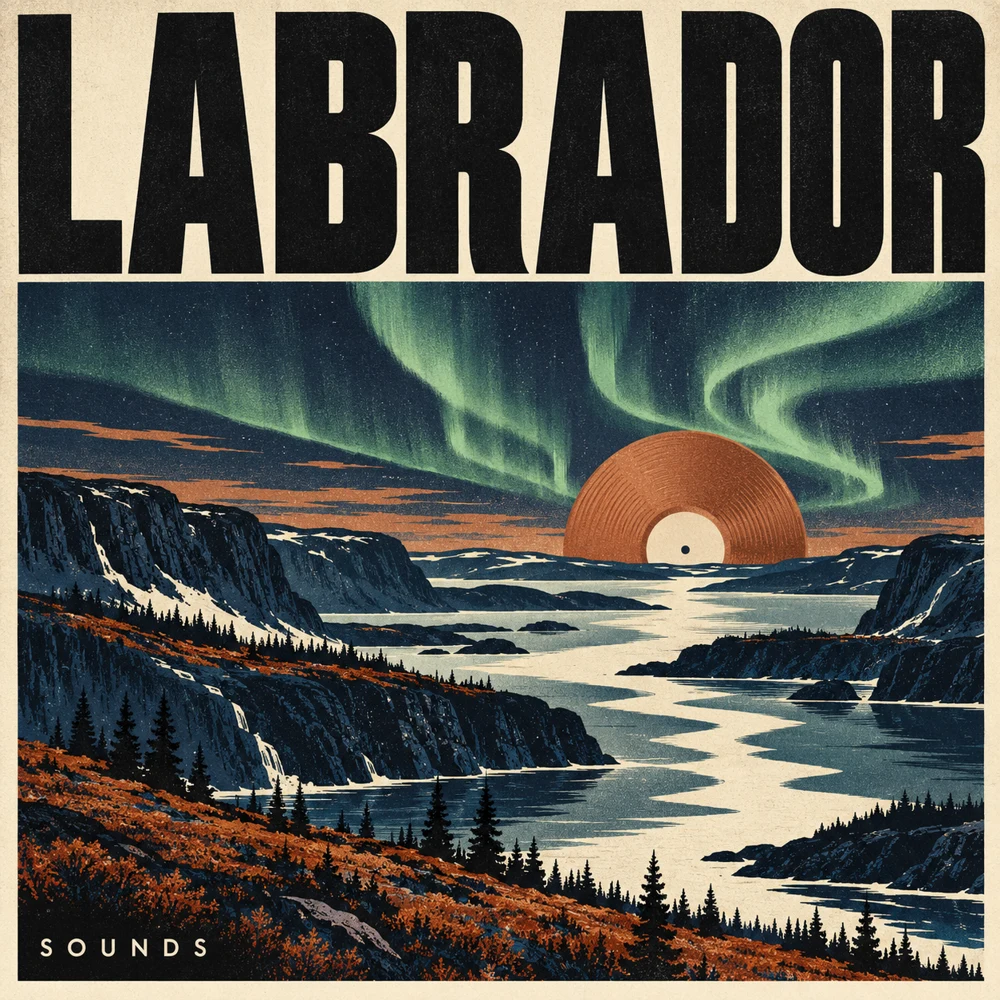
LAND · LANGUAGE · BELONGING · 26 SONGS
Labrador
A route through Labrador-connected songs, Lake Melville, community repertoire, western Labrador bands, Innu creative practice and Nunatsiavut vocal traditions. These are distinct histories and communities, not interchangeable regional labels.
The preserved selection includes cross-border and diaspora ties when documented. The position notes explain the current editorial route while leaving exact session, personnel and unheard sonic details open where evidence is limited.
Listen on SpotifyThe stories in the grooves.
Read in playlist order. Position notes are current editorial readings of the saved order, not a claim about original intent or an audio audition. Sources support specific cultural context; open each track’s qualifications for limits.
Place and the people who sing it
Begins with Woman of Labrador (A person before the landscape) and reaches Northern Lights of Labrador (Introducing a sustained ensemble portrait). Open the track notes for the documented connections and the editorial reasons for this order.
Why this track belongs: Andy Vine’s Woman of Labrador concerns writer Elizabeth Goudie, according to Silver Wolf Band’s own interview. Their contemporary rendition connects a named person’s story with the band’s active Labrador repertoire work.
Sources and limits
- Newfoundland Quarterly: Silver Wolf Band Q&A
Public source text inspected on 2026-10-26. First-person account of Labrador-based creative practice, Woman of Labrador/Elizabeth Goudie and Butter and Snow’s old homestead subject. Not session authentication.
Scope: exact-work
- Silver Wolf Band official biography
Public source text inspected on 2026-10-26. Active Labrador writing, performing and repertoire reinterpretation, including named Woman of Labrador and Old Mokami. General sound descriptions are not transferred to individual recordings.
Scope: artist-project
- Spotify exact-ID public catalog metadata
HTTP200 public title/description read on 2026-10-26. Silver Wolf Band · Storms & Prayers · Song · 2020. Edition association only; no playback or session inference.
Scope: exact-work
Qualifications:
- The interview discusses the planned rendition; current exact-ID metadata associates it with Storms & Prayers. No claim that the selected session features Goudie or any archival voice.
Why this position in the playlist
Role: A person before the landscape
Proposed editorial rationale: At 1, begin with Goudie rather than an unpeopled scenic image. Keep Silver Wolf Band at 2 so the focus can move from a person to Lake Melville without simultaneously changing project.
To the next track: Keep the same band while moving from Elizabeth Goudie’s story to the creator-stated Lake Melville subject: a change of focus, not an inferred sonic blend.
- Newfoundland Quarterly: Silver Wolf Band Q&A
Why this track belongs: Jamie Jackman explicitly describes Estuary as paying respect to Lake Melville and the communities shaped by it. This is a creator-stated geographical connection, not simply an inferred meaning of the title.
Sources and limits
- The East: Estuary, Jamie Jackman interview
Public source text inspected on 2026-10-26. Creator explicitly connects this song to Lake Melville and local home/community. Video footage is not evidence of this audio’s recording location.
Scope: exact-work
- Spotify exact-ID public catalog metadata
HTTP200 public title/description read on 2026-10-26. Silver Wolf Band · Storms & Prayers · Song · 2020. Edition association only; no playback or session inference.
Scope: exact-work
- Retained prior guide context
Retained for provenance only; not newly relied on for the revised claims. Different recording links and source bundles are not exact-master proof.
Scope: unclassified
Qualifications:
- Creator testimony supports subject, not the audio’s recording location. Video landscapes do not authenticate the selected master.
Why this position in the playlist
Role: A precise waterway after the human introduction
Proposed editorial rationale: At 2, give the opening’s idea of home a named waterway before Harry Martin’s broader Labrador title at 3. The two consecutive band tracks compare different documented subjects rather than treating one regional song as sufficient.
From the previous track: Keep the same band while moving from Elizabeth Goudie’s story to the creator-stated Lake Melville subject: a change of focus, not an inferred sonic blend.
To the next track: Widen the opening from a named waterway to Harry Martin’s region-named work, introducing a different local songwriter.
- The East: Estuary, Jamie Jackman interview
Why this track belongs: Harry Martin’s documented Labrador songwriting practice meets a work-specific catalog record here: Memorial University credits him as writer and performer of A Land Called Labrador. The selection comes from regional music-making, not birthplace alone.
Sources and limits
- Newfoundland and Labrador Heritage: Harry Martin
Public source text inspected on 2026-10-26. Documents Martin’s regional songwriting, work and performance practice beyond birthplace. Does not itself name A Land Called Labrador.
Scope: artist-project
- Memorial University discography: Homebrew 7
Public source text inspected on 2026-10-26. Lists A land called Labrador with Harry Martin as writer and performer. Physical compilation record, not an audio fingerprint.
Scope: exact-work
- Spotify exact-ID public catalog metadata
HTTP200 public title/description read on 2026-10-26. Harry Martin · Homebrew 7 · Song · 2006. Edition association only; no playback or session inference.
Scope: exact-work
Qualifications:
- No detailed itinerary or hunting/trapping narrative is transferred from Martin’s other songs to this one. Homebrew is a compilation association, not recording-date proof.
Why this position in the playlist
Role: Widening the named place to the region
Proposed editorial rationale: At 3, expand from Lake Melville to the regional address in the title, then introduce the Flummies at 4. The shift establishes more than one local interpreter before the extended ensemble chapter begins.
From the previous track: Widen the opening from a named waterway to Harry Martin’s region-named work, introducing a different local songwriter.
To the next track: After Martin’s individual songwriting, introduce the Flummies through a Labrador-named entry before the sustained ensemble portrait.
- Newfoundland and Labrador Heritage: Harry Martin
Northern Lights of Labrador
The Flummies
Recording: Brothers on the River
Open exact recording on SpotifyWhy this track belongs: Northern Lights of Labrador is listed in the Flummies’ own Brothers on the River repertoire. Their long-running Happy Valley–Goose Bay music-making gives this place-named selection an active community-practice connection.
Sources and limits
- The Flummies official repertoire page
Public source text inspected on 2026-10-26. Lists named Brothers on the River tracks; describes the band’s Labrador repertoire and jig/reel practice. No lyric narrative or exact performance is inferred.
Scope: repertoire
- East Coast Music Association: The Flummies honour
Public source text inspected on 2026-10-26. Documents Happy Valley–Goose Bay-based group’s long-running Labrador repertoire practice. The group is not made representative of every Labrador community.
Scope: artist-project
- Spotify exact-ID public catalog metadata
HTTP200 public title/description read on 2026-10-26. The Flummies · Brothers on the River · Song · 2022. Edition association only; no playback or session inference.
Scope: exact-work
- Retained prior guide context
Retained for provenance only; not newly relied on for the revised claims. Different recording links and source bundles are not exact-master proof.
Scope: unclassified
Qualifications:
- The title does not prove a specific aurora event, lyric history or location of the recording. The long same-ensemble block is a curatorial trade-off, not evidence of optimal energy.
Why this position in the playlist
Role: Introducing a sustained ensemble portrait
Proposed editorial rationale: At 4, move from Martin to a local group through another explicitly Labrador-named work. This starts six consecutive Flummies selections; the proposed purpose is a repertoire portrait, not a claim that the group represents the whole region.
From the previous track: After Martin’s individual songwriting, introduce the Flummies through a Labrador-named entry before the sustained ensemble portrait.
To the next track: Keep the new ensemble but move from the region-named Northern Lights work to its album’s title track, comparing repertoire rather than predicting sound.
- The Flummies official repertoire page
The community gathers
Begins with Brothers on the River (Title-work view of the same project) and reaches Slap Our Boat in the Water (Ending the extended ensemble group). Open the track notes for the documented connections and the editorial reasons for this order.
Why this track belongs: The Flummies’ official list identifies Brothers on the River as the album’s title work. Including it makes room for their broader recorded project, rather than reducing the group to one place-named favorite.
Sources and limits
- The Flummies official repertoire page
Public source text inspected on 2026-10-26. Lists named Brothers on the River tracks; describes the band’s Labrador repertoire and jig/reel practice. No lyric narrative or exact performance is inferred.
Scope: repertoire
- East Coast Music Association: The Flummies honour
Public source text inspected on 2026-10-26. Documents Happy Valley–Goose Bay-based group’s long-running Labrador repertoire practice. The group is not made representative of every Labrador community.
Scope: artist-project
- Spotify exact-ID public catalog metadata
HTTP200 public title/description read on 2026-10-26. The Flummies · Brothers on the River · Song · 2022. Edition association only; no playback or session inference.
Scope: exact-work
Qualifications:
- The title alone does not establish which river, people or event the song depicts. No detailed storytelling or vocal arrangement is asserted.
Why this position in the playlist
Role: Title-work view of the same project
Proposed editorial rationale: At 5, keep the ensemble after Northern Lights but move to its album’s title work. Kenemish at 6 then supplies a different named catalog entry before the reel changes the repertoire type; no unverified story of particular brothers is needed.
From the previous track: Keep the new ensemble but move from the region-named Northern Lights work to its album’s title track, comparing repertoire rather than predicting sound.
To the next track: Follow the title work with another named entry, while leaving Kenemish’s detailed narrative explicitly unresolved rather than inventing it.
- The Flummies official repertoire page
Why this track belongs: The Kenemish Song is a named entry in the Flummies’ official Labrador repertoire list. It is retained as another part of that living project; the available work evidence does not establish a detailed lyric history.
Sources and limits
- The Flummies official repertoire page
Public source text inspected on 2026-10-26. Lists named Brothers on the River tracks; describes the band’s Labrador repertoire and jig/reel practice. No lyric narrative or exact performance is inferred.
Scope: repertoire
- Spotify exact-ID public catalog metadata
HTTP200 public title/description read on 2026-10-26. The Flummies · Brothers on the River · Song · 2022. Edition association only; no playback or session inference.
Scope: exact-work
- Retained prior guide context
Retained for provenance only; not newly relied on for the revised claims. Different recording links and source bundles are not exact-master proof.
Scope: unclassified
Qualifications:
- No full lyric translation, historical Kenemish event or particular community narrative is established. Do not fill the gap from the title alone.
Why this position in the playlist
Role: A named repertoire stop with an explicit evidence limit
Proposed editorial rationale: At 6, place another song entry between the album title work and Richies Reel. The slot’s role is to deepen the one-ensemble portrait before changing repertoire form, while openly leaving its specific narrative unresolved.
From the previous track: Follow the title work with another named entry, while leaving Kenemish’s detailed narrative explicitly unresolved rather than inventing it.
To the next track: Move from a song entry to a named reel within documented jig/reel practice; the 1:46 duration is evidence, not a faster-tempo claim.
- The Flummies official repertoire page
Why this track belongs: Richies Reel brings a named reel into the Flummies group of selections. The ensemble documents jigs and reels as part of its Labrador practice, so dance repertoire is included alongside songs without inventing a particular dance event.
Sources and limits
- The Flummies official repertoire page
Public source text inspected on 2026-10-26. Lists named Brothers on the River tracks; describes the band’s Labrador repertoire and jig/reel practice. No lyric narrative or exact performance is inferred.
Scope: repertoire
- Spotify exact-ID public catalog metadata
HTTP200 public title/description read on 2026-10-26. The Flummies · Brothers on the River · Song · 2022. Edition association only; no playback or session inference.
Scope: exact-work
- Retained prior guide context
Retained for provenance only; not newly relied on for the revised claims. Different recording links and source bundles are not exact-master proof.
Scope: unclassified
Qualifications:
- The jig/reel practice is documented, but exact instrumentation, recurring phrases and a real dance setting for this master were not auditioned.
Why this position in the playlist
Role: A concise dance-repertoire entry
Proposed editorial rationale: At 7, use the 1:46 catalog-length reel between two song entries. That is a documented form/duration distinction inside a long artist block; it does not establish a faster tempo or an energy lift.
From the previous track: Move from a song entry to a named reel within documented jig/reel practice; the 1:46 duration is evidence, not a faster-tempo claim.
To the next track: Follow the concise reel with Ray Campbell’s authored song as documented across releases, returning from repertoire form to circulation history.
- The Flummies official repertoire page
Why this track belongs: The Flummies’ discography credits Ray Campbell’s Comb Your Hair Flat Down, and a Memorial University anniversary-album record documents its later circulation. The selected Homebrew 14 item draws on this sustained repertoire, not an assumed anonymous folk song.
Sources and limits
- The Flummies official discography
Public source text inspected on 2026-10-26. Lists Comb Your Hair Flat Down, credits Ray Campbell and places it on Labradorimiut; a different release from the selected Homebrew compilation.
Scope: exact-work
- Memorial University: Flummies anniversary album
Public indexed extract inspected on 2026-10-26. Lists Comb Your Hair Flat Down and Ray Campbell credit on another documented issue; confirms repertoire circulation, not identical master.
Scope: exact-work
- Spotify exact-ID public catalog metadata
HTTP200 public title/description read on 2026-10-26. The Flummies · Homebrew 14 · Song · 2013. Edition association only; no playback or session inference.
Scope: exact-work
- Retained prior guide context
Retained for provenance only; not newly relied on for the revised claims. Different recording links and source bundles are not exact-master proof.
Scope: unclassified
- Retained prior guide context
Retained for provenance only; not newly relied on for the revised claims. Different recording links and source bundles are not exact-master proof.
Scope: unclassified
Qualifications:
- The earlier albums document the work, not equivalence with this Homebrew master. Repeated release does not prove a particular communal singalong or audience response.
Why this position in the playlist
Role: A work carried across releases
Proposed editorial rationale: At 8, follow the reel with an authored song that has a documented life on more than one release. Slap Our Boat at 9 then closes this ensemble group, making the block about repertoire circulation as well as one album.
From the previous track: Follow the concise reel with Ray Campbell’s authored song as documented across releases, returning from repertoire form to circulation history.
To the next track: Keep one final Flummies entry; Slap Our Boat’s title may suggest departure editorially without claiming a documented voyage.
- The Flummies official discography
Slap Our Boat in the Water
The Flummies
Recording: Brothers on the River
Open exact recording on SpotifyWhy this track belongs: Slap Our Boat in the Water is listed as the opening work on the Flummies’ Brothers on the River project. Here it is another documented piece of their local repertoire; the boat in the title is not treated as evidence of a specific voyage.
Sources and limits
- The Flummies official repertoire page
Public source text inspected on 2026-10-26. Lists named Brothers on the River tracks; describes the band’s Labrador repertoire and jig/reel practice. No lyric narrative or exact performance is inferred.
Scope: repertoire
- Spotify exact-ID public catalog metadata
HTTP200 public title/description read on 2026-10-26. The Flummies · Brothers on the River · Song · 2022. Edition association only; no playback or session inference.
Scope: exact-work
- Retained prior guide context
Retained for provenance only; not newly relied on for the revised claims. Different recording links and source bundles are not exact-master proof.
Scope: unclassified
Qualifications:
- Title-based departure is an editorial motif, not a sourced lyric interpretation. This playlist does not reproduce the album order or establish a real boat journey.
Why this position in the playlist
Role: Ending the extended ensemble group
Proposed editorial rationale: At 9, repurpose the album opener as the end of this six-track portrait. Its title can suggest departure editorially, and its 2:20 catalog length precedes the 5:12 Banks of North River; the next change is to a Labrador City project, not a claimed acoustic reset.
From the previous track: Keep one final Flummies entry; Slap Our Boat’s title may suggest departure editorially without claiming a documented voyage.
To the next track: End the six-track ensemble portrait and enter Labrador Black Spruce’s Labrador City network; compare catalog durations, not presumed energy.
- The Flummies official repertoire page
Westward, into living music
Begins with Banks of North River (Beginning the western Labrador chapter) and reaches Coffee Pots (Return to the opening band through a different project). Open the track notes for the documented connections and the editorial reasons for this order.
Banks of North River
Labrador Black Spruce
Recording: The Best of Labrador Black Spruce
Open exact recording on SpotifyWhy this track belongs: Memorial University’s discography places Labrador Black Spruce’s project in Labrador City and credits Banks of North River to E. Davis and W. Arsenault. This brings a western Labrador recording network into the route with specific work evidence.
Sources and limits
- Memorial University: Ashuanipi Wish
Public source text inspected on 2026-10-26. Labrador City release/project and named works with writer credits: Banks of North River, Ashuanipi Wish and Ode to Labrador. Physical-disc personnel and dates not silently applied to all current masters.
Scope: exact-work
- Spotify exact-ID public catalog metadata
HTTP200 public title/description read on 2026-10-26. Labrador Black Spruce · The Best of Labrador Black Spruce · Song · 1998. Edition association only; no playback or session inference.
Scope: exact-work
Qualifications:
- The source describes Ashuanipi Wish’s physical issue; current ID is catalog-associated with The Best of Labrador Black Spruce. Work authorship is supported, identical master is not assumed. No exact North River location inferred.
Why this position in the playlist
Role: Beginning the western Labrador chapter
Proposed editorial rationale: At 10, change ensemble after the extended Flummies portrait and allow a longer 5:12 catalog-duration entry. Ashuanipi Wish stays beside it so the band is presented through two credited works, before Harvey expands the chapter through a different practice.
From the previous track: End the six-track ensemble portrait and enter Labrador Black Spruce’s Labrador City network; compare catalog durations, not presumed energy.
To the next track: Keep Labrador Black Spruce for its differently credited title work, so western Labrador has a two-work introduction rather than a single example.
- Memorial University: Ashuanipi Wish
Why this track belongs: The university discography identifies Ashuanipi Wish as Ric Burt and Nick Kennedy’s title work in Labrador Black Spruce’s Labrador City project. It gives their own songwriting a place beside the preceding Davis–Arsenault work.
Sources and limits
- Memorial University: Ashuanipi Wish
Public source text inspected on 2026-10-26. Labrador City release/project and named works with writer credits: Banks of North River, Ashuanipi Wish and Ode to Labrador. Physical-disc personnel and dates not silently applied to all current masters.
Scope: exact-work
- Spotify exact-ID public catalog metadata
HTTP200 public title/description read on 2026-10-26. Labrador Black Spruce · Ashuanipi Wish · Song · 1995. Edition association only; no playback or session inference.
Scope: exact-work
Qualifications:
- The title does not by itself establish a detailed geographical narrative. Physical-disc date/personnel are not independently verified for every current catalog transfer.
Why this position in the playlist
Role: A second authorship within the same project
Proposed editorial rationale: At 11, keep the band to compare a differently credited work rather than making western Labrador a single-track detour. Derina Harvey at 12 then shifts from this group’s recorded history to a Wabush-connected artist working elsewhere.
From the previous track: Keep Labrador Black Spruce for its differently credited title work, so western Labrador has a two-work introduction rather than a single example.
To the next track: From the band’s Labrador City discography, widen to Harvey’s Wabush musical upbringing and Alberta-based band practice.
- Memorial University: Ashuanipi Wish
Why this track belongs: Derina Harvey’s interview notes describe a musical upbringing in Wabush and band formation in Alberta. The artist-published Fallen Man’s Daughter text connects its narrator to mining and fishing family life, giving the diaspora connection a concrete subject rather than only an origin label.
Sources and limits
- Musical Connections: Derina Harvey episode notes
Public source text inspected on 2026-10-26. Producer’s written interview summary identifies musical upbringing in Wabush and band formation after moving to Alberta. No podcast audio played.
Scope: artist-project
- Derina Harvey Band: Waves of Home
Public source text inspected on 2026-10-26. Artist-published named song text links the narrator to fishing, mining family life and loss. Narrator is not automatically autobiographical; no lyrics quoted.
Scope: exact-work
- Newfoundland and Labrador House of Assembly, 26 October 2023
Public source text inspected on 2026-10-26. Member’s statement identifies Labrador City/Wabush band, local performances, Nightmare Song video nomination and locally filmed videos; not selected audio recording venue.
Scope: community-scene
- Spotify exact-ID public catalog metadata
HTTP200 public title/description read on 2026-10-26. Derina Harvey Band · Waves of Home · Song · 2023. Edition association only; no playback or session inference.
Scope: exact-work
Qualifications:
- Narrator is not asserted to be Harvey or a literal family biography. Podcast notes were read, not audio; the selected recording is not claimed to document the Wabush event.
Why this position in the playlist
Role: Western Labrador connection carried outward
Proposed editorial rationale: At 12, widen the Labrador City chapter to Harvey’s Wabush-to-Alberta practice, then return at 13 to a trio actively working in Labrador West. The adjacency also has a real local-performance link: the Assembly record places Ptarmageddon alongside the Derina Harvey Band in Wabush.
From the previous track: From the band’s Labrador City discography, widen to Harvey’s Wabush musical upbringing and Alberta-based band practice.
To the next track: Place Harvey before Ptarmageddon through their documented Wabush performance-network connection, while keeping that event distinct from either selected master.
- Musical Connections: Derina Harvey episode notes
Why this track belongs: Nightmare Song belongs through Ptarmageddon’s Labrador City/Wabush creative practice, documented in the House of Assembly and the band’s Dream Logic release. The Assembly account names the video and local filming/performance activity, making the connection more specific than a genre tag.
Sources and limits
- Newfoundland and Labrador House of Assembly, 26 October 2023
Public source text inspected on 2026-10-26. Member’s statement identifies Labrador City/Wabush band, local performances, Nightmare Song video nomination and locally filmed videos; not selected audio recording venue.
Scope: community-scene
- Ptarmageddon: Dream Logic
Public source text inspected on 2026-10-26. Artist album text lists Nightmare Song and credits Edwards, Neary and Soper; named creative project, no sonic analysis.
Scope: exact-work
- Spotify exact-ID public catalog metadata
HTTP200 public title/description read on 2026-10-26. Ptarmageddon · Dream Logic · Song · 2022. Edition association only; no playback or session inference.
Scope: exact-work
- Retained prior guide context
Retained for provenance only; not newly relied on for the revised claims. Different recording links and source bundles are not exact-master proof.
Scope: unclassified
Qualifications:
- The statement’s local video locations are not the audio’s recording venues. Alternative-rock description is attributed to the Assembly account, not a personal listening judgment.
Why this position in the playlist
Role: Contemporary Labrador West practice beyond heritage categories
Proposed editorial rationale: At 13, complete the western chapter with another active local project, following the actual Harvey performance-network connection. Silver Wolf Band returns at 14 for a new album pair, so the route broadens contemporary work before revisiting its first group.
From the previous track: Place Harvey before Ptarmageddon through their documented Wabush performance-network connection, while keeping that event distinct from either selected master.
To the next track: Leave the western Labrador chapter and return to Silver Wolf Band through a different cataloged project, not a supposed matching genre or tempo.
- Newfoundland and Labrador House of Assembly, 26 October 2023
Why this track belongs: Coffee Pots is a catalog-confirmed part of Silver Wolf Band’s Make Your Heart Home project. The band’s own biography and interview describe sustained Labrador community-based writing and performance; the selection extends that ongoing practice beyond their repertoire covers.
Sources and limits
- Silver Wolf Band official biography
Public source text inspected on 2026-10-26. Active Labrador writing, performing and repertoire reinterpretation, including named Woman of Labrador and Old Mokami. General sound descriptions are not transferred to individual recordings.
Scope: artist-project
- Newfoundland Quarterly: Silver Wolf Band Q&A
Public source text inspected on 2026-10-26. First-person account of Labrador-based creative practice, Woman of Labrador/Elizabeth Goudie and Butter and Snow’s old homestead subject. Not session authentication.
Scope: exact-work
- Spotify exact-ID public catalog metadata
HTTP200 public title/description read on 2026-10-26. Silver Wolf Band · Make Your Heart Home · Song · 2025. Edition association only; no playback or session inference.
Scope: exact-work
- Retained prior guide context
Retained for provenance only; not newly relied on for the revised claims. Different recording links and source bundles are not exact-master proof.
Scope: unclassified
Qualifications:
- Detailed lyric/psychological interpretation in the older note is withheld: the attached lyric aggregator is not treated as creator testimony. The title alone does not establish literal Labrador daily routines.
Why this position in the playlist
Role: Return to the opening band through a different project
Proposed editorial rationale: At 14, reintroduce Silver Wolf Band after the western Labrador chapter, now with a Make Your Heart Home track. Willows and Sand follows from the same project, allowing the next slot’s documented family narrative to add specificity rather than assigning an unverified story to Coffee Pots.
From the previous track: Leave the western Labrador chapter and return to Silver Wolf Band through a different cataloged project, not a supposed matching genre or tempo.
To the next track: Follow the project-level Coffee Pots introduction with the separately documented Willows and Sand family narrative; do not backfill unsupported lyrics for the former.
- Silver Wolf Band official biography
What stays when people leave
Begins with Willows and Sand (A documented family narrative within the returning project) and reaches Old Mokami (Closing the band’s return with shared repertoire). Open the track notes for the documented connections and the editorial reasons for this order.
Why this track belongs: The release account for Willows and Sand describes a family trying to live after tragedy while the natural world continues. Combined with Silver Wolf Band’s documented Labrador practice, it adds present-day human experience rather than presenting the region only through heritage scenery.
Sources and limits
- Canadian Beats: Willows and Sand release account
Public indexed extract inspected on 2026-10-26. Indexed promotional account describes family coping with tragedy and continuing natural world. Theme attributed to release account, not asserted as a real family’s biography.
Scope: exact-work
- Silver Wolf Band official biography
Public source text inspected on 2026-10-26. Active Labrador writing, performing and repertoire reinterpretation, including named Woman of Labrador and Old Mokami. General sound descriptions are not transferred to individual recordings.
Scope: artist-project
- Spotify exact-ID public catalog metadata
HTTP200 public title/description read on 2026-10-26. Silver Wolf Band · Make Your Heart Home · Song · 2025. Edition association only; no playback or session inference.
Scope: exact-work
- Retained prior guide context
Retained for provenance only; not newly relied on for the revised claims. Different recording links and source bundles are not exact-master proof.
Scope: unclassified
Qualifications:
- The promotional account is indexed-only in this review. It describes the song’s narrative, not an identified real family or a verified autobiographical event; no resilience effect on listeners is predicted.
Why this position in the playlist
Role: A documented family narrative within the returning project
Proposed editorial rationale: At 15, follow the project-level Coffee Pots introduction with a specifically documented theme. Butter and Snow at 16 then moves from a family narrative to the band’s stated old-homestead subject, giving the four-track return distinct perspectives on home.
From the previous track: Follow the project-level Coffee Pots introduction with the separately documented Willows and Sand family narrative; do not backfill unsupported lyrics for the former.
To the next track: Move from the release-described family narrative to the band’s stated old-homestead subject, making two different accounts of home explicit.
- Canadian Beats: Willows and Sand release account
Why this track belongs: The band’s first-person interview identifies Butter and Snow as concerning an old homestead that families still regard as home after residents have left. That is a precise Labrador memory practice, not a mood inferred from the song title.
Sources and limits
- Newfoundland Quarterly: Silver Wolf Band Q&A
Public source text inspected on 2026-10-26. First-person account of Labrador-based creative practice, Woman of Labrador/Elizabeth Goudie and Butter and Snow’s old homestead subject. Not session authentication.
Scope: exact-work
- Spotify exact-ID public catalog metadata
HTTP200 public title/description read on 2026-10-26. Silver Wolf Band · Pockets Filled with Rocks · Song · 2018. Edition association only; no playback or session inference.
Scope: exact-work
Qualifications:
- The account does not identify every family or exact homestead location. A descriptive creator statement is not an audition of the selected arrangement.
Why this position in the playlist
Role: Home remembered beyond daily occupancy
Proposed editorial rationale: At 16, put the stated homestead theme after Willows and Sand’s family narrative. Old Mokami at 17 then expands the frame to a shared repertoire’s mountain connection, while keeping the same contemporary interpreters in view.
From the previous track: Move from the release-described family narrative to the band’s stated old-homestead subject, making two different accounts of home explicit.
To the next track: Extend home-as-homestead into Old Mokami’s documented mountain-linked repertoire, keeping the contemporary interpreter constant.
- Newfoundland Quarterly: Silver Wolf Band Q&A
Why this track belongs: Old Mokami links Silver Wolf Band’s stated repertoire practice with a Labrador standard associated with the mountain near North West River. Memorial University distinguishes Byron Chaulk’s lyrics from Gerald Mitchell’s music on an earlier recording, clarifying work history without replacing the contemporary selection.
Sources and limits
- Silver Wolf Band official biography
Public source text inspected on 2026-10-26. Active Labrador writing, performing and repertoire reinterpretation, including named Woman of Labrador and Old Mokami. General sound descriptions are not transferred to individual recordings.
Scope: artist-project
- Newfoundland and Labrador Heritage: Byron Chaulk
Public source text inspected on 2026-10-26. Connects Old Mokami to a mountain near North West River and Labrador repertoire. No quotation of lyrics or selected-master claim.
Scope: exact-work
- Memorial University: Our Labrador
Public source text inspected on 2026-10-26. Lists Old Mokami with Byron Chaulk lyrics and Gerald Mitchell music; this is a different performance/album, supporting work authorship only.
Scope: exact-work
- Spotify exact-ID public catalog metadata
HTTP200 public title/description read on 2026-10-26. Silver Wolf Band · There's No Time · Song · 2022. Edition association only; no playback or session inference.
Scope: exact-work
- Retained prior guide context
Retained for provenance only; not newly relied on for the revised claims. Different recording links and source bundles are not exact-master proof.
Scope: unclassified
Qualifications:
- The older Gerald Mitchell issue is work-history evidence, not this master. No claim that the mountain’s significance is identical across every Labrador community.
Why this position in the playlist
Role: Closing the band’s return with shared repertoire
Proposed editorial rationale: At 17, end the four-track Silver Wolf return by moving from its homestead song to inherited regional repertoire. Nitassinan follows with a different, explicitly Innu cultural geography; the comparison expands how land is named without equating the traditions.
From the previous track: Extend home-as-homestead into Old Mokami’s documented mountain-linked repertoire, keeping the contemporary interpreter constant.
To the next track: End the band’s reprise and introduce Nitassinan’s distinct Innu cultural geography; adjacent land themes do not imply the same cultural tradition.
- Silver Wolf Band official biography
Language, identity and remembrance
Begins with Nitassinan (A cross-border Innu perspective on land) and reaches Nutarasuk (A particular history of adaptation and transmission). Open the track notes for the documented connections and the editorial reasons for this order.
Why this track belongs: Nitassinan’s Innu-aimun title refers to an Innu homeland extending across present-day Labrador and Québec, as explained by Institut Tshakapesh. Vollant’s Eku Mamu selection belongs through this cultural geography and his active Innu creative practice; his Québec-based career is not relocated to Labrador.
Sources and limits
- Institut Tshakapesh: Florent Vollant
Public source text inspected on 2026-10-26. Innu cultural institution documents Vollant’s Labrador-to-Mani-utenam life and active Innu Nikamu/community creative work. Québec and Labrador remain distinct.
Scope: artist-project
- Institut Tshakapesh: Nation innue
Public source text inspected on 2026-10-26. Explains Nitassinan as our land in Innu-aimun and a homeland crossing present-day Labrador/Québec geography. General cultural geography, not a detailed song translation.
Scope: general-context
- Conseil de la culture: Eku Mamu project
Public indexed extract inspected on 2026-10-26. Cultural presenter describes the album’s Innu/French/English encounter and land/family themes. Does not prove all languages occur in this selected track.
Scope: artist-project
- Spotify exact-ID public catalog metadata
HTTP200 public title/description read on 2026-10-26. Florent Vollant · Eku Mamu · Song · 2009. Edition association only; no playback or session inference.
Scope: exact-work
- Retained prior guide context
Retained for provenance only; not newly relied on for the revised claims. Different recording links and source bundles are not exact-master proof.
Scope: unclassified
- Retained prior guide context
Retained for provenance only; not newly relied on for the revised claims. Different recording links and source bundles are not exact-master proof.
Scope: unclassified
- Retained prior guide context
Retained for provenance only; not newly relied on for the revised claims. Different recording links and source bundles are not exact-master proof.
Scope: unclassified
Qualifications:
- The title’s meaning and cultural geography are established; the entire song has not been translated or language-audited. A film also called Nitassinan is not evidence for this recording. Innu and Inuit contexts are not interchangeable.
Why this position in the playlist
Role: A cross-border Innu perspective on land
Proposed editorial rationale: At 18, follow Old Mokami’s mountain-linked repertoire with a differently grounded account of land and belonging. Feel the Inukness at 19 must be introduced as a distinct Inuit-related title and project, not as a continuation of the same people or language.
From the previous track: End the band’s reprise and introduce Nitassinan’s distinct Innu cultural geography; adjacent land themes do not imply the same cultural tradition.
To the next track: Explicitly distinguish Vollant’s Innu context from the Flummies’ Inuk-related title and project; adjacency invites careful comparison, not equivalence.
- Institut Tshakapesh: Florent Vollant
Why this track belongs: Feel the Inukness is listed in the Flummies’ own repertoire, and its title explicitly foregrounds Inuk identity. Their documented Labrador music-making returns in a different context from the earlier album portrait; the work is not made a definition of all Inuit music.
Sources and limits
- The Flummies official repertoire page
Public source text inspected on 2026-10-26. Lists named Brothers on the River tracks; describes the band’s Labrador repertoire and jig/reel practice. No lyric narrative or exact performance is inferred.
Scope: repertoire
- East Coast Music Association: The Flummies honour
Public source text inspected on 2026-10-26. Documents Happy Valley–Goose Bay-based group’s long-running Labrador repertoire practice. The group is not made representative of every Labrador community.
Scope: artist-project
- Spotify exact-ID public catalog metadata
HTTP200 public title/description read on 2026-10-26. The Flummies · Brothers on the River · Song · 2022. Edition association only; no playback or session inference.
Scope: exact-work
Qualifications:
- Title and repertoire evidence do not establish full lyrical meaning or community-wide representativeness. Ethnic identity is not inferred from sound, appearance or performer names.
Why this position in the playlist
Role: Return of an ensemble through explicit belonging
Proposed editorial rationale: At 19, recall the Flummies after the distinct Innu selection, stating the cultural difference rather than blurring it. Sons of Labrador/Labradorimiut at 20 then introduces a documented Nunatsiavut anthem and another interpreter, changing both social function and project.
From the previous track: Explicitly distinguish Vollant’s Innu context from the Flummies’ Inuk-related title and project; adjacency invites careful comparison, not equivalence.
To the next track: Follow the returning ensemble with Edmunds’s documented Nunatsiavut anthem and television-memory repertoire, changing social function and interpreter.
- The Flummies official repertoire page
Sons of Labrador/Labradorimiut
Deantha Edmunds
Recording: My Beautiful Home
Open exact recording on SpotifyWhy this track belongs: Edmunds identifies Sons of Labrador/Labradorimiut as Sid Dicker’s Nunatsiavut anthem in a classical arrangement. Inuit Tapiriit Kanatami also documents the television-theme and family-reception connection, giving this selection a specific social history rather than a general northern label.
Sources and limits
- Inuit Art Quarterly: Deantha Edmunds interview
Public source text inspected on 2026-10-26. Artist identifies Sid Dicker anthem, translated German lullaby in coastal Labrador manuscripts, Harry Martin song and their classical arrangements on My Beautiful Home. No media played.
Scope: exact-work
- Inuit Tapiriit Kanatami: Inuttitut choral culture
Public source text inspected on 2026-10-26. Artist’s Nunatsiavut repertoire agency and Sons of Labrador television/family reception. Context, not proof of the selected performance.
Scope: community-scene
- Spotify exact-ID public catalog metadata
HTTP200 public title/description read on 2026-10-26. Deantha Edmunds · My Beautiful Home · Song · 2019. Edition association only; no playback or session inference.
Scope: exact-work
Qualifications:
- This is distinct from H. L. Paddon’s Ode to Labrador and other similarly titled songs. The selected catalog item is not claimed to be the television theme recording or a particular concert.
Why this position in the playlist
Role: A named community anthem in a new interpretive setting
Proposed editorial rationale: At 20, move from the Flummies title’s belonging question to a documented Nunatsiavut public/family use. Legacy at 21 then presents Edmunds as a contemporary composer, so her role is not limited to interpreting inherited repertoire.
From the previous track: Follow the returning ensemble with Edmunds’s documented Nunatsiavut anthem and television-memory repertoire, changing social function and interpreter.
To the next track: Move from Edmunds interpreting an anthem to her own commemorative composition; the continuity is the artist, not a uniform purpose.
- Inuit Art Quarterly: Deantha Edmunds interview
Legacy
Deantha Edmunds, Leslee Heys, Annie Corrigan, Atlantic String Quartet
Recording: Connections
Open exact recording on SpotifyWhy this track belongs: Edmunds explains Legacy as a work drawing attention to Missing and Murdered Indigenous Women, Girls and Two-Spirit people. It belongs through her contemporary Nunatsiavut-connected artistic practice and the composition’s stated commemorative purpose, not as generic background grief.
Sources and limits
- Inuit Art Quarterly: five performances
Public source text inspected on 2026-10-26. Creator explains Legacy’s MMIWG2S+ purpose and Connections work, and Life’s Song’s named throat-singer collaboration. Special choral presentation of Legacy is distinguished from album arrangement.
Scope: exact-work
- Deantha Edmunds official music page
Public source text inspected on 2026-10-26. Artist presents My Beautiful Home as joining her Inuk identity and classical practice, and Connections as original music. Artist/project evidence.
Scope: artist-project
- Spotify exact-ID public catalog metadata
HTTP200 public title/description read on 2026-10-26. Deantha Edmunds, Leslee Heys, Annie Corrigan, Atlantic String Quartet · Connections · Song · 2022. Edition association only; no playback or session inference.
Scope: exact-work
- Retained prior guide context
Retained for provenance only; not newly relied on for the revised claims. Different recording links and source bundles are not exact-master proof.
Scope: unclassified
- Retained prior guide context
Retained for provenance only; not newly relied on for the revised claims. Different recording links and source bundles are not exact-master proof.
Scope: unclassified
Qualifications:
- The source also describes a special youth/deaf-choir event; that event’s participants are not added to this album master. Full current credits are preserved, not individually authenticated by ear.
Why this position in the playlist
Role: Contemporary responsibility within songs of belonging
Proposed editorial rationale: At 21, follow the familiar anthem with Edmunds’s own stated purpose and authorship. Nutarasuk at 22 then introduces an inherited translated lullaby: the comparison concerns what music can carry across generations, not a claim that tragedy is resolved by the next piece.
From the previous track: Move from Edmunds interpreting an anthem to her own commemorative composition; the continuity is the artist, not a uniform purpose.
To the next track: Follow contemporary commemoration with a specific translated lullaby tradition; do not present the next song as resolving the harm Legacy addresses.
- Inuit Art Quarterly: five performances
Nutarasuk
Friedrich Reichardt, Deantha Edmunds
Recording: My Beautiful Home
Open exact recording on SpotifyWhy this track belongs: Edmunds describes Nutarasuk as a German lullaby translated into Labrador Inuttitut and found among coastal Moravian church manuscripts. Her interpretation makes locally transformed repertoire visible without implying that all Inuit music shares one origin.
Sources and limits
- Inuit Art Quarterly: Deantha Edmunds interview
Public source text inspected on 2026-10-26. Artist identifies Sid Dicker anthem, translated German lullaby in coastal Labrador manuscripts, Harry Martin song and their classical arrangements on My Beautiful Home. No media played.
Scope: exact-work
- Inuit Tapiriit Kanatami: Inuttitut choral culture
Public source text inspected on 2026-10-26. Artist’s Nunatsiavut repertoire agency and Sons of Labrador television/family reception. Context, not proof of the selected performance.
Scope: community-scene
- Spotify exact-ID public catalog metadata
HTTP200 public title/description read on 2026-10-26. Friedrich Reichardt, Deantha Edmunds · My Beautiful Home · Song · 2019. Edition association only; no playback or session inference.
Scope: exact-work
Qualifications:
- Reichardt’s catalog credit is not evidence of a duet or a living performer on this recording. The historical source is not proof that this modern master was recorded in a Moravian church.
Why this position in the playlist
Role: A particular history of adaptation and transmission
Proposed editorial rationale: At 22, keep Edmunds after her original Legacy but change to a documented translated repertoire. Shirley Montague at 23 then brings another regional practitioner and a different documented presentation, avoiding a continuous closing block by one singer.
From the previous track: Follow contemporary commemoration with a specific translated lullaby tradition; do not present the next song as resolving the harm Legacy addresses.
To the next track: Interrupt the Edmunds group with Montague’s separately documented The Hare presentation, distinguishing practice without claiming an unauditioned sonic contrast.
- Inuit Art Quarterly: Deantha Edmunds interview
Carry it home
Begins with Bathing in Winter (A different practitioner and documented presentation) and reaches Life's Song (An intentionally relational closing work). Open the track notes for the documented connections and the editorial reasons for this order.
Why this track belongs: Shirley Montague’s regional production and performance work, documented by SingSong, connects Bathing in Winter to a living Labrador repertoire network. An archived review specifically describes The Hare presentation as a cappella; the current ID and 2:10 duration preserve that release rather than substituting Montage’s 2:01 version.
Sources and limits
- SingSong: Our Labrador notes
Public source text inspected on 2026-10-26. Documents Shirley Montague’s active regional music/production work and North West River connection, not just birthplace. This album is not The Hare.
Scope: artist-project
- Rattling Books: archived Western Star review of The Hare
Public source text inspected on 2026-10-26. June27 entry reproduces Darrell Squires review, specifically describing Montague’s Bathing in Winter as a cappella on The Hare. Secondary description, not our audition or exact-ID audio match.
Scope: exact-work
- SingSong: Montage — Shirley Montague
Public source text inspected on 2026-10-26. Label lists Bathing in Winter and credits Montague songwriting, but this2:01 version is distinct from selected2:10 The Hare catalog item. Do not transfer musicians/recording venue.
Scope: exact-work
- Spotify exact-ID public catalog metadata
HTTP200 public title/description read on 2026-10-26. Shirley Montague · The Hare · Song · 2008. Edition association only; no playback or session inference.
Scope: exact-work
- Retained prior guide context
Retained for provenance only; not newly relied on for the revised claims. Different recording links and source bundles are not exact-master proof.
Scope: unclassified
Qualifications:
- A cappella is attributed to the archived secondary review, not our audition. Montage supports authorship but is a different version; its musicians and Corner Brook session details are not transferred.
Why this position in the playlist
Role: A different practitioner and documented presentation
Proposed editorial rationale: At 23, interrupt the Edmunds group with Montague before returning to Labrador Black Spruce at 24. The documented a cappella description offers a form-based distinction, while the 2:10 catalog length keeps this a concise stop without guessing its energy.
From the previous track: Interrupt the Edmunds group with Montague’s separately documented The Hare presentation, distinguishing practice without claiming an unauditioned sonic contrast.
To the next track: After Montague, recall Labrador Black Spruce from 10–11 through a distinct regional ode, not an interchangeable version of the Nunatsiavut anthem.
- SingSong: Our Labrador notes
Why this track belongs: The university discography identifies Labrador Black Spruce’s Ode to Labrador with H. L. Paddon’s work. Its regional tribute offers a different history of collective address from Sid Dicker’s Nunatsiavut anthem, with neither treated as speaking for every community.
Sources and limits
- Memorial University: Ashuanipi Wish
Public source text inspected on 2026-10-26. Labrador City release/project and named works with writer credits: Banks of North River, Ashuanipi Wish and Ode to Labrador. Physical-disc personnel and dates not silently applied to all current masters.
Scope: exact-work
- Spotify exact-ID public catalog metadata
HTTP200 public title/description read on 2026-10-26. Labrador Black Spruce · Ashuanipi Wish · Song · 1995. Edition association only; no playback or session inference.
Scope: exact-work
Qualifications:
- The regional ode is not the Nunatsiavut anthem at 20. Source-disc duration and personnel do not prove an audio-identical digital transfer.
Why this position in the playlist
Role: A distinct regional tribute and ensemble return
Proposed editorial rationale: At 24, bring back the band from 10–11 after Montague, then move to Harry Martin’s This is My Home in Edmunds’s interpretation. The sequence contrasts collective address with one songwriter’s work rather than treating all Labrador anthems as interchangeable.
From the previous track: After Montague, recall Labrador Black Spruce from 10–11 through a distinct regional ode, not an interchangeable version of the Nunatsiavut anthem.
To the next track: Change from Paddon’s regional ode to Martin’s song interpreted by Edmunds, reconnecting the early songwriter and later classical-repertoire threads.
- Memorial University: Ashuanipi Wish
This is My Home
Harry Martin, Deantha Edmunds
Recording: My Beautiful Home
Open exact recording on SpotifyWhy this track belongs: Edmunds identifies This is My Home as Harry Martin’s song arranged for her My Beautiful Home project. It creates a documented connection between the Labrador songwriter introduced at 3 and her classical repertoire; Martin’s catalog credit is not evidence that he sings a duet here.
Sources and limits
- Inuit Art Quarterly: Deantha Edmunds interview
Public source text inspected on 2026-10-26. Artist identifies Sid Dicker anthem, translated German lullaby in coastal Labrador manuscripts, Harry Martin song and their classical arrangements on My Beautiful Home. No media played.
Scope: exact-work
- Deantha Edmunds official music page
Public source text inspected on 2026-10-26. Artist presents My Beautiful Home as joining her Inuk identity and classical practice, and Connections as original music. Artist/project evidence.
Scope: artist-project
- Spotify exact-ID public catalog metadata
HTTP200 public title/description read on 2026-10-26. Harry Martin, Deantha Edmunds · My Beautiful Home · Song · 2019. Edition association only; no playback or session inference.
Scope: exact-work
Qualifications:
- Preserve both display credits, while distinguishing composer from performer. No duet, recording venue or precise instrumental roles inferred from the credit line.
Why this position in the playlist
Role: Two earlier threads meet through repertoire
Proposed editorial rationale: At 25, reconnect Martin’s early appearance with Edmunds’s later project, immediately before her own Life’s Song. This prepares the close through a real writer–interpreter relationship rather than simply repeating another home-related title.
From the previous track: Change from Paddon’s regional ode to Martin’s song interpreted by Edmunds, reconnecting the early songwriter and later classical-repertoire threads.
To the next track: After Edmunds’s Martin interpretation, end with her own documented collaborative album finale; the chosen closing purpose is relational rather than a predicted fade or energy descent.
- Inuit Art Quarterly: Deantha Edmunds interview
Life's Song
Deantha Edmunds, Leslee Heys, Ashley Dicker, Atlantic String Quartet, Jennie Williams
Recording: Connections
Open exact recording on SpotifyWhy this track belongs: Life’s Song belongs through Edmunds’s original Connections project and her documented collaboration with throat singers Ashley Dicker and Jennie Williams. She describes a closing reflection on remembrance and love; that account of creative purpose is attributed, not presented as something this audit heard.
Sources and limits
- Inuit Art Quarterly: music, writing and teaching
Public source text inspected on 2026-10-26. Artist describes Life’s Song as Connections finale with string quartet and throat singers’ Love Song, framed around remembrance and love. Creator testimony, not our hearing.
Scope: exact-work
- Inuit Art Quarterly: five performances
Public source text inspected on 2026-10-26. Creator explains Legacy’s MMIWG2S+ purpose and Connections work, and Life’s Song’s named throat-singer collaboration. Special choral presentation of Legacy is distinguished from album arrangement.
Scope: exact-work
- Spotify exact-ID public catalog metadata
HTTP200 public title/description read on 2026-10-26. Deantha Edmunds, Leslee Heys, Ashley Dicker, Atlantic String Quartet, Jennie Williams · Connections · Song · 2022. Edition association only; no playback or session inference.
Scope: exact-work
- Retained prior guide context
Retained for provenance only; not newly relied on for the revised claims. Different recording links and source bundles are not exact-master proof.
Scope: unclassified
Qualifications:
- Creator testimony describes the album ending, including Love Song and retained laughter; no media was played and the selected ID has not been audio-fingerprinted. Nunatsiavut/classical/throat-singing practices are not generalized to every Inuk or Innu musician.
Why this position in the playlist
Role: An intentionally relational closing work
Proposed editorial rationale: At 26, follow the Harry Martin interpretation with Edmunds’s own composition and named collaborators. Its documented place as the Connections finale offers an explicit model for this proposed playlist ending, but the playlist choice is ours—not a recovered instruction or a claim to summarize every Labrador tradition.
From the previous track: After Edmunds’s Martin interpretation, end with her own documented collaborative album finale; the chosen closing purpose is relational rather than a predicted fade or energy descent.
- Inuit Art Quarterly: music, writing and teaching
Follow the threads.
These earlier reading lists offer broader context. The per-track source notes identify what each reference supports and where verification remains open.
- https://nqonline.ca/article/qa-with-silver-wolf-band/
- https://www.silverwolfband.com/biography
- https://www.theeastmag.com/2020/06/23/music-video-silver-wolf-band-point-out-that-lake-melville-isnt-a-bay-at-all-on-estuary/
- https://www.heritage.nf.ca/articles/arts/harry-martin-article.php
- https://www.theflummies.com/home/
- https://www.ecma.com/news/2023-honourary-award-recipients/
- https://open.spotify.com/track/30X84ul5FiOXKBROvBtIld
- https://www.atlanticseabreeze.com/ItemOne.asp?ID=2029
- https://capelin.library.mun.ca/v/nlsound/285
- https://rss.com/podcasts/musicalconnectionsnl/995272/
- https://derinaharveyband.bandcamp.com/album/waves-of-home
- https://ptarmageddon.bandcamp.com/track/nightmare-song
- https://ptarmageddon.bandcamp.com/album/dream-logic
- https://www.assembly.nl.ca/houseBusiness/Hansard/ga50session2/23-10-26.htm
- https://www.paroles-musique.com/eng/Silver-Wolf-Band-Coffee-Pots-lyrics%2Cp12839494
- https://canadianbeats.ca/2024/04/27/silver-wolf-band-share-singlewillows-and-sand/
- https://alex-sawatzky.com/silver-wolf-band-1
- https://www.heritage.nf.ca/articles/arts/byron-chaulk-article.php
- https://capelin.library.mun.ca/v/nlsound/577
- https://florentvollant.com/
- https://www.tshakapesh.ca/artistes/florent-vollant/
- https://music.apple.com/ca/song/1575428980
- https://nikanprod.com/en/productions/nitassinan/
- https://www.inuitartfoundation.org/inuit-art-quarterly/iaq-online/deantha-edmunds-on-life-as-an-inuk-opera-singer
- https://itk.ca/revitalizing-inuttitut-through-choral-culture/
- https://www.inuitartfoundation.org/inuit-art-quarterly/iaq-online/deantha-edmunds-on-5-of-her-most-iconic-musical-performances
- https://www.inuitartfoundation.org/inuit-art-quarterly/iaq-online/how-deantha-edmunds-is-decolonizing-opera
- https://www.shazam.com/song/1668903989/legacy
- https://singsonginc.bandcamp.com/album/our-labrador
- https://music.amazon.com.au/tracks/B00BMUZAWU
- https://rattlingbooks.blogspot.com/2007/06/
- https://deantha.ca/music/
- https://www.inuitartfoundation.org/inuit-art-quarterly/iaq-online/deantha-edmunds-on-music-writing-teaching-and-uplifting-others
- https://classical.music.apple.com/us/album/1668903980