SIRJAN · SOUTHERN ROUTES · WORK SONGS · LIVING CREATION · 21 SONGS · 96:12.879
Kerman
Follow a Kerman melody into a new arrangement, then listen across Sirjan-linked collections, southern collaborations, work-associated titles and distinct celebrations. Five of the retained selections are explicitly provisional extended exploration, with exact-work distinctions still open. Separate artist and archive companions broaden the route without pretending every provincial community is covered.
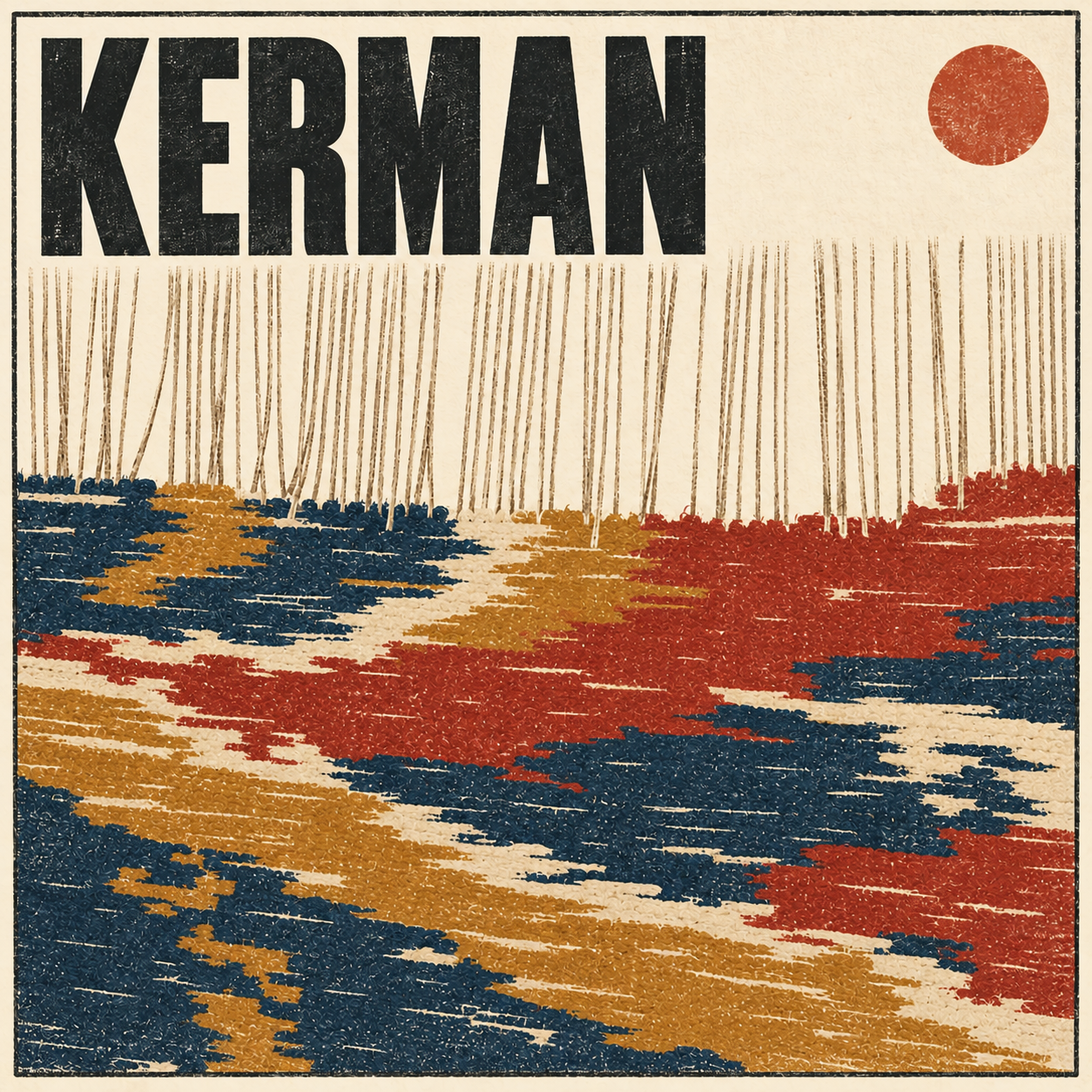
The saved public Spotify playlist now has the 21 reviewed recordings in this order, totalling 96:12.879. The cover uses the approved site master. Inclusion and position explanations are current, source-informed editorial readings; recording audio, lyrics, complete playback and transitions have not been independently auditioned.
This editorial material abstraction shows thread-like lines meeting an unfinished woven field. It refers to documented carpet-pattern calling and Mehrevatan’s separately linked contemporary Hashi, drawing attention to work and reinterpretation. It is not an authentic Kerman carpet, a loom diagram, an inherited symbol, a transcription, or a representation of every community. The sun and color fields are visual choices, not claims about local dyes, practice or sacred meaning.
The strongest exact-recording threads here run through the Sirjan-linked Desert collections and the Nazari–Tohidi Rudbar-Zamin project. Four Bruise Song selections are spaced through the route as project visits; no track-specific lyric account or best-of ranking is inferred.
Korti titles, pastoral Giskoo, camel-watering Oshtor Moro, wedding-associated Sar Tarash and Hanabandoon, and the nobat-linked closer point to different repertoire contexts. These titles do not prove the selected masters were recorded while the work or ceremonies happened.
Mehrevatan’s Hashi adapts words derived from Kerman carpet-pattern calling. Pattern directions are more specific than generic songs about carpets; the complete Woven Sounds film is multi-province. Hashi remains a separate public companion.
Northern Persian, southern Garmsiri, city dialect histories and Afshar histories complicate a single Kerman sound. Eastern Kerman’s documented Baluchi dance release and Bam-area context are research windows, not covert evidence that every playlist master covers those communities.
Women’s recorded and creative work includes the separate Mahoor Hanā bandān catalogue witness, Parvin Gholamshahi’s Bam memorial account, Mehrevatan’s women’s choir history and Mansureh Sabetzadeh’s documenting role. Edition dates here are digital catalogue attributions, not composition or field-session dates; audio and lyrics remain unauditioned.
Mehrevatan reworks words from Kerman carpet-pattern calling in a contemporary choral piece. The ensemble credits Masoud Nekooei for the music and its own voices. This public video is a separate companion after the Korti and work-song section; its 2018 upload does not date the recording session. The exact Spotify catalogue match and video completeness have not been verified.
Baba Leili · Music: Masoud Nekooei; voices: Mehrevatan
Mehrevatan identifies this as an old southern-Kerman song reworked by the ensemble. Place it beside the later Asheki visit as another local creative approach, without assuming a shared melody or master. The 2018 video upload is not a session date, and catalogue listings disagree on the separate digital issue year. Completeness has not been auditioned.
Ali Ghamsari describes taking the Kerman melody Faatelo into a chaharmezrab-like tar form before improvisation at Mahan. Compare this artist-posted video with the opening Rastak recording as two distinct interpretations. Its 2021 upload is not a verified session date; no identical digital master is asserted.
Woven Sounds — full documentary · Mehdi Aminian / Roots Revival
The full, publicly posted forty-minute Woven Sounds documentary opens a deeper look at weaving, pattern-calling and women’s work. Its academic project includes a Kerman-labelled short demo, while the complete film spans more than one province. The 2023 upload does not date every recording within it; full playback has not been independently checked.
Kiss of Chisel and Stone — Iranian Tar148, Meymand · Ali Ghamsari
Ali Ghamsari’s Meymand video presents a new composition responding to rock-carved space. It is a site-responsive contemporary work, not evidence of an inherited Meymand melody. The 2025 upload is not a recording date, and the similarly named digital issue has not been master-matched.
Public catalogue metadata and playlist order were checked on 27 October 2026. Saved artwork was matched to the approved master. No independent audio, lyric, transition, account-playback or full-companion audition is claimed. Five retained recordings are labelled provisional extended exploration.
DEEPER CONTEXT · LIVING SCENES · RESEARCH LIMITS
Follow another thread.
Open a topic to explore more of this place and its music.
Kerman-labelled Woven Sounds 10-minute demo
The Austrian Academy project points to an explicitly Kerman-labelled short demo of pattern singing. It is an excerpt, not the complete documentary or a core playlist track; the production and upload dates have different meanings.
The artist’s album offers a wider multi-province branch. A work-by-work connection to Kerman and an identical Spotify master have not been established for these tracks, so they stay outside this province-specific core.
The Mahoor catalogue identifies a women’s group and a short Kerman wedding recording. The reference supplies metadata, while a complete permitted public player has not been verified. It is distinct from the playlist’s Narouei-credited Hanabandoon.
Mahoor documents an eastern-Kerman dance-music release and named contributors. The accessible publisher post includes an excerpt; a verified full public album stream and the excerpt’s exact track identity remain open.
A local report documents Parvin Gholamshahi singing a lullaby at a Bam earthquake memorial. Its short video is a contextual witness, not a verified complete song or an identified soundtrack master.
Read in playlist order. Position notes are current editorial readings of the saved order, not a claim about original intent or an audio audition. Sources support specific cultural context; open each track’s qualifications for limits.
Kerman melody associated with singer/teacher Ali Fadaei; band tribute; Dance With Rastak track released2021-04-30.
Scope: Do not infer an unchanged historical master.
Qualification: Attribution boundary: Kerman melody; exact village not claimed. Selected digital edition: 2021-04-30 (selected digital edition metadata; not session/composition date). The recording, lyrics and transition have not been independently auditioned.
Why this position in the playlist
Role: Contemporary Kerman melody doorway
Current editorial reading: Opens with an artist-documented Kerman melody reinterpreted by a contemporary ensemble; the optional Ghamsari comparison follows here.
To the next track: Next, Nazi Be Naz: Sets a Narouei-credited regional collection beside the opening new arrangement, introducing the Sirjan thread without claiming a sonic match.
Locates Dar Hammumi wedding practice in Baft, Bardsir and Sirjan; distinguishes southern variants.; Describes female Abadoun wedding-group singing and women’s Morak mourning (Mor in Jiroft).; Differentiates agricultural Korti, shepherd kordi, camel-driving/watering calls, and carpet work.
Scope: Not independently established as peer-reviewed.; Geographic genre descriptions do not locate a catalogue master.; Do not repeat speculative ancient/Mithraic origins or infer Kurdish ethnicity from shepherd kordi.
Scope: Personnel are collection-level, not exact track assignments.; Physical publication attribution does not supersede 2010 digital edition date.; Sleeve-image requests returned403; no claim to have inspected original booklet.
Qualification: Attribution boundary: Sirjan/Amirabad Shul collection crosswalk is secondary. Selected digital edition: 2010-07-14 (selected digital edition metadata; not session/composition date). The recording, lyrics and transition have not been independently auditioned.
Why this position in the playlist
Role: Sirjan-linked festive repertoire
Current editorial reading: Sets a Narouei-credited regional collection beside the opening new arrangement, introducing the Sirjan thread without claiming a sonic match.
From the previous track: After Faatelo: Sets a Narouei-credited regional collection beside the opening new arrangement, introducing the Sirjan thread without claiming a sonic match.
To the next track: Next, Badveh: Introduces the Rudbar-Zamin voice/chang/percussion collaboration before the work-song comparison, so modern practice is present from the first chapter.
Nazari: voice/chang; Emad Tohidi: percussion and rhythmic design. Project situated in Rudbar-Zamin, southern Kerman, with cross-border exchanges.; Chang identified as ghaychak; not harp.
Scope: Text read in https://t.me/s/hosainnazari/218?q=%23%DA%AF%D8%B1%D9%88%D9%87 ; direct permalink did not render.; No lyric-specific story, precise session date or village allocation.
2018-11-22 edition, nine tracks; ℗2018 Music Center Of Hozeh Honari.
Scope: Other Nazari/Nazaripour catalog entries display different dates; no automatic alias/master merge.
Qualification: Attribution boundary: Rudbar-Zamin album scope, not session locality. Selected digital edition: 2018-11-22 (selected digital edition metadata; not session/composition date). The recording, lyrics and transition have not been independently auditioned.
Why this position in the playlist
Role: Living southern collaboration
Current editorial reading: Introduces the Rudbar-Zamin voice/chang/percussion collaboration before the work-song comparison, so modern practice is present from the first chapter.
From the previous track: After Nazi Be Naz: Introduces the Rudbar-Zamin voice/chang/percussion collaboration before the work-song comparison, so modern practice is present from the first chapter.
To the next track: Next, Avaz Mahali (Korti Bala Va Lati): Starts the adjacent Korti-title comparison, asking how two catalogued ensembles treat a work-associated repertoire label; their actual musical relationship remains unheard.
Locates Dar Hammumi wedding practice in Baft, Bardsir and Sirjan; distinguishes southern variants.; Describes female Abadoun wedding-group singing and women’s Morak mourning (Mor in Jiroft).; Differentiates agricultural Korti, shepherd kordi, camel-driving/watering calls, and carpet work.
Scope: Not independently established as peer-reviewed.; Geographic genre descriptions do not locate a catalogue master.; Do not repeat speculative ancient/Mithraic origins or infer Kurdish ethnicity from shepherd kordi.
Edition date 2010-07-17; displayed artist and track list; ℗2022 Music Center Of Hozeh Honari.
Scope: Distributor-supplied catalog corroboration, not independent recording-session evidence.; No booklet-to-digital master identity established.
Qualification: Attribution boundary: Vol.2 collection-level only. Selected digital edition: 2010-07-17 (selected digital edition metadata; not session/composition date). The recording, lyrics and transition have not been independently auditioned.
Why this position in the playlist
Role: First Korti work-title encounter
Current editorial reading: Starts the adjacent Korti-title comparison, asking how two catalogued ensembles treat a work-associated repertoire label; their actual musical relationship remains unheard.
From the previous track: After Badveh: Starts the adjacent Korti-title comparison, asking how two catalogued ensembles treat a work-associated repertoire label; their actual musical relationship remains unheard.
To the next track: Next, Korti Khani: Keeps the two Korti titles adjacent as a listening question, not a conclusion that one complements or duplicates the other; then moves to another documented remake.
Why this track belongs: Retain for an explicit comparison between two differently credited Korti-titled recordings. Shared name/credit differences establish a question worth hearing, not demonstrated complementarity or non-duplication.
Locates Dar Hammumi wedding practice in Baft, Bardsir and Sirjan; distinguishes southern variants.; Describes female Abadoun wedding-group singing and women’s Morak mourning (Mor in Jiroft).; Differentiates agricultural Korti, shepherd kordi, camel-driving/watering calls, and carpet work.
Scope: Not independently established as peer-reviewed.; Geographic genre descriptions do not locate a catalogue master.; Do not repeat speculative ancient/Mithraic origins or infer Kurdish ethnicity from shepherd kordi.
Scope: Personnel are collection-level, not exact track assignments.; Physical publication attribution does not supersede 2010 digital edition date.; Sleeve-image requests returned403; no claim to have inspected original booklet.
Qualification: Attribution boundary: Sirjan collection, secondary crosswalk. Selected digital edition: 2010-07-14 (selected digital edition metadata; not session/composition date). The recording, lyrics and transition have not been independently auditioned.
Why this position in the playlist
Role: Second Korti work-title encounter
Current editorial reading: Keeps the two Korti titles adjacent as a listening question, not a conclusion that one complements or duplicates the other; then moves to another documented remake.
From the previous track: After Avaz Mahali (Korti Bala Va Lati): Keeps the two Korti titles adjacent as a listening question, not a conclusion that one complements or duplicates the other; then moves to another documented remake.
To the next track: Next, Sakineh - Kerman: Moves southern-Kerman Sakineh from the near-end to the first return point after Korti. Its explicit source link reconnects collection repertoire and contemporary arrangement by 21:29.722, rather than waiting until 82:56.087.
Sakineh identified as southern Kerman; Essentials2023 described as re-recorded/remastered.
Scope: Supports repertoire relation, not identity with selected2016 Among Eternal Suns master.; 2023 member credits do not establish every2016 performer.
Lists 2016-12-20 and ℗2016 HonarAval; corroborates the selected edition date displayed by Spotify.
Scope: Two platforms may share distributor metadata; not independent historical/session proof. WOMEX 2023 is a different-edition repertoire witness.
Qualification: Attribution boundary: 2023Essentials is a different recording edition. Selected digital edition: 2016-12-20 (selected digital edition metadata; not session/composition date). The recording, lyrics and transition have not been independently auditioned.
Why this position in the playlist
Role: Southern repertoire reinterpreted
Current editorial reading: Moves southern-Kerman Sakineh from the near-end to the first return point after Korti. Its explicit source link reconnects collection repertoire and contemporary arrangement by 21:29.722, rather than waiting until 82:56.087.
From the previous track: After Korti Khani: Moves southern-Kerman Sakineh from the near-end to the first return point after Korti. Its explicit source link reconnects collection repertoire and contemporary arrangement by 21:29.722, rather than waiting until 82:56.087.
To the next track: Next, Sorna O Avaz: Begins the reed/occasion chapter with a title that names sorna and voice; it supplies a role-based doorway before the locality and wedding titles.
Edition date 2010-07-17; displayed artist and track list; ℗2022 Music Center Of Hozeh Honari.
Scope: Distributor-supplied catalog corroboration, not independent recording-session evidence.; No booklet-to-digital master identity established.
Qualification: Attribution boundary: No track-level instrumental allocation. Selected digital edition: 2010-07-17 (selected digital edition metadata; not session/composition date). The recording, lyrics and transition have not been independently auditioned.
Why this position in the playlist
Role: Sorna and voice
Current editorial reading: Begins the reed/occasion chapter with a title that names sorna and voice; it supplies a role-based doorway before the locality and wedding titles.
From the previous track: After Sakineh - Kerman: Begins the reed/occasion chapter with a title that names sorna and voice; it supplies a role-based doorway before the locality and wedding titles.
To the next track: Next, Paye Jame Faryab: Introduces the explicit Faryab place-name within the reed/occasion chapter before the wedding pair; the title is not treated as a session location.
Locates Dar Hammumi wedding practice in Baft, Bardsir and Sirjan; distinguishes southern variants.; Describes female Abadoun wedding-group singing and women’s Morak mourning (Mor in Jiroft).; Differentiates agricultural Korti, shepherd kordi, camel-driving/watering calls, and carpet work.
Scope: Not independently established as peer-reviewed.; Geographic genre descriptions do not locate a catalogue master.; Do not repeat speculative ancient/Mithraic origins or infer Kurdish ethnicity from shepherd kordi.
Edition date 2010-07-17; displayed artist and track list; ℗2022 Music Center Of Hozeh Honari.
Scope: Distributor-supplied catalog corroboration, not independent recording-session evidence.; No booklet-to-digital master identity established.
Qualification: Attribution boundary: Title names Faryab; no session village claim. Selected digital edition: 2010-07-17 (selected digital edition metadata; not session/composition date). The recording, lyrics and transition have not been independently auditioned.
Why this position in the playlist
Role: Faryab-named occasion
Current editorial reading: Introduces the explicit Faryab place-name within the reed/occasion chapter before the wedding pair; the title is not treated as a session location.
From the previous track: After Sorna O Avaz: Introduces the explicit Faryab place-name within the reed/occasion chapter before the wedding pair; the title is not treated as a session location.
To the next track: Next, Sar Tarash: Places wedding-barbering repertoire directly before henna-titled repertoire: an evidenced social-context pairing, not an auditioned transition.
Locates Dar Hammumi wedding practice in Baft, Bardsir and Sirjan; distinguishes southern variants.; Describes female Abadoun wedding-group singing and women’s Morak mourning (Mor in Jiroft).; Differentiates agricultural Korti, shepherd kordi, camel-driving/watering calls, and carpet work.
Scope: Not independently established as peer-reviewed.; Geographic genre descriptions do not locate a catalogue master.; Do not repeat speculative ancient/Mithraic origins or infer Kurdish ethnicity from shepherd kordi.
Edition date 2010-07-17; displayed artist and track list; ℗2022 Music Center Of Hozeh Honari.
Scope: Distributor-supplied catalog corroboration, not independent recording-session evidence.; No booklet-to-digital master identity established.
Qualification: Attribution boundary: Genre function, not recording of an actual wedding. Selected digital edition: 2010-07-17 (selected digital edition metadata; not session/composition date). The recording, lyrics and transition have not been independently auditioned.
Why this position in the playlist
Role: Wedding barbering context
Current editorial reading: Places wedding-barbering repertoire directly before henna-titled repertoire: an evidenced social-context pairing, not an auditioned transition.
From the previous track: After Paye Jame Faryab: Places wedding-barbering repertoire directly before henna-titled repertoire: an evidenced social-context pairing, not an auditioned transition.
To the next track: Next, Hanabandoon: Completes the wedding-related pair with a return to the Narouei collection; remains distinct from the women’s Mahoor archival recording.
Scope: Personnel are collection-level, not exact track assignments.; Physical publication attribution does not supersede 2010 digital edition date.; Sleeve-image requests returned403; no claim to have inspected original booklet.
Qualification: Attribution boundary: Do not claim the women of KC15 perform this master. Selected digital edition: 2010-07-14 (selected digital edition metadata; not session/composition date). The recording, lyrics and transition have not been independently auditioned.
Why this position in the playlist
Role: Henna-titled wedding context
Current editorial reading: Completes the wedding-related pair with a return to the Narouei collection; remains distinct from the women’s Mahoor archival recording.
From the previous track: After Sar Tarash: Completes the wedding-related pair with a return to the Narouei collection; remains distinct from the women’s Mahoor archival recording.
To the next track: Next, Maryam: Provides the first spaced return to Bruise Song after the wedding chapter and immediately before the catalogue-designated chang solo. The contrast is between documented project roles and a solo label, not a claim about Maryam’s specific arrangement.
11
Maryam
Hossein Nazari, Emad Tohidi
Place and practice: Provisional extended exploration
Why this track belongs: PROVISIONAL EXTENDED EXPLORATION: retain Maryam within the existing four-cut sample of a well-documented Rudbar-Zamin creative project. Track-specific lyrics, arrangement distinction and superiority to the five unselected album tracks are not established; the selection buys project depth, not a newly proven cultural category.
Nazari: voice/chang; Emad Tohidi: percussion and rhythmic design. Project situated in Rudbar-Zamin, southern Kerman, with cross-border exchanges.; Chang identified as ghaychak; not harp.
Scope: Text read in https://t.me/s/hosainnazari/218?q=%23%DA%AF%D8%B1%D9%88%D9%87 ; direct permalink did not render.; No lyric-specific story, precise session date or village allocation.
2018-11-22 edition, nine tracks; ℗2018 Music Center Of Hozeh Honari.
Scope: Other Nazari/Nazaripour catalog entries display different dates; no automatic alias/master merge.
Qualification: Provisional extended exploration: exact-work distinction remains open. Attribution boundary: No translated lyric narrative assumed. Selected digital edition: 2018-11-22 (selected digital edition metadata; not session/composition date). The recording, lyrics and transition have not been independently auditioned.
Why this position in the playlist
Role: First spaced project return
Current editorial reading: Provides the first spaced return to Bruise Song after the wedding chapter and immediately before the catalogue-designated chang solo. The contrast is between documented project roles and a solo label, not a claim about Maryam’s specific arrangement.
From the previous track: After Hanabandoon: Provides the first spaced return to Bruise Song after the wedding chapter and immediately before the catalogue-designated chang solo. The contrast is between documented project roles and a solo label, not a claim about Maryam’s specific arrangement.
To the next track: Next, Taknavazie Chang: Follows a Nazari–Tohidi return with the catalogued chang solo to create a focused instrument-comparison question; does not assert the same player or exact instrument realization.
Nazari: voice/chang; Emad Tohidi: percussion and rhythmic design. Project situated in Rudbar-Zamin, southern Kerman, with cross-border exchanges.; Chang identified as ghaychak; not harp.
Scope: Text read in https://t.me/s/hosainnazari/218?q=%23%DA%AF%D8%B1%D9%88%D9%87 ; direct permalink did not render.; No lyric-specific story, precise session date or village allocation.
Qualification: Attribution boundary: No claim which of three displayed artists plays every note. Selected digital edition: 2010-07-17 (selected digital edition metadata; not session/composition date). The recording, lyrics and transition have not been independently auditioned.
Why this position in the playlist
Role: Catalogued chang solo
Current editorial reading: Follows a Nazari–Tohidi return with the catalogued chang solo to create a focused instrument-comparison question; does not assert the same player or exact instrument realization.
From the previous track: After Maryam: Follows a Nazari–Tohidi return with the catalogued chang solo to create a focused instrument-comparison question; does not assert the same player or exact instrument realization.
To the next track: Next, Giskoo: Follows the solo doorway with pastoral repertoire, then sits directly beside camel-watering repertoire so livelihood contexts are clear rather than scattered.
Locates Dar Hammumi wedding practice in Baft, Bardsir and Sirjan; distinguishes southern variants.; Describes female Abadoun wedding-group singing and women’s Morak mourning (Mor in Jiroft).; Differentiates agricultural Korti, shepherd kordi, camel-driving/watering calls, and carpet work.
Scope: Not independently established as peer-reviewed.; Geographic genre descriptions do not locate a catalogue master.; Do not repeat speculative ancient/Mithraic origins or infer Kurdish ethnicity from shepherd kordi.
Edition date 2010-07-17; displayed artist and track list; ℗2022 Music Center Of Hozeh Honari.
Scope: Distributor-supplied catalog corroboration, not independent recording-session evidence.; No booklet-to-digital master identity established.
Qualification: Attribution boundary: Collection-level locality. Selected digital edition: 2010-07-17 (selected digital edition metadata; not session/composition date). The recording, lyrics and transition have not been independently auditioned.
Why this position in the playlist
Role: Pastoral livelihood
Current editorial reading: Follows the solo doorway with pastoral repertoire, then sits directly beside camel-watering repertoire so livelihood contexts are clear rather than scattered.
From the previous track: After Taknavazie Chang: Follows the solo doorway with pastoral repertoire, then sits directly beside camel-watering repertoire so livelihood contexts are clear rather than scattered.
To the next track: Next, Oshtor Moro: Completes the pastoral/camel-work pair before another modern-project return; no claim that the actual recording documents working animals.
Locates Dar Hammumi wedding practice in Baft, Bardsir and Sirjan; distinguishes southern variants.; Describes female Abadoun wedding-group singing and women’s Morak mourning (Mor in Jiroft).; Differentiates agricultural Korti, shepherd kordi, camel-driving/watering calls, and carpet work.
Scope: Not independently established as peer-reviewed.; Geographic genre descriptions do not locate a catalogue master.; Do not repeat speculative ancient/Mithraic origins or infer Kurdish ethnicity from shepherd kordi.
Edition date 2010-07-17; displayed artist and track list; ℗2022 Music Center Of Hozeh Honari.
Scope: Distributor-supplied catalog corroboration, not independent recording-session evidence.; No booklet-to-digital master identity established.
Qualification: Attribution boundary: Social repertoire, not proof a camel/session is audible. Selected digital edition: 2010-07-17 (selected digital edition metadata; not session/composition date). The recording, lyrics and transition have not been independently auditioned.
Why this position in the playlist
Role: Camel-watering repertoire
Current editorial reading: Completes the pastoral/camel-work pair before another modern-project return; no claim that the actual recording documents working animals.
From the previous track: After Giskoo: Completes the pastoral/camel-work pair before another modern-project return; no claim that the actual recording documents working animals.
To the next track: Next, Asheki: Moves away from Maryam to give a third separate Bruise Song visit after the livelihood pair. This is a project-level return point, not a lyric-derived connection to herding.
15
Asheki
Hossein Nazari, Emad Tohidi
Place and practice: Provisional extended exploration
Why this track belongs: PROVISIONAL EXTENDED EXPLORATION: retain Asheki as another exact work from the same regional collaboration, but do not claim an independently documented love narrative, contrast or necessary pairing with Maryam. Its new separated return is the curatorial role; exact-work differentiation remains open.
Nazari: voice/chang; Emad Tohidi: percussion and rhythmic design. Project situated in Rudbar-Zamin, southern Kerman, with cross-border exchanges.; Chang identified as ghaychak; not harp.
Scope: Text read in https://t.me/s/hosainnazari/218?q=%23%DA%AF%D8%B1%D9%88%D9%87 ; direct permalink did not render.; No lyric-specific story, precise session date or village allocation.
2018-11-22 edition, nine tracks; ℗2018 Music Center Of Hozeh Honari.
Scope: Other Nazari/Nazaripour catalog entries display different dates; no automatic alias/master merge.
Qualification: Provisional extended exploration: exact-work distinction remains open. Attribution boundary: Same project does not mean identical melodic role. Selected digital edition: 2018-11-22 (selected digital edition metadata; not session/composition date). The recording, lyrics and transition have not been independently auditioned.
Why this position in the playlist
Role: Second spaced project return
Current editorial reading: Moves away from Maryam to give a third separate Bruise Song visit after the livelihood pair. This is a project-level return point, not a lyric-derived connection to herding.
From the previous track: After Oshtor Moro: Moves away from Maryam to give a third separate Bruise Song visit after the livelihood pair. This is a project-level return point, not a lyric-derived connection to herding.
To the next track: Next, Maghame Balaei Soghooni: Begins a transparently labelled extended exploration of catalogue-named maqams, beside Sar Avordi and Sabzeh Pari. The version is retained, but compactness is no longer presented as cultural justification.
16
Maghame Balaei Soghooni
Foad Tohidi, Hossein Johari, Yousef Salimi
Place and practice: Provisional extended exploration
Why this track belongs: PROVISIONAL EXTENDED EXPLORATION: retain one exact Vol.3 Balaei Soghooni example within a small named-maqam comparison. No source inspected establishes a unique function for this master or why it outranks the Vol.2 alternative. This is a scope choice pending audition/liner-note evidence, not a compactness-based endorsement.
Edition date 2010-07-17; displayed artist and track list; ℗2022 Music Center Of Hozeh Honari.
Scope: Distributor-supplied catalog corroboration, not independent recording-session evidence.; No booklet-to-digital master identity established.
Qualification: Provisional extended exploration: exact-work distinction remains open. Attribution boundary: Shared title is not master equivalence. Selected digital edition: 2010-07-17 (selected digital edition metadata; not session/composition date). The recording, lyrics and transition have not been independently auditioned.
Why this position in the playlist
Role: Named-maqam exploration
Current editorial reading: Begins a transparently labelled extended exploration of catalogue-named maqams, beside Sar Avordi and Sabzeh Pari. The version is retained, but compactness is no longer presented as cultural justification.
From the previous track: After Asheki: Begins a transparently labelled extended exploration of catalogue-named maqams, beside Sar Avordi and Sabzeh Pari. The version is retained, but compactness is no longer presented as cultural justification.
To the next track: Next, Maghame Sar Avordi: Anchors the named-maqam cluster with an evidenced overlap between work and lament contexts; that supports asking about flexible social uses without assigning an occasion to this master.
Locates Dar Hammumi wedding practice in Baft, Bardsir and Sirjan; distinguishes southern variants.; Describes female Abadoun wedding-group singing and women’s Morak mourning (Mor in Jiroft).; Differentiates agricultural Korti, shepherd kordi, camel-driving/watering calls, and carpet work.
Scope: Not independently established as peer-reviewed.; Geographic genre descriptions do not locate a catalogue master.; Do not repeat speculative ancient/Mithraic origins or infer Kurdish ethnicity from shepherd kordi.
Edition date 2010-07-17; displayed artist and track list; ℗2022 Music Center Of Hozeh Honari.
Scope: Distributor-supplied catalog corroboration, not independent recording-session evidence.; No booklet-to-digital master identity established.
Qualification: Attribution boundary: Context at repertoire level. Selected digital edition: 2010-07-17 (selected digital edition metadata; not session/composition date). The recording, lyrics and transition have not been independently auditioned.
Why this position in the playlist
Role: Work and lament context
Current editorial reading: Anchors the named-maqam cluster with an evidenced overlap between work and lament contexts; that supports asking about flexible social uses without assigning an occasion to this master.
From the previous track: After Maghame Balaei Soghooni: Anchors the named-maqam cluster with an evidenced overlap between work and lament contexts; that supports asking about flexible social uses without assigning an occasion to this master.
To the next track: Next, Maghame Sabzeh Pari: Completes the named-maqam exploration after Sar Avordi. The separate Faryab/Sang Moharram anthology link is a contextual research door, not proof this master is a different function or sound.
18
Maghame Sabzeh Pari
Foad Tohidi, Hossein Johari, Yousef Salimi
Place and practice: Provisional extended exploration
Why this track belongs: PROVISIONAL EXTENDED EXPLORATION: retain a catalogued maqam with a separate-anthology Faryab/Sang Moharram research connection. Exact-master social function and distinct sonic contribution beyond the other maqams are unestablished; do not claim non-redundancy.
Separate anthology names ghaychak from Bardsir, nobat/sotak from Shahdad, choochap/henna from Narmashir Bam, Sabze Pari/Sang Moharram from Faryab.
Scope: Not the Desert masters. Original publisher announcement not recovered; use only a repertoire-map lead.
Qualification: Provisional extended exploration: exact-work distinction remains open. Attribution boundary: Separate Bagh Ava Faryab link is repertoire-only. Selected digital edition: 2010-07-17 (selected digital edition metadata; not session/composition date). The recording, lyrics and transition have not been independently auditioned.
Why this position in the playlist
Role: Named-maqam comparison
Current editorial reading: Completes the named-maqam exploration after Sar Avordi. The separate Faryab/Sang Moharram anthology link is a contextual research door, not proof this master is a different function or sound.
From the previous track: After Maghame Sar Avordi: Completes the named-maqam exploration after Sar Avordi. The separate Faryab/Sang Moharram anthology link is a contextual research door, not proof this master is a different function or sound.
To the next track: Next, Nabat: Provides the fourth separated Bruise Song visit after the named-maqam cluster, before the festive/ceremonial closing pair. The late position is editorial, not justified by length or invented lyrical resolution.
19
Nabat
Hossein Nazari, Emad Tohidi
Place and practice: Provisional extended exploration
Why this track belongs: PROVISIONAL EXTENDED EXPLORATION: retain Nabat to revisit the project at the end of the route, without claiming it is uniquely representative, lyrically conclusive or best because longest. Four retained album cuts are a documented-scope choice, not a four-song quota or a proven best-of ranking.
Nazari: voice/chang; Emad Tohidi: percussion and rhythmic design. Project situated in Rudbar-Zamin, southern Kerman, with cross-border exchanges.; Chang identified as ghaychak; not harp.
Scope: Text read in https://t.me/s/hosainnazari/218?q=%23%DA%AF%D8%B1%D9%88%D9%87 ; direct permalink did not render.; No lyric-specific story, precise session date or village allocation.
2018-11-22 edition, nine tracks; ℗2018 Music Center Of Hozeh Honari.
Scope: Other Nazari/Nazaripour catalog entries display different dates; no automatic alias/master merge.
Qualification: Provisional extended exploration: exact-work distinction remains open. Attribution boundary: No track-specific lyric translation. Selected digital edition: 2018-11-22 (selected digital edition metadata; not session/composition date). The recording, lyrics and transition have not been independently auditioned.
Why this position in the playlist
Role: Final spaced project return
Current editorial reading: Provides the fourth separated Bruise Song visit after the named-maqam cluster, before the festive/ceremonial closing pair. The late position is editorial, not justified by length or invented lyrical resolution.
From the previous track: After Maghame Sabzeh Pari: Provides the fourth separated Bruise Song visit after the named-maqam cluster, before the festive/ceremonial closing pair. The late position is editorial, not justified by length or invented lyrical resolution.
To the next track: Next, Holo Haloo: Reprises festive repertoire after the final modern-project return, immediately before a different ceremonial tradition. Shared title with Rastak’s2025 Balochi Halo Halo is explicitly rejected.
Locates Dar Hammumi wedding practice in Baft, Bardsir and Sirjan; distinguishes southern variants.; Describes female Abadoun wedding-group singing and women’s Morak mourning (Mor in Jiroft).; Differentiates agricultural Korti, shepherd kordi, camel-driving/watering calls, and carpet work.
Scope: Not independently established as peer-reviewed.; Geographic genre descriptions do not locate a catalogue master.; Do not repeat speculative ancient/Mithraic origins or infer Kurdish ethnicity from shepherd kordi.
Scope: Not Kerman despite resemblance to Holo Haloo title. Do not move provincial attribution to fit gap.
Qualification: Attribution boundary: Do not match recordings by similar romanized title. Selected digital edition: 2010-07-17 (selected digital edition metadata; not session/composition date). The recording, lyrics and transition have not been independently auditioned.
Why this position in the playlist
Role: Festive reprise
Current editorial reading: Reprises festive repertoire after the final modern-project return, immediately before a different ceremonial tradition. Shared title with Rastak’s2025 Balochi Halo Halo is explicitly rejected.
From the previous track: After Nabat: Reprises festive repertoire after the final modern-project return, immediately before a different ceremonial tradition. Shared title with Rastak’s2025 Balochi Halo Halo is explicitly rejected.
To the next track: Next, Salam Bar Khorshid: Ends with the distinct sunrise/sunset nobat repertoire connection, allowing the full form rather than asserting a heard final cadence or an actual sunrise session.
Locates Dar Hammumi wedding practice in Baft, Bardsir and Sirjan; distinguishes southern variants.; Describes female Abadoun wedding-group singing and women’s Morak mourning (Mor in Jiroft).; Differentiates agricultural Korti, shepherd kordi, camel-driving/watering calls, and carpet work.
Scope: Not independently established as peer-reviewed.; Geographic genre descriptions do not locate a catalogue master.; Do not repeat speculative ancient/Mithraic origins or infer Kurdish ethnicity from shepherd kordi.
Scope: Personnel are collection-level, not exact track assignments.; Physical publication attribution does not supersede 2010 digital edition date.; Sleeve-image requests returned403; no claim to have inspected original booklet.
Qualification: Attribution boundary: AmirabadShul tradition; actual session occasion unproved. Selected digital edition: 2010-07-14 (selected digital edition metadata; not session/composition date). The recording, lyrics and transition have not been independently auditioned.
Why this position in the playlist
Role: Nobat-linked ceremonial close
Current editorial reading: Ends with the distinct sunrise/sunset nobat repertoire connection, allowing the full form rather than asserting a heard final cadence or an actual sunrise session.
From the previous track: After Holo Haloo: Ends with the distinct sunrise/sunset nobat repertoire connection, allowing the full form rather than asserting a heard final cadence or an actual sunrise session.
Closing note: The closing role is an editorial placement; a heard final cadence or sunrise session has not been established.
Follow the threads.
These earlier reading lists offer broader context. The per-track source notes identify what each reference supports and where verification remains open.