
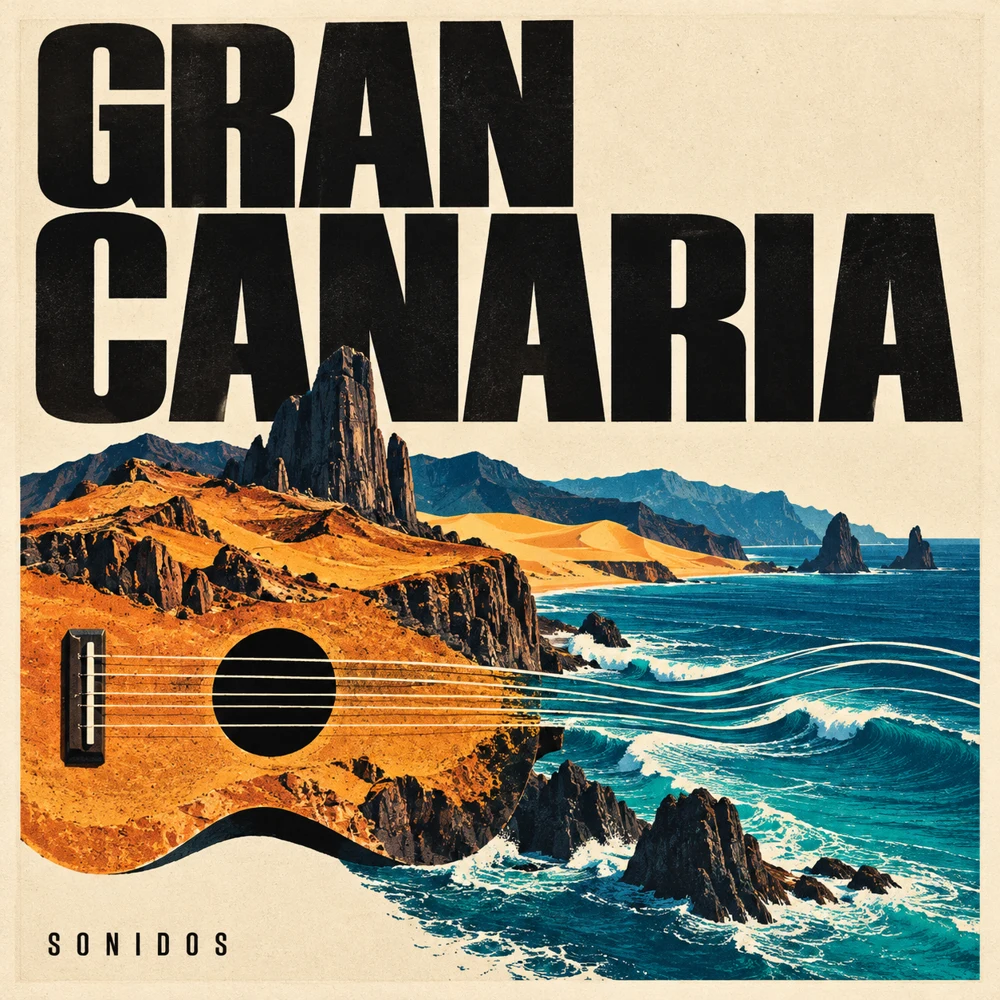
ISLAND ROOTS · NEW VOICES · 36 SONGS
Gran Canaria & the Canaries
Gran Canaria anchors this route, which also visits music and communities elsewhere in the Canary Islands. Timple practice, authored island songs, ensembles, public celebrations and contemporary popular projects belong here through distinct, documented connections.
The saved order links regional and archipelago-wide stories. Its position notes are current editorial explanations; neither an artist's birthplace nor an evocative title alone makes a recording specifically Gran Canarian.
Listen on SpotifyThe stories in the grooves.
Read in playlist order. Position notes are current editorial readings of the saved order, not a claim about original intent or an audio audition. Sources support specific cultural context; open each track’s qualifications for limits.
Vegueta to the high country
Begins with Campanas de Vegueta (Neighbourhood entrance and returning-ensemble seed) and reaches Sombra Del Nublo (Canción Canaria) - Remasterizado (Néstor Álamo repertoire closes the opening). Open the track notes for the documented connections and the editorial reasons for this order.
Why this track belongs: Los Gofiones's own songbook places Campanas de Vegueta in a remembered neighbourhood and credits José María Millares. This is a work-specific Gran Canaria reference, not merely an ensemble's origin.
Sources and limits
- Existing guide context 1: losgofiones.com
Official ensemble text, credits and rerecording-project description read. Work-specific neighbourhood context; exact Spotify master not cross-matched.
Qualifications:
- No actual bells, recording location, communal chorus or vocal phrasing has been verified by listening.
Why this position in the playlist
Role: Neighbourhood entrance and returning-ensemble seed
Proposed editorial rationale: Open at the scale of a neighbourhood before slot 2 names the whole island. Introducing Los Gofiones first also makes their later return with Quevedo at 35 a recognizable structural connection.
To the next track: The neighbourhood reference expands to the island dedication while the ensemble remains constant, making geographical scale the first change rather than an assumed sonic contrast.
- Existing guide context 1: losgofiones.com
Why this track belongs: The ensemble's official text explicitly addresses Gran Canaria and credits Manuel R. Melián. It provides an unambiguous island dedication before the route expands into the archipelago.
Sources and limits
- Existing guide context 1: losgofiones.com
Official ensemble text and songwriter credit read. Explicit Gran Canaria dedication; no audio audition.
Qualifications:
- This island dedication is not a claim that the ensemble or song represents every island community.
Why this position in the playlist
Role: Widen from neighbourhood to island
Proposed editorial rationale: Keep Los Gofiones for a second track so the opening can widen from Vegueta to the island without changing performer at the same time. Mary Sánchez then introduces a different interpretive partnership and a smaller named place.
From the previous track: The neighbourhood reference expands to the island dedication while the ensemble remains constant, making geographical scale the first change rather than an assumed sonic contrast.
To the next track: After naming the island, the route enters Teror's documented public-song repertoire through another fully credited interpretive partnership.
- Existing guide context 1: losgofiones.com
¡Ay Teror, Que Lindo Eres! (Rancho Parrendero Canario) - Remasterizado
Mary Sánchez, Los Bandama
Open exact recording on SpotifyWhy this track belongs: Mary Sánchez's municipal festival address identifies this Néstor Álamo song among the works she recorded for Teror and links them to the Pino celebrations. The current recording credits also include Los Bandama.
Sources and limits
- Existing guide context 1: teror.es
Mary Sánchez’s own festival address published by Teror municipality read: Néstor Álamo repertoire, recording history and Pino celebration context.
Qualifications:
- The selected remaster is not authenticated as a recording made at the festival. Religious context describes the practice, not every listener's beliefs.
Why this position in the playlist
Role: Teror's public celebration context
Proposed editorial rationale: After the island dedication, choose a named community and documented public occasion. Following it with Caminito de Teror keeps the place constant while changing the interpreter, rather than immediately turning Teror into a passing postcard.
From the previous track: After naming the island, the route enters Teror's documented public-song repertoire through another fully credited interpretive partnership.
To the next track: The same Teror repertoire is heard through a different cataloged interpreter, making cross-island circulation visible without relocating Teror or claiming a shared arrangement.
- Existing guide context 1: teror.es
Why this track belongs: Teror's published festival address identifies Caminito de Teror in Néstor Álamo's place-specific repertoire. The catalog selects Luis Morera, associated with the La Palma group Taburiente, so the connection is the song and its circulation, not Morera being from Gran Canaria.
Sources and limits
- Existing guide context 1: open.spotify.com
Direct page initially returned title only; subsequent indexed Spotify tracklist read: exact work and performer appear on Tenderete. Exact-ID track-page metadata now independently confirms the catalog album association, not the original session/broadcast date.
- Existing guide context 2: teror.es
Municipal festival address read: Caminito de Teror in Néstor Álamo’s place-specific repertoire. Different interpreter from this catalog item.
- Canary education cultural history: Taburiente
Indexed institutional cultural-history entry read: La Palma-associated project, discography including Ach-Guañac, and inter-island work. Does not prove exact cut’s genre or release master.
- Spotify exact-ID public track-page catalog metadata
HTTP 200; public Open Graph metadata associates this exact title/performer ID with Tenderete (2003). No playback, audio fingerprint or broadcast-event authentication.
Qualifications:
- Exact-ID public Spotify metadata now associates this Luis Morera selection with Tenderete (2003). That resolves the catalog compilation link, not the specific television performance or recording session; 2003 is an edition date.
Why this position in the playlist
Role: Same place through another island's interpreter
Proposed editorial rationale: Put this immediately after the other Teror song to make the same-place/different-interpreter comparison explicit. Mary Sánchez and Los Bandama then return at 5, completing a short Teror-to-Nublo group rather than a chronological artist survey.
From the previous track: The same Teror repertoire is heard through a different cataloged interpreter, making cross-island circulation visible without relocating Teror or claiming a shared arrangement.
To the next track: Mary Sánchez and Los Bandama return after Morera, closing the place-song group through another named Néstor Álamo work before a new chapter.
- Existing guide context 1: open.spotify.com
Sombra Del Nublo (Canción Canaria) - Remasterizado
Mary Sánchez, Los Bandama
Open exact recording on SpotifyWhy this track belongs: RTVE's Néstor Álamo memorial identifies Sombra del Nublo among his major works and documents Mary Sánchez and Los Bandama in the associated interpretive community. It belongs through a named Gran Canarian repertoire history.
Sources and limits
- Existing guide context 1: www.rtve.es
RTVE memorial synopsis read: Néstor Álamo work list and Mary Sánchez/Los Bandama participation; not selected-master equivalence.
Qualifications:
- The memorial program is contextual evidence, not proof that this catalog master is its performance. No vocal weight or exact accompaniment is inferred.
Why this position in the playlist
Role: Néstor Álamo repertoire closes the opening
Proposed editorial rationale: Return to the Sánchez–Bandama partnership after Morera, then end the opening place-song group before the timple chapter. The recurring interpreter gives continuity without claiming a seamless sound transition.
From the previous track: Mary Sánchez and Los Bandama return after Morera, closing the place-song group through another named Néstor Álamo work before a new chapter.
To the next track: The place-song opening gives way to a named timple composition with documented local concert use, shifting from lyrical geography to a musical practice.
- Existing guide context 1: www.rtve.es
Strings become a gathering
Begins with Chipude (Timple chapter with local public-life evidence) and reaches Siete Rosas (Woman interpreter closes the gathering chapter). Open the track notes for the documented connections and the editorial reasons for this order.
Why this track belongs: Instituto Cervantes lists Chipude as José Antonio Ramos's timple composition, and Las Palmas's municipal concert program includes it in a Canary Day tribute repertoire. That supplies creative and local performance connections beyond Ramos's birthplace.
Sources and limits
- Existing guide context 1: datos.bne.es
Preserved public source attachment; not independently verified as support in this pass. Its presence is not blanket evidence for the older prose. See added claim-specific sources where available.
- Existing guide context 2: infonortedigital.com
Indexed original article excerpt read: Ramos and Chipude identified; stronger added institutional repertoire/program sources support the draft.
- Instituto Cervantes: Canarian timple repertoire
Indexed institutional program read: Chipude identified as a timple composition by José Antonio Ramos; not selected arrangement.
- Las Palmas: Canary Day concert repertoire
Indexed municipal program read: Chipude included in the local concert’s José Antonio Ramos repertoire. No event-audio identity claim.
Qualifications:
- Chipude is also a place-name associated with La Gomera, but the title's intended referent is not independently established here. Do not present it as a Gran Canaria locality or infer this master’s precise instrumentation from another arrangement.
Why this position in the playlist
Role: Timple chapter with local public-life evidence
Proposed editorial rationale: Start the instrument-focused chapter with a named composition already present in Gran Canaria's public concert life. The next item then changes from a single named composer-performer to a documented timple–guitar partnership.
From the previous track: The place-song opening gives way to a named timple composition with documented local concert use, shifting from lyrical geography to a musical practice.
To the next track: Ramos's composition is followed by the documented Germán López–Antonio Toledo partnership, moving from an individual repertoire reference to collaboration.
- Existing guide context 1: datos.bne.es
Why this track belongs: Teguise's Casa-Museo del Timple program documents Germán López and Antonio Toledo's Canela y Limón project, combining Canarian and flamenco-related repertoire. López's connection is an active timple practice and collaborative network, not only origin.
Sources and limits
- Existing guide context 1: teguise.es
Municipal concert announcement read: exact named project, timple/guitar roles, collaborators and repertoire context; project scope is not every cut.
Qualifications:
- Teguise is on Lanzarote, not Gran Canaria. Project-wide repertoire does not establish every influence, instrument balance or improvisation in this selected cut.
Why this position in the playlist
Role: Documented timple–guitar partnership
Proposed editorial rationale: Follow Ramos with a named two-musician project so the chapter is not just a list of timplistas. Cabrera's Nube de Hielo then changes the focus again, from collaboration to a composition's teaching and transmission.
From the previous track: Ramos's composition is followed by the documented Germán López–Antonio Toledo partnership, moving from an individual repertoire reference to collaboration.
To the next track: The duo project gives way to a work taught and transcribed within timple education, adding transmission rather than an invented quieter interlude.
- Existing guide context 1: teguise.es
Why this track belongs: Timple teacher Pedro Izquierdo documents Benito Cabrera's Nube de Hielo as a composition he transcribes and teaches, with the composer's permission. This is a living repertoire-transmission connection to Canarian culture.
Sources and limits
- Existing guide context 1: pedroizquierdo.com
Teacher’s first-person account read: composition, pedagogical use, permission, original instrumental and later sung versions; not Spotify master mapping.
Qualifications:
- This is wider Canarian context, not a demonstrated Gran Canaria-origin work. The teacher distinguishes an instrumental original from later sung versions; that history does not alone authenticate this Spotify master's arrangement.
Why this position in the playlist
Role: Teaching and transmission within the timple chapter
Proposed editorial rationale: Put the teaching-repertoire example between a duo project and the three credited musicians of Polca Majorera. The slot adds learning as a social function, rather than making the instrument chapter depend on invented contrasts of speed or brightness.
From the previous track: The duo project gives way to a work taught and transcribed within timple education, adding transmission rather than an invented quieter interlude.
To the next track: The teaching example leads to three credited musicians and a repertory polca, changing the documented participant structure before the chapter exits.
- Existing guide context 1: pedroizquierdo.com
Polca Majorera
Totoyo Millares, Domingo Rodríguez ”El Colorao”, Germán López
Open exact recording on SpotifyWhy this track belongs: Polca Majorera appears in institutional timple study repertoire, while the current catalog credits Totoyo Millares, Domingo Rodríguez “El Colorao” and Germán López. It belongs through a named repertoire and practitioner network, not three birthplace claims.
Sources and limits
- Existing guide context 1: www.canariashistoria.com
Indexed article/distributor text read: repertoire and multi-artist Polca Majorera release context. Full page unavailable; added conservatory repertoire supplies narrower support.
- Existing guide context 2: music.apple.com
Preserved public source attachment; not independently verified as support in this pass. Its presence is not blanket evidence for the older prose. See added claim-specific sources where available.
- Conservatorio de Tenerife: timple study repertoire
Indexed institutional curriculum read: Polca Majorera in Totoyo/Germán López teaching/transcription repertoire. Work transmission, not this master’s performance.
Qualifications:
- The title carries a majorero/Fuerteventura association, not a Gran Canaria-only claim. Several releases and arrangements exist; the consulted teaching text and distributor metadata are not an audio match to this 3:40 master.
Why this position in the playlist
Role: Multi-artist timple lineage
Proposed editorial rationale: Close the four-track timple group with three credited artists before returning to Los Gofiones's isa. Germán López's reappearance from 7 makes the chapter internally connected while the next song recalls the opening ensemble.
From the previous track: The teaching example leads to three credited musicians and a repertory polca, changing the documented participant structure before the chapter exits.
To the next track: The timple group ends and Los Gofiones return with an authored isa, linking to the opening ensemble through a new repertoire function.
- Existing guide context 1: www.canariashistoria.com
Why this track belongs: Los Gofiones's official songbook identifies Isa del Querer, its writer and its love/serenade text. The selection connects the route to an authored isa in the ensemble's active Canarian repertoire.
Sources and limits
- Existing guide context 1: losgofiones.com
Official songbook text and credits read: authored isa and serenade theme. No lyric quotation or performance-analysis claim.
Qualifications:
- The song text evokes serenading; this is not proof that the selected recording documents an actual serenade or a particular dance event.
Why this position in the playlist
Role: Return to the opening ensemble through isa
Proposed editorial rationale: Bring Los Gofiones back after the instrument-focused quartet, but with a different cultural function from their opening place songs. Los Sabandeños next allows a two-ensemble repertoire comparison without claiming that they sound alike.
From the previous track: The timple group ends and Los Gofiones return with an authored isa, linking to the opening ensemble through a new repertoire function.
To the next track: Two named ensembles sit together under the isa repertoire reference; the relationship is cultural and cataloged, not a claim of identical arrangements.
- Existing guide context 1: losgofiones.com
Isa de los Cantos Canarios - Tanganillo - Remasterizado
Los Sabandeños
Open exact recording on SpotifyWhy this track belongs: Sony's own repertoire listing identifies Isa de los Cantos Canarios – Tanganillo by Los Sabandeños; Canarian institutional accounts document the group's work transmitting archipelago repertoire. This is a Tenerife-associated ensemble, not a Gran Canaria group.
Sources and limits
- Existing guide context 1: xn--sabandeos-r6a.es
Preserved public source attachment; not independently verified as support in this pass. Its presence is not blanket evidence for the older prose. See added claim-specific sources where available.
- Sony Music: Los Sabandeños repertoire
Label tracklist read: exact Isa de los Cantos Canarios – Tanganillo work named; not this particular remaster identified.
- Canary Islands government: Los Sabandeños
Institutional biography read in the Spain audit: collection, adaptation and circulation of Canarian repertoire, not Gran Canaria-exclusive origin.
Qualifications:
- Other recorded versions have similar names. Sony's listing supports work/repertoire identity, not the exact remastered edition or identical music across every variant.
Why this position in the playlist
Role: Neighbouring-island ensemble comparison
Proposed editorial rationale: Place it directly after Los Gofiones's isa so the shared repertoire label provides a clear comparison across ensembles. María Mérida then prevents the chapter from ending as only a succession of male-led groups.
From the previous track: Two named ensembles sit together under the isa repertoire reference; the relationship is cultural and cataloged, not a claim of identical arrangements.
To the next track: The second ensemble is followed by María Mérida's documented regional television repertoire, giving an individual woman interpreter the chapter's closing position.
- Existing guide context 1: xn--sabandeos-r6a.es
Why this track belongs: Contemporary reporting explicitly names María Mérida performing Siete Rosas in a multi-island television program; RTVE's later tribute places the song in her remembered repertoire. The connection is regional performance culture rather than her origin alone.
Sources and limits
- Existing guide context 1: www.europapress.es
Contemporary regional television-program report read: María Mérida explicitly programmed to perform Siete Rosas. Not the selected recording.
- Existing guide context 2: open.spotify.com
Direct page initially returned title only; subsequent indexed Spotify tracklist read: exact work and performer appear on Tenderete. Exact-ID track-page metadata now independently confirms the catalog album association, not the original session/broadcast date.
- RTVE: María Mérida repertoire tribute
Indexed broadcaster synopsis read: Siete rosas in a tribute to Mérida’s repertoire. It is a later tribute, not her selected master.
- Spotify exact-ID public track-page catalog metadata
HTTP 200; public Open Graph metadata associates this exact title/performer ID with Tenderete (2003). No playback, audio fingerprint or broadcast-event authentication.
Qualifications:
- This is wider Canarian repertoire, not an established Gran Canaria-origin composition. Exact-ID metadata associates the selection with Tenderete (2003), not necessarily a 2003 performance; the later tribute/program sources describe other events. No sustained-vibrato claim has been auditioned.
Why this position in the playlist
Role: Woman interpreter closes the gathering chapter
Proposed editorial rationale: Follow the two ensembles with a named woman interpreter before moving into Taburiente's work at 13. The slot changes the kind of cultural protagonist while keeping repertoire transmission as the chapter's subject.
From the previous track: The second ensemble is followed by María Mérida's documented regional television repertoire, giving an individual woman interpreter the chapter's closing position.
To the next track: Mérida's repertoire legacy leads to Taburiente's specific La Palma person-and-place memory, opening a different kind of cultural story.
- Existing guide context 1: www.europapress.es
Island memory, open sea
Begins with Quinta Verde (Specific La Palma cultural-memory entrance) and reaches Noches de Arguineguín (Named south-coast anchor before the outward turn). Open the track notes for the documented connections and the editorial reasons for this order.
Why this track belongs: A Canary education publication connects Taburiente's Quinta Verde to Leocricia Pestana and her estate in Santa Cruz de La Palma; the cataloged text supplies the garden imagery. It is a specific La Palma reference, not an unnamed imaginary Gran Canaria garden.
Sources and limits
- Existing guide context 1: www.shazam.com
Catalog text/credits read. Garden imagery and work identity only; conflicting album dates are not used as established history.
- Existing guide context 2: multitrack.es
Artist representative’s project biography read; broad project influences are not asserted for this exact cut.
- Canary education publication: Leocricia Pestana
Indexed institutional entry read: Leocricia Pestana, La Quinta Verde estate in Santa Cruz de La Palma, and Taburiente’s dedication. No audio audition.
Qualifications:
- This is not Gran Canaria geography. Consulted catalog sources disagree on some album dating, so no original-release date is asserted; their metadata is not exact-master authentication.
Why this position in the playlist
Role: Specific La Palma cultural-memory entrance
Proposed editorial rationale: Begin the memory chapter with a concrete person/place association after Mérida's repertoire legacy. Keeping Taburiente for 14 then creates a short project comparison before their collaboration with Mestisay at 15.
From the previous track: Mérida's repertoire legacy leads to Taburiente's specific La Palma person-and-place memory, opening a different kind of cultural story.
To the next track: Two Taburiente works remain adjacent for a bounded project comparison, with the second's longer duration visible rather than justified through unmeasured intensity.
- Existing guide context 1: www.shazam.com
Why this track belongs: Taburiente’s representative and Canary cultural-history sources document its reworking of Canarian repertoire. Teror municipality also names Luis Morera of Taburiente performing Ach Guañac at its auditorium, supplying a specific Gran Canaria reception link beyond the band’s La Palma association.
Sources and limits
- Existing guide context 1: multitrack.es
Representative’s project biography read: Canarian repertoire and changing influences; insufficient for exact title meaning or cut-level genre claims.
- Canary education cultural history: Taburiente
Indexed institutional cultural-history entry read: La Palma-associated project, discography including Ach-Guañac, and inter-island work. Does not prove exact cut’s genre or release master.
- Teror municipality: Ach Guañac in local programming
Indexed municipal program read: Luis Morera of Taburiente announced to perform Ach Guañac at Teror auditorium. Supports actual Gran Canaria reception of the work, not this selected recording as that performance.
Qualifications:
- Exact title meaning and this cut’s political subject or jazz/rock proportions have not been verified. Teror’s event program supports local reception, not the selected master’s session or a Gran Canaria composition origin.
Why this position in the playlist
Role: Longer Taburiente context before collaboration
Proposed editorial rationale: Keep the 6:17 selection beside Quinta Verde rather than scattering the same band across the route. Its position then makes Taburiente's credited meeting with Mestisay at 15 legible as a change in collaborators, not merely another unrelated title.
From the previous track: Two Taburiente works remain adjacent for a bounded project comparison, with the second's longer duration visible rather than justified through unmeasured intensity.
To the next track: Taburiente's own two-work group opens into its named collaboration with Mestisay, making the partner change and Valentina tribute easy to follow.
- Existing guide context 1: multitrack.es
En Busca de Valentina - Edición Remasterizada
Olga Cerpa y Mestisay, Taburiente
Open exact recording on SpotifyWhy this track belongs: Museos de Tenerife documents the Mestisay–Taburiente tribute to Valentina Hernández of El Hierro, the title song by Manuel González, and collaboration with the Fundación Auditorio de Las Palmas de Gran Canaria. This is a concrete inter-island creative project.
Sources and limits
- Existing guide context 1: www.museosdetenerife.org
Museum’s production account read: title-song authorship, El Hierro tribute, Mestisay/Taburiente collaboration and Las Palmas auditorium involvement. Multiple project versions distinguished.
Qualifications:
- The source describes the project and more than one promotional/song version. It does not identify every feature of this remastered Spotify edition.
Why this position in the playlist
Role: Inter-island tribute with an actual Gran Canaria institution
Proposed editorial rationale: After two Taburiente tracks, introduce their joint project with Mestisay, then let Mestisay continue alone at 16. Naming Valentina here also gives the closing Arrorró at 36 a prepared cultural reference rather than a surprise archival token.
From the previous track: Taburiente's own two-work group opens into its named collaboration with Mestisay, making the partner change and Valentina tribute easy to follow.
To the next track: Mestisay continues immediately after the joint project, preserving an artist thread while moving from a named tribute toward the group's separate recorded project.
- Existing guide context 1: www.museosdetenerife.org
Why this track belongs: Mestisay's label documents the group's work in Las Palmas cultural venues and the La Rosa de los Vientos project with Portuguese producer Júlio Pereira. The inclusion is grounded in a creative network and discography, not a generic Atlantic mood.
Sources and limits
- Existing guide context 1: www.nubenegra.com
Record label project history read: Las Palmas cultural venues, album project and producer; not track-by-track sound analysis.
Qualifications:
- The label discusses the album and stage project, not every detail of this title track. Atlantic imagery is not proof of a particular borrowed rhythm or of recording on Gran Canaria.
Why this position in the playlist
Role: Mestisay carries the collaboration onward
Proposed editorial rationale: Continue with Mestisay immediately after the joint tribute, changing partners without abandoning the artist thread. Mary Sánchez then returns at 17, reconnecting the newer project history to a documented coastal song.
From the previous track: Mestisay continues immediately after the joint project, preserving an artist thread while moving from a named tribute toward the group's separate recorded project.
To the next track: Mestisay's project history yields to the returning Mary Sánchez–Los Bandama partnership and a documented coastal-song classification.
- Existing guide context 1: www.nubenegra.com
Somos Costeros (Canto Costero) - Remasterizado
Mary Sánchez, Los Bandama
Open exact recording on SpotifyWhy this track belongs: Fundación Nanino Díaz Cutillas catalogs Somos Costeros by Mary Sánchez and Los Bandama as Pancho Guerra's canción costera. Los Gofiones's songbook also documents fishing and festivity imagery in this repertoire.
Sources and limits
- Existing guide context 1: www.fundacionnanino.es
Specialist archive catalog read: Mary Sánchez/Los Bandama physical issue lists Somos costeros, Pancho Guerra and canción costera. Not this remaster’s session.
- Los Gofiones songbook: Somos Costeros
Official work text and credit read: fishing/festivity imagery. This ensemble’s text supports work context, not Mary Sánchez’s selected recording identity.
Qualifications:
- Cultural classification is not proof this recording was made during work or a fiesta. The archive describes another physical issue and does not establish this remaster's session date.
Why this position in the playlist
Role: Coastal work and festivity, not scenery alone
Proposed editorial rationale: Bring the opening interpretive partnership back after Mestisay, now for a coastal social world rather than Teror's celebrations. The following Arguineguín song then fixes the coastal chapter to a named place on Gran Canaria.
From the previous track: Mestisay's project history yields to the returning Mary Sánchez–Los Bandama partnership and a documented coastal-song classification.
To the next track: Coastal social repertoire is followed by an explicit Arguineguín place reference, keeping the route's Gran Canaria centre visible before the next island shift.
- Existing guide context 1: www.fundacionnanino.es
Why this track belongs: The exact catalog item identifies Fernando Benítez and associates Noches de Arguineguín with Tenderete (2003). Teror municipality also names Benítez of Los Gofiones performing the variant-titled La noche en Arguineguín, while the ensemble songbook supplies Néstor Álamo’s work context. This anchors the route to Gran Canaria’s southern coast and a documented local repertoire network.
Sources and limits
- Existing guide context 1: losgofiones.com
Official ensemble songbook text and work credit read for variant title La noche en Arguineguín; different ensemble and unresolved exact selected-recording mapping.
- Existing guide context 2: www.youtube.com
Preserved public source attachment; not independently verified as support in this pass. Its presence is not blanket evidence for the older prose. See added claim-specific sources where available.
- Existing guide context 3: open.spotify.com
Direct page initially returned title only; subsequent indexed Spotify tracklist read: exact work and performer appear on Tenderete. Exact-ID track-page metadata now independently confirms the catalog album association, not the original session/broadcast date.
- Spotify exact-ID public track-page catalog metadata
HTTP 200; public Open Graph metadata associates this exact title/performer ID with Tenderete (2003). No playback, audio fingerprint or broadcast-event authentication.
- Teror municipality: Fernando Benítez repertoire
Indexed municipal program read: Fernando Benítez identified with Los Gofiones and announced to perform La noche en Arguineguín. Resolves the performer/repertoire connection; the 2013 event is not the selected Tenderete compilation master.
Qualifications:
- The selected Tenderete album association and Benítez’s Los Gofiones/repertoire connection are now directly documented in separate catalog and municipal sources. The singular/plural title variants are retained as provenance detail; neither source independently proves which broadcast event or audio master was used.
Why this position in the playlist
Role: Named south-coast anchor before the outward turn
Proposed editorial rationale: Close the coastal-memory group with an explicit local place, then make the next island shift unmistakable. This keeps the expanded itinerary geographically legible rather than letting every island scene blur into one.
From the previous track: Coastal social repertoire is followed by an explicit Arguineguín place reference, keeping the route's Gran Canaria centre visible before the next island shift.
To the next track: The south-coast title gives way to Lanzarote's Mararía story; the geographical departure is deliberate and should remain labelled, not blurred into one island landscape.
- Existing guide context 1: losgofiones.com
What it means to belong
Begins with Mararía (De "Mararía") (Lanzarote film-and-literature chapter entrance) and reaches La Ceniza (feat. Valeria Castro) (Documented contemporary reworking, not inferred fusion). Open the track notes for the documented connections and the editorial reasons for this order.
Why this track belongs: Yaiza's own account documents Pedro Guerra performing Mararía at Femés and explains his involvement in the novel's film adaptation and score. This is a specific Lanzarote cultural connection, not Tenerife birthplace standing in for the whole archipelago.
Sources and limits
- Existing guide context 1: yaiza.es
Municipal account read: Guerra’s Femés performance and direct explanation of Mararía film/score involvement; not selected-master equivalence.
Qualifications:
- Lanzarote is not Gran Canaria. The catalog retains De “Mararía”; the municipal performance account is not proof that this Spotify item is that concert.
Why this position in the playlist
Role: Lanzarote film-and-literature chapter entrance
Proposed editorial rationale: Follow Arguineguín with another named island setting, but change from coastal song repertoire to literature and film. Two further Guerra songs then compare social subjects within the same author's work before Valeria Castro enters.
From the previous track: The south-coast title gives way to Lanzarote's Mararía story; the geographical departure is deliberate and should remain labelled, not blurred into one island landscape.
To the next track: Guerra remains the author while the cultural subject moves from film/literature to social inequality; this is a thematic comparison, not a sonic continuation claim.
- Existing guide context 1: yaiza.es
Why this track belongs: A Generalitat Valenciana teaching publication uses Pedro Guerra's Debajo del puente to discuss structural inequality, while Yaiza documents it in his Femés concert repertoire. It belongs as socially engaged songwriting circulating in the Canaries, not a verified song about a local bridge.
Sources and limits
- Existing guide context 1: www.uv.es
Institutional teaching PDF read at printed pp.108–110: work, author and structural-inequality teaching activity; it is a Valencia educational use, not local Gran Canaria origin.
- Existing guide context 2: anuariossgae.com
Preserved public source attachment; not independently verified as support in this pass. Its presence is not blanket evidence for the older prose. See added claim-specific sources where available.
- Yaiza: Guerra’s documented Femés repertoire
Municipal concert account read: Debajo del puente and Contamíname named in the local repertoire. Supports reception in Lanzarote, not a Gran Canaria subject.
Qualifications:
- The teaching use is in Valencia and the performance evidence in Lanzarote; neither makes the song Gran Canaria-specific. No actual bridge or recording location is identified.
Why this position in the playlist
Role: Social inequality within the songwriter mini-suite
Proposed editorial rationale: Keep Guerra after Mararía but change the subject from a literary island setting to social inequality. Contamíname then completes the three-work comparison with cultural encounter, making the repeated artist a short thematic suite rather than an unexplained run.
From the previous track: Guerra remains the author while the cultural subject moves from film/literature to social inequality; this is a thematic comparison, not a sonic continuation claim.
To the next track: A documented inequality theme is followed by cultural exchange in another Guerra work, completing a short three-song social/narrative suite.
- Existing guide context 1: www.uv.es
Why this track belongs: RTVE identifies Pedro Guerra's Contamíname with cultural exchange and documents its history through different interpreters; Yaiza also records its performance at Femés. The connection is authored repertoire and local circulation, not an assertion that every lyric depicts the islands.
Sources and limits
- Existing guide context 1: www.elperiodico.cat
Preserved public source attachment; not independently verified as support in this pass. Its presence is not blanket evidence for the older prose. See added claim-specific sources where available.
- Yaiza: Guerra’s documented Femés repertoire
Municipal concert account read: Debajo del puente and Contamíname named in the local repertoire. Supports reception in Lanzarote, not a Gran Canaria subject.
- RTVE: Contamíname and versions
Indexed broadcaster work history read: Guerra authorship and cultural exchange; the discussed SAF collaboration is a different version and not transferred to this ID.
Qualifications:
- The selected Pedro Guerra remaster is not the Ana Belén/Víctor Manuel/SAF version discussed in part of RTVE's history. Broader theme alone would not establish island provenance.
Why this position in the playlist
Role: Cultural-exchange exit from Guerra's suite
Proposed editorial rationale: End the Guerra group with exchange rather than another physical landscape, then turn to Castro's concrete experience of home. This moves from a general social proposition to one artist's documented La Palma circumstances without making the sequence chronologically linear.
From the previous track: A documented inequality theme is followed by cultural exchange in another Guerra work, completing a short three-song social/narrative suite.
To the next track: A general exchange theme gives way to Castro's specifically documented experience of being unable to return to La Palma, moving from proposition to lived circumstance.
- Existing guide context 1: www.elperiodico.cat
Why this track belongs: Castro's own account describes writing un hogar in Madrid while ash prevented her return to La Palma; RNE connects the work to her family's loss during the Tajogaite eruption. This is direct creative context, not birthplace-only admission.
Sources and limits
- Existing guide context 1: www.rtve.es
Article read: primarily El borde del mundo / El 47, a different song; not relied on as evidence for un hogar.
- Existing guide context 2: www.rtve.es
RNE artist-program synopsis read: un hogar, family loss during the eruption and album context; not an audio audition of the Spotify selection.
- Valeria Castro: direct account of both eruption songs
Direct artist interview text read: un hogar written in Madrid amid blocked travel; la raíz written facing the volcano from her parents’ home. No lyric text reproduced.
Qualifications:
- La Palma and Gran Canaria are distinct islands. The relevant context is during the eruption, not an unsupported claim that the song was written only after it ended; no vocal restraint or exact sound of this master is asserted.
Why this position in the playlist
Role: La Palma experience of displacement
Proposed editorial rationale: Put the experience of being unable to return home after Contamíname's broader exchange theme. Keep la raíz beside it because the artist distinguishes writing from afar from writing while facing the volcano, giving the pair a specific reason to remain together.
From the previous track: A general exchange theme gives way to Castro's specifically documented experience of being unable to return to La Palma, moving from proposition to lived circumstance.
To the next track: Castro's two accounts distinguish writing from afar from writing facing the volcano, a stronger reason for adjacency than assuming both simply share the same mood.
- Existing guide context 1: www.rtve.es
Why this track belongs: In her published interview, Castro says she wrote la raíz facing the volcano from her parents' home. The work therefore has a specific La Palma creative connection independent of her birthplace or a generic roots metaphor.
Sources and limits
- Existing guide context 1: www.rtve.es
Preserved public source attachment; not independently verified as support in this pass. Its presence is not blanket evidence for the older prose. See added claim-specific sources where available.
- Existing guide context 2: talentoabordo.com
Direct artist account read: distinguishes un hogar written in Madrid from la raíz written facing the volcano at her parents’ home. Specific La Palma connection.
Qualifications:
- Do not relocate Tajogaite to Gran Canaria or describe both songs as written under the same circumstances. No rise-and-fall vocal narrative has been auditioned.
Why this position in the playlist
Role: Companion work written facing the volcano
Proposed editorial rationale: Follow un hogar to complete the artist's contrast between distance and presence. The next track retains Castro but introduces Ale Acosta's documented project, so this slot is the end of a two-work personal account rather than a third interchangeable solo song.
From the previous track: Castro's two accounts distinguish writing from afar from writing facing the volcano, a stronger reason for adjacency than assuming both simply share the same mood.
To the next track: Castro stays in the credits but the project changes to Ale Acosta's documented folk/electronic work, ending the personal-song pair with a collaboration.
- Existing guide context 1: www.rtve.es
Why this track belongs: In RTVE's interview, Ale Acosta explains La ceniza within El porvenir's engagement with Canarian folk and electronics, including use of tambor herreño on the work. Castro's collaboration is named in both source and catalog.
Sources and limits
- Existing guide context 1: www.rtve.es
Creator interview read: exact work, Canarian folk/electronics project and tambor herreño. Instrument claim attributed to testimony, not audition.
Qualifications:
- The instrument claim is attributed to the creator's interview, not personal audition. The project's broader Canarian context does not make the song a Gran Canaria-origin tradition or another verified eruption narrative.
Why this position in the playlist
Role: Documented contemporary reworking, not inferred fusion
Proposed editorial rationale: Keep Castro in view after her two songs while changing the credited project. Closing this chapter with an explicitly documented reworking then prepares the move to Rosana's popular repertoire without claiming a measured energy lift.
From the previous track: Castro stays in the credits but the project changes to Ale Acosta's documented folk/electronic work, ending the personal-song pair with a collaboration.
To the next track: The collaborative production chapter gives way to Rosana's documented island reception, shifting from how a project is made to how popular repertoire returns to audiences.
- Existing guide context 1: www.rtve.es
The open-air afternoon
Begins with El talismán (Popular repertoire returned to an island audience) and reaches Borracho Hasta El Amanecer (Las Palmas band with outward circulation). Open the track notes for the documented connections and the editorial reasons for this order.
Why this track belongs: Rosana's official biography places El talismán in her Lunas rotas breakthrough; Arrecife's municipality and local reporting document the song being shared with audiences on Lanzarote. This supplies a repertoire/reception connection beyond origin alone.
Sources and limits
- Existing guide context 1: www.rosana.net
Artist official biography was read in this same audit’s Spain pass: exact work and Lunas rotas breakthrough; local reception needs the additional sources, not birthplace alone.
- Arrecife municipality: El talismán with local audiences
Indexed municipal report read; direct opening returned an error. Names Rosana sharing El talismán at local events, supporting reception, not composition location.
- Diario de Lanzarote: Rosana at El Reducto
Local newspaper report read: 27 August 2017 account names both El talismán and A fuego lento in Arrecife performance. Secondary local reception evidence; audience-count and sonic claims not relied on.
Qualifications:
- This is not a Gran Canaria-origin song, nor automatically Canarian folk. Its use at a later island event does not mean this Spotify recording documents that event.
Why this position in the playlist
Role: Popular repertoire returned to an island audience
Proposed editorial rationale: Start the popular-circulation chapter after Acosta and Castro's project with a songwriter whose repertoire has returned to island public events. A fuego lento stays adjacent as a second song from that debut-album history, before the route returns to Gran Canaria's Efecto Pasillo.
From the previous track: The collaborative production chapter gives way to Rosana's documented island reception, shifting from how a project is made to how popular repertoire returns to audiences.
To the next track: Two Lunas rotas songs with documented Lanzarote reception form a limited artist mini-portrait; their adjacency does not claim an acoustic contrast or crescendo.
- Existing guide context 1: www.rosana.net
Why this track belongs: RNE identifies A fuego lento within Lunas rotas, while reporting from Arrecife names it in Rosana's El Reducto performance. The justification is documented island repertoire use, not merely a Lanzarote-born singer.
Sources and limits
- Existing guide context 1: www.rtve.es
RNE exact-work text read: Lunas rotas and songwriter/performer history. Added local report supplies Lanzarote reception.
- Diario de Lanzarote: Rosana at El Reducto
Local newspaper report read: 27 August 2017 account names both El talismán and A fuego lento in Arrecife performance. Secondary local reception evidence; audience-count and sonic claims not relied on.
Qualifications:
- The local performance report supports reception on Lanzarote, not Gran Canaria-specific composition. No relaxed swing or audible refrain effect has been verified.
Why this position in the playlist
Role: Second Rosana work, then return to Gran Canaria
Proposed editorial rationale: Keep the two debut-album songs together to make a brief Rosana comparison, then exit to Efecto Pasillo's Las Palmas carnival context. The preserved pair is an editorial mini-portrait, not proof of different tempos or a warming mood.
From the previous track: Two Lunas rotas songs with documented Lanzarote reception form a limited artist mini-portrait; their adjacency does not claim an acoustic contrast or crescendo.
To the next track: The Rosana pair ends and Gran Canaria's civic programming returns through Efecto Pasillo, keeping Lanzarote and Las Palmas evidence distinct.
- Existing guide context 1: www.rtve.es
Why this track belongs: Las Palmas's municipality names Pan y mantequilla in Efecto Pasillo's carnival-opening program at Plaza de Santa Ana. This is a specific song and public occasion on Gran Canaria, not birthplace or popularity alone.
Sources and limits
- Existing guide context 1: www.laspalmasgc.es
Municipal program read: Pan y mantequilla explicitly named for Las Palmas carnival; local project history also includes No importa que llueva.
Qualifications:
- An announced carnival program does not authenticate the selected studio master or prove every attendee's response. Do not transfer the folk references of a later Efecto Pasillo album onto this song.
Why this position in the playlist
Role: Gran Canaria civic-pop anchor
Proposed editorial rationale: Return to a documented Gran Canaria civic setting after Rosana's Lanzarote reception. Placing this before the band's second track establishes the local performance context before widening to its recorded repertoire.
From the previous track: The Rosana pair ends and Gran Canaria's civic programming returns through Efecto Pasillo, keeping Lanzarote and Las Palmas evidence distinct.
To the next track: A song explicitly announced for the carnival program is followed by another named work in the same band's history, extending the project without fabricating a confirmed event setlist.
- Existing guide context 1: www.laspalmasgc.es
Why this track belongs: The same municipal account names No importa que llueva and Pan y mantequilla within Efecto Pasillo's album trajectory, connecting the band to repeated Las Palmas carnival participation. The second selection belongs to this documented local creative/civic network.
Sources and limits
- Existing guide context 1: www.rtve.es
Preserved public source attachment; not independently verified as support in this pass. Its presence is not blanket evidence for the older prose. See added claim-specific sources where available.
- Las Palmas municipality: Efecto Pasillo project and civic context
Municipal program text read: names No importa que llueva in the band’s trajectory and documents carnival participation; does not confirm that song’s performance in the announced set.
Qualifications:
- The source explicitly announces Pan y mantequilla, not a verified performance of this song at that event. The old sunny peak and immediate-participation descriptions are editorial expectations, not audio evidence.
Why this position in the playlist
Role: Band repertoire beyond one carnival title
Proposed editorial rationale: Keep the band for one more work rather than making the carnival connection a single isolated hit. Then change the social question at 29 to Arístides Moreno's agricultural subject, avoiding a third consecutive item justified only by mainstream visibility.
From the previous track: A song explicitly announced for the carnival program is followed by another named work in the same band's history, extending the project without fabricating a confirmed event setlist.
To the next track: After two mainstream band works, the route changes subject to banana workers and a live-labelled selection, giving island labour a place in the popular chapter.
- Existing guide context 1: www.rtve.es
Why this track belongs: Arístides Moreno's artist dossier describes Horcon Boys as a tribute to banana workers; contemporary reporting connects the song and original video to Gáldar. The current catalog explicitly labels this selection En Vivo.
Sources and limits
- Existing guide context 1: www3.gobiernodecanarias.org
Government announcement read: regional cultural-export program and artist. It does not itself establish the exact song’s labour theme; added dossier/report support that claim.
- Arístides Moreno artist dossier
Indexed artist dossier read: Horcon Boys as tribute to banana workers. Self/representative project statement, not selected Live event identification.
- Canarias Noticias: Horcon Boys and Gáldar
Local report read: original video in Gáldar and song’s small banana-farmer subject. Original video is distinct from selected Live audio.
Qualifications:
- The original video and artist dossier do not identify the event captured by this Live master. Humour and delivery are not substitutes for an unauditioned performance analysis.
Why this position in the playlist
Role: Agricultural labour enters the popular chapter
Proposed editorial rationale: Follow the two Efecto Pasillo songs with a documented labour subject and live-labelled format, then move to Los Coquillos's band history. This adds a social world to the chapter rather than treating the island only as holiday scenery.
From the previous track: After two mainstream band works, the route changes subject to banana workers and a live-labelled selection, giving island labour a place in the popular chapter.
To the next track: Moreno's labour-centered work leads to a Las Palmas band with outward circulation, distinguishing social subject from scene and reception history.
- Existing guide context 1: www3.gobiernodecanarias.org
Why this track belongs: RTVE's song-history account identifies Los Coquillos as a Las Palmas band and traces Borracho hasta el amanecer through its recorded repertoire and later Latin American reception. This is a documented creative-scene and circulation connection.
Sources and limits
- Existing guide context 1: www.rtve.es
RTVE song-history text read: Las Palmas band, named work and Latin American reception; sonic adjectives are not adopted as audition evidence.
Qualifications:
- Descriptions of a party atmosphere or exuberant chorus are not adopted as direct listening findings. The source's version history does not authenticate the selected master.
Why this position in the playlist
Role: Las Palmas band with outward circulation
Proposed editorial rationale: Close the six-track popular chapter after Moreno's work-centered song with a band whose repertoire travelled outward. The next slot then begins the contemporary urban-scene group explicitly, rather than pretending one continuous genre or generation.
From the previous track: Moreno's labour-centered work leads to a Las Palmas band with outward circulation, distinguishing social subject from scene and reception history.
To the next track: The Las Palmas band chapter closes and an explicitly Tenerife-linked contemporary network begins; a new chapter is clearer than an invented seamless genre shift.
- Existing guide context 1: www.rtve.es
The islands after dark
Begins with Contando Lunares (feat. Cruzzi) (Contemporary Tenerife-linked collaboration entrance) and reaches PLAYA DEL INGLÉS (Named Gran Canaria location before the closing return). Open the track notes for the documented connections and the editorial reasons for this order.
Why this track belongs: RTVE's Canaries program places Don Patricio within the contemporary La Laguna scene, while the catalog identifies Contando Lunares and credits Cruzzi. The cultural link is a documented regional creative network, with a cross-source name linkage still to resolve.
Sources and limits
- Existing guide context 1: www.rtve.es
Broadcaster’s own program description read: Don Patricio/Bejo/Cruz Cafuné in La Laguna. Scene-level, not exact work/master or Cruzzi alias verification.
- Existing guide context 2: www.youtube.com
Only page title retrieved: Contando Lunares feat. Cruz Cafuné. It differs from current Spotify Cruzzi credit; no silent identity equivalence asserted.
Qualifications:
- Credit-linkage hold: the attached video title says feat. Cruz Cafuné, whereas Spotify says Cruzzi. Preserve the current catalog credit and do not silently assert the alias or exact cross-source recording identity.
Not established: Spotify’s Cruzzi and the attached video’s Cruz Cafuné are independently confirmed equivalent credits for this exact recording.
Why this position in the playlist
Role: Contemporary Tenerife-linked collaboration entrance
Proposed editorial rationale: Open the contemporary group after Los Coquillos's different band history, then keep Bejo beside Don Patricio because RTVE documents them in the same La Laguna scene. This is an explicitly Tenerife-linked expansion, not a claim both are Gran Canaria artists.
From the previous track: The Las Palmas band chapter closes and an explicitly Tenerife-linked contemporary network begins; a new chapter is clearer than an invented seamless genre shift.
To the next track: Don Patricio and Bejo are adjacent because the broadcaster documents them in the same La Laguna scene, not because Tenerife and Gran Canaria are interchangeable.
- Existing guide context 1: www.rtve.es
Why this track belongs: A University of La Laguna research study discusses Mucho in Bejo's emergence within Canarian trap; RTVE separately places him in the La Laguna contemporary scene. This provides work-and-scene evidence rather than an unsupported island-rap label.
Sources and limits
- Existing guide context 1: www.rtve.es
Broadcaster’s program description read: Bejo in La Laguna contemporary scene; no work-specific Mucho evidence in this page.
- Existing guide context 2: www.youtube.com
Preserved public source attachment; not independently verified as support in this pass. Its presence is not blanket evidence for the older prose. See added claim-specific sources where available.
- University of La Laguna research: Canarian trap scene
Indexed university-hosted research text read: discusses Mucho in Bejo’s Canarian scene emergence. Historical view counts are not used and exact master is not matched.
Qualifications:
- This is Tenerife-linked wider-Canarian context, not Gran Canaria-origin proof. The study and source video do not establish every feature of this current master; no syllable-placement analysis was performed.
Why this position in the playlist
Role: Second regional-scene perspective, shorter commitment
Proposed editorial rationale: Keep Bejo after the Don Patricio collaboration so the visitor can recognize a documented scene connection, then move to Ptazeta and Juacko's different partnership. The catalog's 2:01 duration also limits this second scene example's length without an invented energy contrast.
From the previous track: Don Patricio and Bejo are adjacent because the broadcaster documents them in the same La Laguna scene, not because Tenerife and Gran Canaria are interchangeable.
To the next track: The Tenerife-associated pair leads to Ptazeta and Juacko's different creative partnership, bringing the contemporary route back toward Gran Canaria.
- Existing guide context 1: www.rtve.es
Why this track belongs: RTVE archives Ptazeta and producer Juacko presenting Mami; a direct interview describes their collaborative writing process and her move from Gran Canaria. This supplies creative-practice evidence for the partnership, not simply an artist's birthplace.
Sources and limits
- Existing guide context 1: www.rtve.es
RTVE exact-work performance synopsis read: Ptazeta/Juacko partnership and named work. Not selected-master identity.
- Ptazeta direct interview: Mami creative partnership
Indexed direct interview read: she describes creating Mami with Juacko and moving from Gran Canaria. Supports creative project beyond birthplace; no instrumental analysis.
Qualifications:
- The televised performance is not the Spotify master. A broad trap label or artist testimony does not prove the beat, vocal placement or every instrument on this recording.
Why this position in the playlist
Role: Gran Canaria creative partnership returns
Proposed editorial rationale: After the Tenerife-linked pair, return to a Gran Canaria-linked creative partnership and include a woman's authorship in the contemporary chapter. Quevedo and Myke Towers then widen the collaboration geographically while returning to a named island location.
From the previous track: The Tenerife-associated pair leads to Ptazeta and Juacko's different creative partnership, bringing the contemporary route back toward Gran Canaria.
To the next track: The artist–producer partnership gives way to a transnational collaboration with a specific Gran Canaria place reference, widening collaborators while tightening geography.
- Existing guide context 1: www.rtve.es
Why this track belongs: LOS40 documents the collaborators promoting Playa del Inglés with coordinates for that southern Gran Canaria location. The work therefore has a specific place reference and documented promotional connection, alongside the Quevedo–Myke Towers collaboration.
Sources and limits
- Existing guide context 1: los40.com
LOS40 report read: song collaboration and promotion using Playa del Inglés coordinates. Source supports named-place link, not recording location or entire lyric meaning.
Qualifications:
- A title and promotional location do not establish where the master was recorded or that every image in the lyrics is literal. Chart performance is not the reason for island admission.
Why this position in the playlist
Role: Named Gran Canaria location before the closing return
Proposed editorial rationale: Close the contemporary-scene chapter by returning to a named Gran Canaria place, then keep Quevedo for his collaboration with Los Gofiones at 35. The sequence shifts partners while reconnecting the late route to the opening ensemble.
From the previous track: The artist–producer partnership gives way to a transnational collaboration with a specific Gran Canaria place reference, widening collaborators while tightening geography.
To the next track: Quevedo stays in the credits but Los Gofiones return as collaborators, reconnecting the contemporary group to the ensemble heard at the opening.
- Existing guide context 1: los40.com
Return to the voices
Begins with HIJO DE VOLCÁN (Opening ensemble returns in a current project) and reaches Arrorró (Valentina herself answers the earlier tribute). Open the track notes for the documented connections and the editorial reasons for this order.
Why this track belongs: The current catalog and release credits identify Quevedo with Los Gofiones on HIJO DE VOLCÁN; Televisión Canaria documents using the song in its island-wide youth project. The inclusion is a concrete collaboration and cultural use, not a generic modern-versus-traditional slogan.
Sources and limits
- Existing guide context 1: www.youtube.com
Preserved public source attachment; not independently verified as support in this pass. Its presence is not blanket evidence for the older prose. See added claim-specific sources where available.
- Televisión Canaria: Hijo de volcán public-media project
Originating broadcaster’s text read: Quevedo/Los Gofiones work used in an archipelago-wide youth-profile project. Public use, not all-islands authorship or master fingerprint.
- Qobuz distributor credits: Hijo de volcán
Distributor-supplied credits and 5:48 duration read: named collaborators and roles; catalog correspondence is not personal audition or exact audio fingerprint.
Qualifications:
- Credits document roles but do not establish how prominent each sound is. No direct quotation from the opening songs or shared melody has been verified. The cultural use is archipelago-wide, not exclusively Gran Canaria.
Why this position in the playlist
Role: Opening ensemble returns in a current project
Proposed editorial rationale: Place the collaboration penultimately so Los Gofiones return from the beginning without taking the final word. Valentina's Arrorró then answers the tribute prepared at 15, giving the route two distinct structural returns rather than one claim of sonic climax.
From the previous track: Quevedo stays in the credits but Los Gofiones return as collaborators, reconnecting the contemporary group to the ensemble heard at the opening.
To the next track: The ensemble bookend is followed by Valentina herself, answering the tribute at 15 and leaving the final social function as lullaby rather than a presumed sonic climax.
- Existing guide context 1: www.youtube.com
Why this track belongs: Canarian ethnomusicology and education sources identify Valentina Hernández's Arrorró within El Hierro's transmitted lullaby repertoire. This gives the earlier En busca de Valentina tribute a specific historical person and practice to return to.
Sources and limits
- Existing guide context 1: www.adeje.es
Preserved public source attachment; not independently verified as support in this pass. Its presence is not blanket evidence for the older prose. See added claim-specific sources where available.
- Existing guide context 2: www.etnografiacanaria.com
Ethnomusicological account read: Valentina’s version, lullaby function and vocal analysis. Its analyzed recording is not independently matched to this Spotify ID.
- Existing guide context 3: open.spotify.com
Direct page initially returned title only; subsequent indexed Spotify tracklist read: exact work and performer appear on Tenderete. Exact-ID track-page metadata now independently confirms the catalog album association, not the original session/broadcast date.
- Canary education publication: Valentina repertoire
Indexed institutional biography read: Valentina’s transmission of El Hierro repertoire including Arrorró. Not a specific Spotify session identification.
- Instituto Canario de las Tradiciones: Valentina
Indexed specialist account read: El Hierro practice and documented Tenderete appearance. This does not independently match the selected master to that broadcast.
- Spotify exact-ID public track-page catalog metadata
HTTP 200; public Open Graph metadata associates this exact title/performer ID with Tenderete (2003). No playback, audio fingerprint or broadcast-event authentication.
Qualifications:
- El Hierro is not Gran Canaria. Exact-ID Spotify metadata confirms the Tenderete (2003) compilation association, but 2003 is not a verified performance date. The separately analyzed Valentina version is not audio-matched to this ID; do not claim a particular broadcast, unamplified sound or exact accompaniment without that link.
Why this position in the playlist
Role: Valentina herself answers the earlier tribute
Proposed editorial rationale: End after the contemporary Los Gofiones return with the person named at 15, rather than stopping at the star collaboration. Its 1:37 catalog length and documented lullaby function make the closing intention clear without predicting quietness or acoustic resolution.
From the previous track: The ensemble bookend is followed by Valentina herself, answering the tribute at 15 and leaving the final social function as lullaby rather than a presumed sonic climax.
- Existing guide context 1: www.adeje.es
Follow the threads.
These earlier reading lists offer broader context. The per-track source notes identify what each reference supports and where verification remains open.
- Los Gofiones: Álbum Canario and song credits
- RTVE: Memorial Néstor Álamo
- Fundación Nanino Díaz Cutillas: Mary Sánchez repertory
- Teguise: Germán López and Antonio Toledo, Canela y Limón
- Pedro Izquierdo: Nube de hielo and the solo timple
- Nubenegra: Mestisay biography
- Museos de Tenerife: En busca de Valentina
- Multitrack: Taburiente artist biography
- Shazam: Quinta Verde credits and song text
- Los Sabandeños: official biography
- RTVE: a musical journey through Tenerife and Gran Canaria
- El Periódico: Pedro Guerra on cultural exchange and Contamíname
- Yaiza: Pedro Guerra performs Mararía in Femés
- Rosana: official biography
- RTVE: Valeria Castro and La raíz
- RTVE: Ale Acosta and Valeria Castro explain La ceniza
- Las Palmas de Gran Canaria: Efecto Pasillo and Pan y mantequilla
- RTVE: Borracho hasta el amanecer by Los Coquillos
- Government of the Canary Islands: Arístides Moreno
- Don Patricio official artist channel: Contando Lunares credits
- Bejo official artist channel: Mucho
- RTVE: Ptazeta and Juacko perform Mami
- LOS40: Quevedo and Myke Towers, Playa del Inglés
- Quevedo official artist channel: HIJO DE VOLCÁN credits