Postcards in Sound
← Back to the listening map
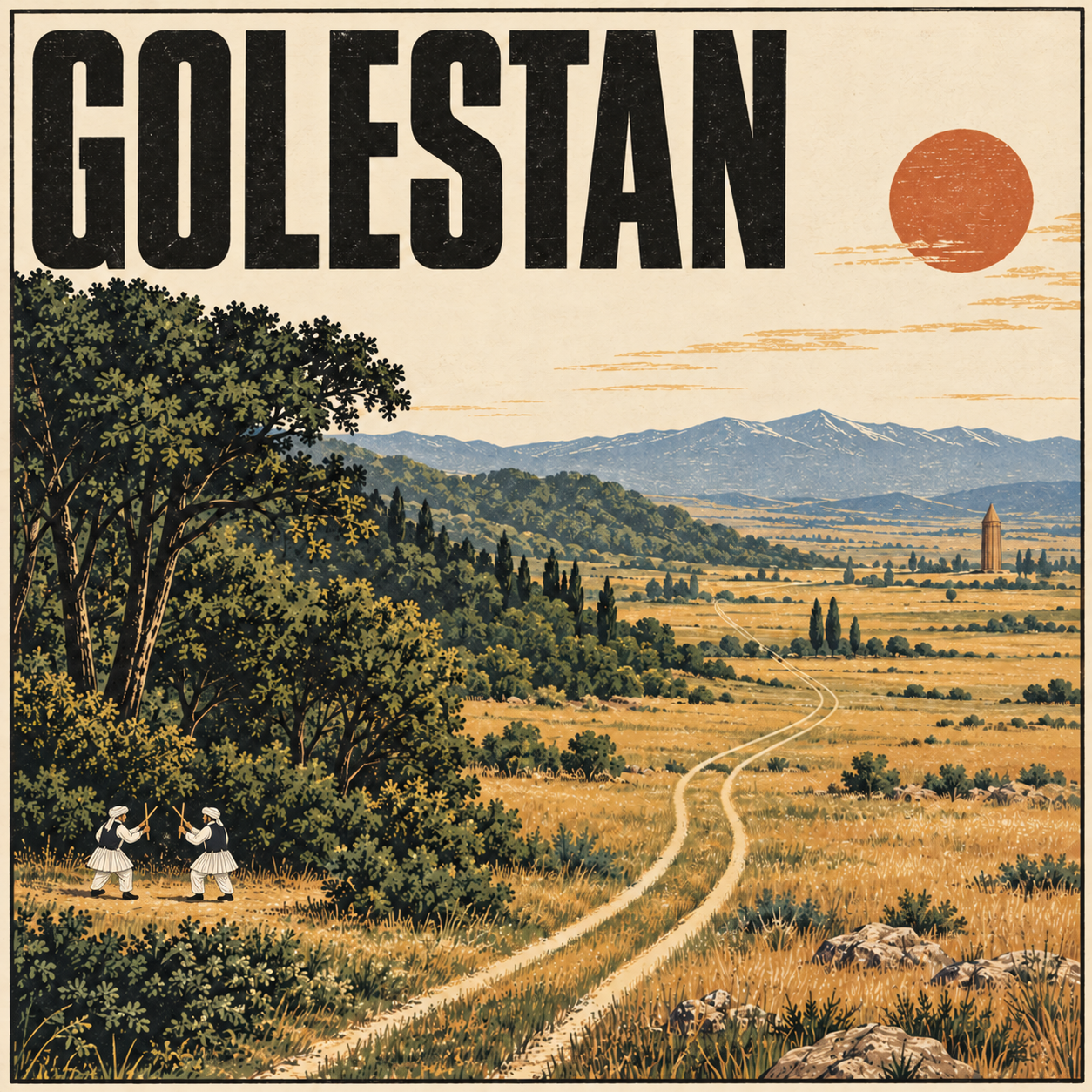
Illustrated Golestan plain with forest, a distant Gonbad tower and two Sistani stick dancers

KATULI · TURKMEN · LIVING PRACTICE · 11 SONGS · 54:11.228

Golestan

Golestan is not one northern sound. Katul and the villages east of Gorgan have their own singers, narratives and instrumental practices. Iranian Turkmen musicians work within traditions that also cross the border. Resident Sistani communities sustain another part of the province’s musical life. This guide connects those practices with named local ensembles, new Katuli compositions, an experimental Turkmen collaboration and a chamber reworking of a melody from Ramian and Katul.

Begin with the Spotify route, then choose a short companion below. The second track introduces a chamber reworking early, while longer narratives remain separated by compact selections. Contemporary traditional performance, new composition and cross-genre experiment offer different ways of hearing how inherited music continues to develop. The approved cover appears on this page; direct playlist and track links avoid older third-party preview snapshots.

Listen on Spotify

THE COVER · PLACE AND INTERPRETATION

Behind the artwork.

A golden low plain opens from a forested southern edge, distinguishing Golestan from the wet fields of Gilan and blue coast of Mazandaran. Paired field tracks suggest strings without inventing an instrument; a distant Gonbad tower recalls a documented contemporary musical collaboration; small, separately grounded Sistani stick dancers acknowledge a living resident community. The image is a poetic regional composite, not one documented viewpoint or a depiction of these communities performing together.

IRAN LISTENING ATLAS · CULTURAL ORIENTATION

A place with many voices.

Borders do not define one repertoire

Golestan became a separate province from eastern Mazandaran in 1997. Older releases can therefore say Mazandaran while naming a place now in Golestan. That does not make every eastern Mazandarani selection a Golestan track: a place, practitioner or documented work connection is still necessary. Gorgan, Aliabad Katul, Ramian and the Turkmen plain should not be collapsed into one Caspian or Turkmen category. Turkmen musical life also crosses the Iran–Turkmenistan border. A shared language or a Turkmenistan recording alone cannot represent Golestan. Oghlan Bakhshi belongs here through Iranian Turkmen family transmission and a documented father-and-son performance, with his Gonbad connection and the album’s cross-border repertoire and recording geography made explicit. This is a connection, not a claim of exclusive provincial ownership.

Katul and the communities around Gorgan

The Golestan Music Association’s regional account locates Aliabad Katul at the eastern edge of the Tabari-speaking area and describes harayi, raste maqam and kallekash as important vocal categories. Narrative works and shorter songs coexist. These practitioner terms should guide listening rather than become a rigid sequence imposed on every recording. Ney and dotar matter, but do not exhaust the region’s instruments. Galesh is not an interchangeable label for everyone along the Caspian. Shokri’s linguistic fieldwork treats Ziarat’s Galesh cattle-herders’ speech as a Mazandarani variety and explains its local occupational usage. This does not establish the language of an untranscribed track. Hamoon’s Gorgan-based Sistani performances offer a further community connection; the selection is not a complete representation of Golestan’s population.

Work women and occasions

Mohammad Reza Barzgar’s Katuli work-song study links repertoire to rice and tobacco cultivation, livestock and forest gathering, and names women among its sources, including Zobeydeh Deylam of Mayan. Najvaye Katul’s practitioner account describes women’s festive singing, basin or tray percussion and sar-gerye mourning. These are distinct activities, not one picturesque folk category. A concert version does not reproduce the original working or wedding event. Qopoz playing offers women-associated instrumental practice; Jamileh’s companion film presents a woman’s lead voice. Avaye Aslan’s credited women sing in the chorus. These different roles deserve to be heard separately, and agricultural roots alone do not make a performance an on-site work recording.

Turkmen ensembles in a deliberate experiment

Ghamsari’s official Gonbad film episode 62 names the work Sallanib Gechdi. Hemat Agh sings and Ibrahim Jorjani leads the Turkmen ensemble on dutar, with Goldi Jan Kar on kamancheh, Hamed Pedari, Bay Mohammad Chandari and Anjom Rooz on dutar, and Labib Jazbani on daf. Ghamsari plays tar. His account describes a jointly agreed shortened and changed arrangement with added daf: a specific collaboration with local musicians, rather than a generic northern-music label. Episode 63 presents a different experiment: tar improvisation beside a Zekr-e Khanjar troupe at the same Gonbad tower. Ghamsari explicitly explains that the added instrument is not customary to the ritual. The named group includes Saeed Khodashenas, Esmail Sabuhi, Haji Mohammad Mottaghi, Mansur Ounaq and Qorban Mohammad PourMohammadi. Watch it as a negotiated contemporary response, not a model of ordinary ritual instrumentation. The Sallanib Gechdi and Zekr-e Khanjar films were published on 6 and 11 December 2021 respectively. The credits and descriptions here belong to these particular filmed performances.

ARTIST DIRECT · BEYOND SPOTIFY

Keep listening.

Sallanib Gechdi at Gonbad tower

A documented changed and shortened arrangement with added daf; the local ensemble and named work are central.

Katoulem Goonde and new Katuli compositions

Explore the newly composed Mato prelude, Nazaninam and Katoulem Goonde; the traditional Amiri section is not newly authored.

Avaye Aslan Katul festival concert

A full Aliabad Katul ensemble program with inherited forms, a credited authored lyric and women’s chorus.

Jamileh Amaniyan in Gonbad

A producer-recorded local performance rooted in Iranian Turkmen family and ensemble transmission; no unverified song title or translation is supplied.

Do chub in Gorgan

A Gorgan-based Sistani troupe at the city’s exhibition, not a similarly named group elsewhere.

The Spotify route contains eleven recordings and runs about 54 minutes. The films and local-ensemble links form a separate companion route, with their own dates and performers. Najvaye Katul’s album page points to separate artist-linked download pages; direct audio playback has not been verified. The films offer direct video destinations. Dates, credits and the longer concert’s program appear below. Follow the playlist order below. This is an editorial listening order, not a traditional concert sequence. Full recordings are used without cuts, and companion videos are separate from the running time. Track durations are rounded to the nearest second. Availability can vary by listener, platform and territory. The notes describe documented practices and recording credits; they are not a report of a full audio audition or a promise about seamless transitions. Individual durations are rounded, and recording, composition, performance and publication dates are distinguished where known. Public Spotify artwork association across anonymous preview surfaces remains unverified; this page uses its approved cover and direct recording links.

DEEPER CONTEXT · LIVING SCENES · RESEARCH LIMITS

Follow another thread.

Open a topic to explore more of this place and its music.

Do not stop at Spotify

For a three-minute entrance to present-day collaboration, watch Hemat Agh and Ibrahim Jorjani’s Turkmen ensemble with Ali Ghamsari at Gonbad tower. Hear Jamileh Amaniyan’s producer-recorded Gonbad performance for a woman’s lead voice. Najvaye Katul’s own album page documents new local compositions; Avaye Aslan Katul’s full concert shows a family ensemble with women’s chorus. Hamoon’s short Gorgan performance brings the province’s resident Sistani community into view. These are integral listening choices, not extra Spotify tracks. Najvaye Katul’s album page points to separate artist-linked download pages; direct audio playback has not been verified. The films offer direct video destinations. Dates, credits and the longer concert’s program appear below.

A small listening vocabulary

Dutar or dotar is a two-stringed plucked lute. Gyjak and kamancheh are bowed instruments; ney is a reed flute. Qopoz here means a metal jaw harp. Tar and setar are different plucked lutes, not alternative names for the dutar.

Two comparisons to try

Compare Ghanbari’s compact opener with Fioj’s longer selection: where does a phrase feel complete, and when does a voice invite you to keep following the story? Then compare the chamber piece with the filmed Turkmen ensemble collaboration. What changes when musicians work from inherited material but choose a different group of instruments? These are listening questions, not claims that the recordings share a tune, rhythm or occasion.

Najvaye Katul makes new Katuli compositions

Najvaye Katul is an Aliabad Katul ensemble founded by Mohammad Reza Barzegar. Its own concert programs are unusually useful: they distinguish inherited material, new arrangement and new composition. In the live Katoulem Goonde program, the Mato prelude is Barzegar’s composition; Nazaninam is composed by Azim Vasi Sari to Mohammad Reza Shaki’s words; Katoulem Goonde is composed by Barzegar to Abdolreza Shaki’s text. The traditional Amiri section of its medley is not thereby newly authored. The concert was held at Aliabad Katul’s culture hall on 16 Bahman 1392 SH, and the official album post is dated 21 Bahman 1392 SH. Davoud Alazmani sings; Barzegar leads, arranges and plays dutar; Azim Vasi Sari plays kamancheh and Hossein Khosravi Katuli ney, alongside further dutars and percussion. These are new culture-rooted works by a local ensemble, not music that needs to be relabelled rock or fusion. The official album page links Mato–Lare, Nazaninam and Amiri–Katoulem Goonde among nine tracks. It points to separate artist-linked download pages; direct audio playback has not been verified. The official program identifies the works and musicians without substituting a similarly named recording.

Avaye Aslan Katul joins inherited forms and authored text

Avaye Aslan Katul’s 25 minute 31 second festival film is a longer direct companion, not another anonymous archive. The Aliabad Katul ensemble was formed in 1396 SH under Ali Aslani Katuli. Its documented set moves through Harayi Ali Siya, Mi Fati ro Nedinam, Hey Baghche Saran and Chakke Sema. Nemat Aslani Katuli is credited for the text of Mi Fati ro Nedinam; melody authorship is not established. That distinction prevents a new lyric from being presented as a wholly new composition. Ali Aslani Katuli leads and plays kamancheh; Nemat and Hossein Aslani Katuli sing and play dutar. Mehdi plays tombak, Saheb dayereh and chorus, and Afsaneh and Alemeh are credited in the chorus. The performance was on 1 Esfand 1399 SH, or 19 February 2021, with broadcast upload on 21 February. The credited festival film is the full performance linked here.

Two short companions widen the musical community

Jamileh Amaniyan’s three-minute producer film was recorded in Gonbad-e Kavus in July 2018 and published on 25 September 2018. Hemat Agh plays dotar and Yousef Dibaei kamancheh. The producer describes her learning from her mother and her work with regional ensembles. The song title and lyric translation are not established. Her longer Berlin concert is a separate optional performance, not the same recording. Hamoon’s two-minute do-chub performance was filmed at Gorgan’s seventeenth international exhibition, in the traditional-booth courtyard, during autumn 1404 SH; the group published it on 27 December 2025. Mahsa Hojjati’s field interview and the troupe’s own archive identify this as the Gorgan Sistani group under Mohammad Nuri, not the similarly named troupe based in Sistan. This is living traditional dance and ensemble practice, not evidence of fusion.

Two further repertoire paths

Koroghlu, approximately 3 minutes 25 seconds, offers another Turkmen repertoire path. Hossein Alizadeh’s Torkaman, approximately 11 minutes 34 seconds, is an authored Persian-classical setar response with a Turkmen connection documented in the artist’s statement and scholarship. It is not a substitute for the local ensemble traditions above, but a longer opportunity to consider how a musician responds to them.

Longer narratives and other listening paths

Kafar Mosalman, approximately 23 minutes 56 seconds, and the 18 minute 40 second Aliabad Katool suite are longer narrative commitments. Their recordings differ from shorter similarly named tracks. Ayenedar’s Sur-e Sarv program on NTS includes Darvish-Ali Khosravi of Aliabad Katul with Ne’matollah Aslani’s haft-band ney, followed by Abbas Alla’eddin’s Ziarat Galeshi narrative. The program crosses provincial boundaries rather than representing Golestan alone. The complete four-movement Sharifian work offers a longer chamber-listening option, beyond the third movement in the introductory route.

Recording editions

Release dates describe editions, not automatically composition or recording. Gosan Parsi’s selected catalog entries are dated 7 July 2007 and carry later copyright metadata. The selected catalog dates Mahoor’s dance collection to 2004, with platform day 9 November; a Persian inventory gives a different release month. Epic Music of Iran 17 is dated 31 August 2020 in the digital catalog and draws on staged performances at the 1376 SH Tehran conference. These are not fieldwork dates in Golestan. Journey Across the Steppes is a 2023 release: Spotify gives 14 April, while the label’s Bandcamp edition gives 23 May. Sharifian’s work dates to approximately 1369–70 SH, while Spotify and Apple date the selected digital issue to 13 August 2013; a later album-launch event is separate. Kereshmeh gives 1986 for Torkaman’s initial issue, while the selected Mahoor/Spotify edition is dated 1988. Availability can vary by listener, platform and territory. The notes describe documented practices and recording credits; they are not a report of a full audio audition or a promise about seamless transitions. Individual durations are rounded, and recording, composition, performance and publication dates are distinguished where known.

The stories in the grooves.

Read in playlist order. Position notes are current editorial readings of the saved order, not a claim about original intent or an audio audition. Sources support specific cultural context; open each track’s qualifications for limits.

  1. Katuli (Golestan)

    Ali Hosein Ghanbari

    Open exact recording on Spotify

    Why this track belongs: Gosan Parsi Vol. 6 identifies this recording as Golestan, while the local practitioner profile places Ali Hosein Ghanbari in Katuli modal and narrative practice. It offers a compact introduction to a named regional singer. The exact accompanists, language and session location are not established by the available recording notes.

    Why this position in the playlist

    Role: Katuli vocal/narrative practice

    Current editorial reading: Open with Ghanbari’s compact Katuli voice before the route broadens.

    To the next track: Four Gorgani Pieces for String Quartet,Clarinet and Harp III follows: Shahrzad String Quartet introduces Sharifian’s chamber reworking early.

  2. Four Gorgani Pieces for String Quartet,Clarinet and Harp III

    Shahrzad String Quartet · music by Mohammad Saeed Sharifian

    Open exact recording on Spotify

    Why this track belongs: Sharifian’s launch program identifies four source melodies from a Khaleghi anthology in order; the third is Narges Ghalle Pani. The original anthology locates it in villages east of Gorgan, especially Ramian and Katul. Sharifian is the composer and Shahrzad String Quartet is the credited ensemble; the additional sextet session players are not individually established. Although the catalogue title says harp, a regional association’s reproduction of the notes reports guitar substitution. This is a chamber reworking, not a claim that the recording contains audible harp.

    Why this position in the playlist

    Role: Non-pop chamber re-composition of a named Gorgani folk melody, not a folk field recording or modern indie band

    Current editorial reading: Shahrzad String Quartet introduces Sharifian’s chamber reworking early.

    From the previous track: After Katuli (Golestan), Shahrzad String Quartet introduces Sharifian’s chamber reworking early.

    To the next track: Babajyklar follows: Shift from chamber music to Oghlan’s voice and dutar with his father’s gyjak.

  3. Babajyklar

    Oghlan Bakhshi · Abdolghaffar Geldinejad

    Open exact recording on Spotify

    Why this track belongs: Felmay and Ciro De Rosa’s specialist review document Oghlan’s voice and dutar with his father Abdolghaffar Geldinejad’s gyjak, setting a Kemine love lyric. Family teaching and the documented father-and-son performance establish Iranian Turkmen musical transmission; his Gonbad connection helps locate that musical life. The album was recorded in Iran and Turkmenistan, and its repertoire is transregional. This is a contemporary traditional performance, not a newly invented fusion style.

    Why this position in the playlist

    Role: Living Iranian Turkmen traditional performance

    Current editorial reading: Shift from chamber music to Oghlan’s voice and dutar with his father’s gyjak.

    From the previous track: After Four Gorgani Pieces for String Quartet,Clarinet and Harp III, Shift from chamber music to Oghlan’s voice and dutar with his father’s gyjak.

    To the next track: Moghol Dokhtar (Golestan) follows: Return to Katul after the first Turkmen example, with Ghanbari’s compact tale.

  4. Moghol Dokhtar (Golestan)

    Ali Hosein Ghanbari

    Open exact recording on Spotify

    Why this track belongs: This selection is track 2 of Gosan Parsi Vol. 6, by the same Katuli narrator as the opener. It offers a compact named tale. Similar titles elsewhere do not establish a shared plot, text or melody. The edition’s 2007 release metadata and later 2022 copyright do not establish the recording day.

    Why this position in the playlist

    Role: Katuli named tale selection

    Current editorial reading: Return to Katul after the first Turkmen example, with Ghanbari’s compact tale.

    From the previous track: After Babajyklar, Return to Katul after the first Turkmen example, with Ghanbari’s compact tale.

    To the next track: Qopoz,Galin Alji,At Ayaghi - Live follows: Move from Katuli singing to qopoz and women-associated instrumental practice.

  5. Qopoz,Galin Alji,At Ayaghi - Live

    Bibi Sara Nasi · Maryam Bahmanyar · Ay Jamal Anvari

    Open exact recording on Spotify

    Why this track belongs: The digital edition names Bibi Sara Nasi, Maryam Bahmanyar and Ay Jamal Anvari. Khoobo’s secondary edition inventory identifies qopoz playing and associates Galin Alji with bridal arrival and wedding horse-racing, and At Ayaghi with horse-foot and gait images. Those interpretations are attributed to that inventory, not to an inspected original booklet. Here qopoz means a metal jaw harp. This is a staged Tehran anthology performance, not an asserted recording at a Golestan wedding; instrumental participation is distinct from women’s vocal repertoire.

    Why this position in the playlist

    Role: Turkmen qopoz/jaw-harp program, wedding-associated images

    Current editorial reading: Move from Katuli singing to qopoz and women-associated instrumental practice.

    From the previous track: After Moghol Dokhtar (Golestan), Move from Katuli singing to qopoz and women-associated instrumental practice.

    To the next track: Garrylar Gerek follows: After archival qopoz, hear an authored song in living Turkmen ensemble practice.

  6. Garrylar Gerek

    Oghlan Bakhshi

    Open exact recording on Spotify

    Why this track belongs: The recording review identifies music by Ata Ablyýev and words by Magtymguly Myşşyýew, with second dutar by Altymyrat Pürmämmedow and gyjak by Saparmyrat Annamyradow. Authored music exists within the tradition: this is not a claim that Oghlan composed the piece. Its ensemble setting offers a different relationship from Babajyklar’s father-and-son performance and Humarala’s solo instrumental role.

    Why this position in the playlist

    Role: Authored song within living Turkmen tradition

    Current editorial reading: After archival qopoz, hear an authored song in living Turkmen ensemble practice.

    From the previous track: After Qopoz,Galin Alji,At Ayaghi - Live, After archival qopoz, hear an authored song in living Turkmen ensemble practice.

    To the next track: Abbas Galeshi (Golestan) follows: Give Fioj’s longer Katuli narrative space after the compact ensemble song.

  7. Abbas Galeshi (Golestan)

    Eisa Fioj

    Open exact recording on Spotify

    Why this track belongs: Eisa Fioj’s selection is track 9 of Gosan Parsi Vol. 11, running approximately 7 minutes 23 seconds. It opens a longer space for another named Katuli practitioner. It is a different recording from the 18:40 Epic Music of Iran 18 Aliabad Katool sequence and Mahoor 440’s 5:42 Abbas Galesh; their accompaniment, sections and recording details should not be interchanged.

    Why this position in the playlist

    Role: Katuli narrative practitioner

    Current editorial reading: Give Fioj’s longer Katuli narrative space after the compact ensemble song.

    From the previous track: After Garrylar Gerek, Give Fioj’s longer Katuli narrative space after the compact ensemble song.

    To the next track: Nar Aghaji (Live) follows: Follow that longer tale with a shorter Turkmen festive selection.

  8. Nar Aghaji (Live)

    Mahoor Turkmen dance and festivity collection

    Open exact recording on Spotify

    Why this track belongs: Mahoor publishes a matching Nar Aghaji item from its Turkmen dance and festivity collection. That producer evidence supports a specific festive repertoire connection. The six names in the Spotify credits belong to the album collectively; they are not a verified six-person lineup on this track. The SoundCloud upload is dated 2022 and is not the original release date.

    Why this position in the playlist

    Role: Turkmen festive repertoire

    Current editorial reading: Follow that longer tale with a shorter Turkmen festive selection.

    From the previous track: After Abbas Galeshi (Golestan), Follow that longer tale with a shorter Turkmen festive selection.

    To the next track: Yarerami,ilalari follows: Return to bardic narrative after the festive item, without clustering long tales.

  9. Yarerami,ilalari

    Nazarli Mahjubi · Bahram Berdikor

    Open exact recording on Spotify

    Why this track belongs: The digital edition credits Nazarli Mahjubi and Bahram Berdikor. Khoobo’s secondary edition inventory connects the sections to the Yusof and Ahmad story; this association is not an independently inspected primary-booklet quotation. Seven minutes is an excerpt, not the complete dastan. Iranica’s separate 3:18 Ilari recording offers broader practitioner and repertoire context, but it is not this master and does not establish its instrumental lineup.

    Why this position in the playlist

    Role: Turkmen bardic narrative

    Current editorial reading: Return to bardic narrative after the festive item, without clustering long tales.

    From the previous track: After Nar Aghaji (Live), Return to bardic narrative after the festive item, without clustering long tales.

    To the next track: Humarala follows: Place compact solo dutar between the narrative excerpt and communal ending.

  10. Humarala

    Oghlan Bakhshi

    Open exact recording on Spotify

    Why this track belongs: The recording-specific review identifies solo dutar, offering a compact instrumental contrast to Oghlan’s two vocal or ensemble selections. His Iranian Turkmen family connection does not make the tune or session exclusively Golestani: the album’s repertoire and recording geography cross the border.

    Why this position in the playlist

    Role: Solo dutar within living Turkmen traditional practice

    Current editorial reading: Place compact solo dutar between the narrative excerpt and communal ending.

    From the previous track: After Yarerami,ilalari, Place compact solo dutar between the narrative excerpt and communal ending.

    To the next track: Zekr Khanjar (Live) follows: End with communal ritual repertoire, widening the focus from solo dutar.

  11. Zekr Khanjar (Live)

    Mahoor Turkmen dance and festivity collection

    Open exact recording on Spotify

    Why this track belongs: Iran’s tourism authority documents Zekr-e Khanjar in several Golestan towns, including Gonbad, Kalaleh, Aq Qala, Gomishan and Bandar Turkmen. That establishes a regional practice, not the precise event captured by this recording. The album’s collective musician list should not be read as the lineup of every individual track.

    Why this position in the playlist

    Role: Turkmen named ritual repertoire

    Current editorial reading: End with communal ritual repertoire, widening the focus from solo dutar.

    From the previous track: After Humarala, End with communal ritual repertoire, widening the focus from solo dutar.

Follow the threads.

These earlier reading lists offer broader context. The per-track source notes identify what each reference supports and where verification remains open.