Gilan holds more than one northern sound. Gilaki and Taleshi singing, rice work, mountain life, urban song and new experiments each belong to its musical story.
This 12 recording route moves from a Gilaki song to live jazz, dance, work voices, Taleshi singing and an electroacoustic dedication. Juma and Haray offer artist direct companion listening beyond Spotify. The verified desktop playlist runs 51:22; playback availability may vary.
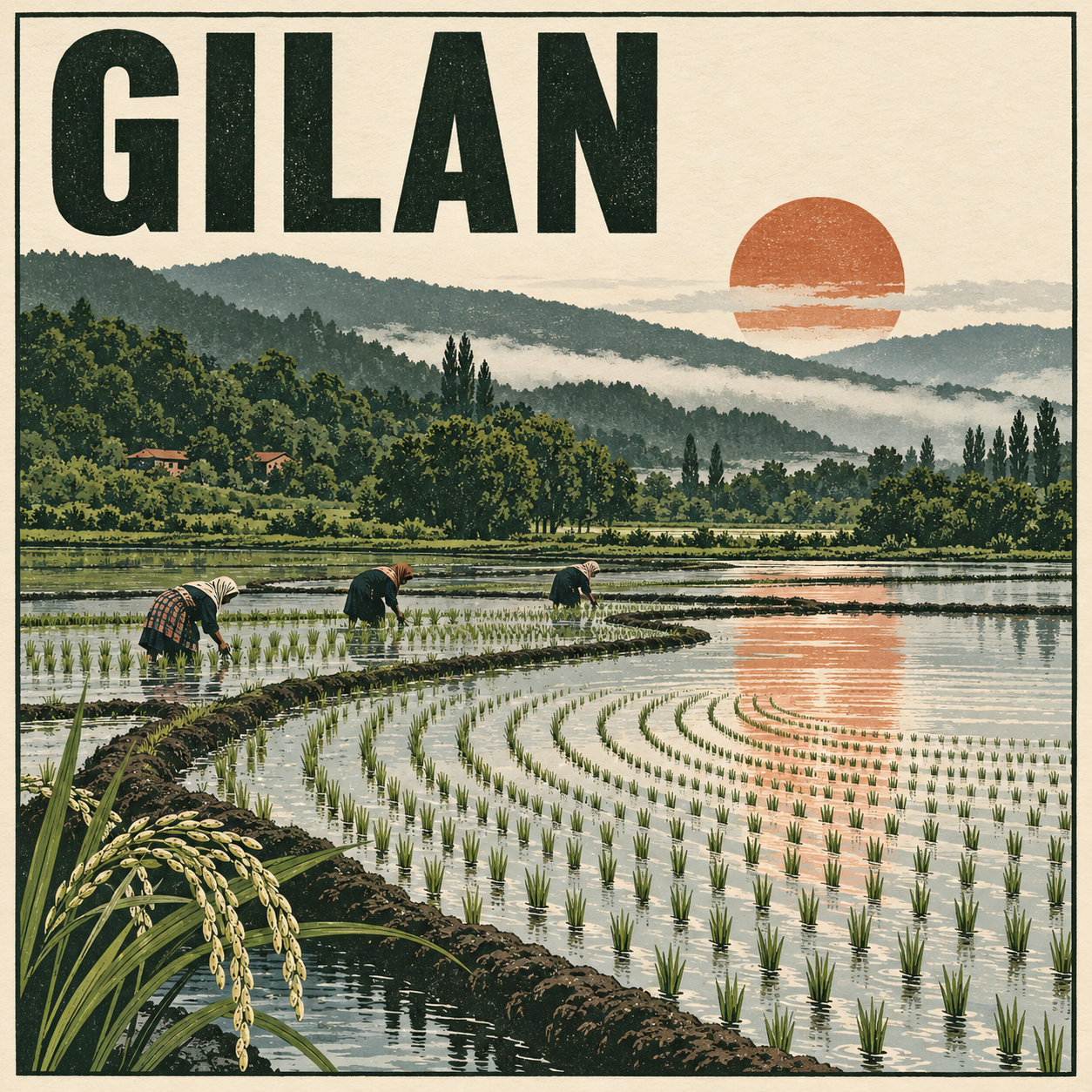
This illustrated postcard places women transplanting rice before Gilan's wooded hills. Curved paddy rows also suggest the grooves of a record, joining field work and listening. A ripe rice ear beside newly planted seedlings deliberately brings different seasons into one image; the checked waist cloth is an illustrative detail, not a claim about a uniform. The scene is a poetic regional composite, not a documented viewpoint or a portrait of the singer.
Gilaki, Taleshi and Rudbari are distinct labels. Eastern and western Gilaki broadly divide around the Sefidrud. Taleshi also varies by locality and crosses borders. The Fumani-style selection marks one specific Taleshi tradition.
Historical accounts place women at the center of cooperative transplanting and weeding. The notes for Hay Omare describe a greeting and choral response in a Rezvanshahr rice paddy. They document this performance, not every present-day farm.
Galeshi pastoral life, Qasemabadi dance, weddings and spring visiting songs belong to different settings. An arranged dance track cannot represent them all. Spring Nowruz singing is distinct from midsummer Noruzbal.
Rasht, Anzali, radio and migration also shaped regional music. Ashourpoor and Akbar connect Gilaki culture with professional song. Juma, Haray, Najafi and Pashaei each create a different contemporary path with documented local ties.
Juma sets Gilaki writing in a current independent project. Start with the 2022 title track on the label page. The checked Spotify album was unavailable in one account; that does not establish worldwide absence.
The Rasht duo makes folk-jazz connected to Gilan and Gilaki. Its artist SoundCloud gives track-specific poem, instrument and production credits. An exact Spotify master was not resolved.
Saved route and desktop duration verified 25 October 2026. Notes are source-led; no full audio audition is claimed.
DEEPER CONTEXT · LIVING SCENES · RESEARCH LIMITS
Follow another thread.
Open a topic to explore more of this place and its music.
Juma and living Gilaki songwriting
Juma, led by Amin Haghrah, builds songs around Gilaki writing and local memory. The 2022 Shovan album draws on poets including Abazar Gholami. The label describes a folk-rock and fusion project; those album tags do not define every track. A 2026 artist announcement for Shurum connects Anzali-port stories with musicians who also work in Haray. Shovan remains an artist-direct companion because the exact Spotify album was unavailable in the account checked.
Masoud Shabanpour and Saman Ayoubi describe Haray as an independent Gilan and Gilaki project. An institutional biography describes their folk-jazz practice. The artist’s Sine Sorkh post names the poem and its specific ney, bass, percussion and production collaborators. Its upload date is not proof of first release. No exact Spotify master was mapped, so the artist SoundCloud is the recommended recording.
Shahin Najafi’s Gileh Lo is included for its documented Gilaki text and dedication to Fereydun Purreza. The Meta Phrygian credits identify the live ensemble, while the 2017 official video identifies a Stockholm performance. Personnel from Najafi’s other projects should not be transferred to this recording. Purreza’s own Gile Lo offers a useful comparison, but melodic identity has not been proved.
Behrouz Pashaei dedicates Shesh to Gilan music and named people. The track credits identify Nasrin Nouri’s voice, Pashaei’s electronics, guitar and setar, Arash Bolouri’s santour, and Kimia NikpourFarokh’s kamancheh. The original folk tune, vocal language and any sample source remain unidentified. This is an experimental dedication with track-level evidence, not a generic province match.
Deylamoon’s theater-and-folk performances and Ali Hashemloo’s Rasht electroacoustic activity widen the picture of living regional practice. Their current work does not yet supply an exact, sufficiently documented Spotify recording for this route. Folk performance, experimental sound and fusion are related paths, not interchangeable genre labels.
The older Purreza and Hamidi Gile Lo can be placed beside Najafi’s jazz tribute. Purreza’s Ra’na and Farajollah Chakani’s Rana I offer different recordings to compare with the core Rastak interpretation. Masoudi’s Gole Pamchal and Rastak’s Gol e Pamchal form a separate comparison. After the Fumani Taleshi selection, Masali and Shandermani styles reveal more local variation. These are optional listening paths; matching titles do not establish identical words, melodies or recording masters.
The rice-work anthology documents greeting, response and departure functions as distinct actions. Its Man Hajiym and Kara Pashimuna Nana extend the core Hay Omare example. Cradle song, bridal-transfer repertoire and Qasemabadi dance belong to other settings. Nowruze-Khuni I documents spring New Year singing; it is not evidence for the separate midsummer Noruzbal celebration.
Saba’s Deylaman is a classical transformation linked to collecting in both Gilan and Mazandaran, without a verified exclusive Gilan source village. Mehdi Hosseini’s Taleshi Hava is another researched composition, but its exact source locality and Spotify master remain unsettled. Aref Ghorbani’s Friday Market and Darya Dadvar’s Guilaneh Jan remain research leads because their exact recording and no-pop fit need more evidence.
Stilo’s linguistic survey separates Gilaki, Rudbari and Taleshi and describes transition zones across present borders. Historical ethnography documents women’s difficult cooperative rice work and responsive singing; it is not a census of every woman today. Rasht radio and authored Gilaki songs carried local language into professional performance. Ashourpoor’s testimony and Akbar’s biography document cultural labor beyond simple birthplace labels.
The short selection does not cover every religious, wedding, mourning, seasonal or instrumental practice. Nowruzkhani and Noruzbal belong to different parts of the year. Pop-rock projects with regional lyrics remain outside this no-pop route, and a Gilaki project based in Tonekabon cannot be reassigned to Gilan on language alone.
Read in playlist order. Position notes are current editorial readings of the saved order, not a claim about original intent or an audio audition. Sources support specific cultural context; open each track’s qualifications for limits.
Why this track belongs: Tirgan names Korashim among Masoudi’s recognized works and identifies the repertoire as folkloric Gilaki. This exact Sarbang/Kora Shim catalog recording introduces a regional song before the jazz turn. A later digital date is not a recording-session date; blanket composer metadata does not settle older authorship.
Listen for: Begin with the named Gilaki repertoire before the route changes setting.
First, it establishes the Gilaki repertoire before any stylistic reinterpretation; putting the jazz track first would defer that straightforward cultural introduction.
To the next track: Gileh Lo Live keeps the regional-language thread but immediately shows a contemporary jazz treatment, so the opening is not an archival block.
Why this track belongs: Use the Meta Phrygian live recording linked below. The official Gilaki text, Purreza dedication and specific ensemble credits support its place. Its early place in the route brings living reinterpretation forward. Purreza’s older Gile Lo is a separate comparison below, not a second independent repertoire item.
Listen for: Hear how a documented Gilaki work moves into a live jazz setting.
Second, it answers the opening regional song with documented live jazz before a visitor has to work through a long traditional preface; later placement would hide a central part of the brief.
From the previous track: Kora Shim establishes Gilaki repertoire; this changes its presentation context, without claiming the two tracks share a tune.
To the next track: Qasemabadi then changes the cultural question from a tribute in concert to a dance association, avoiding a run of individual song portraits.
Why this track belongs: Mahoor’s own upload identifies Qasemabadi from Gilan, compiled and arranged by Hamidi. The dance offers a different social association after the jazz song. This is an issued arrangement, not an unedited wedding field recording; broader dance gestures and instruments are not automatically credits for this master.
Listen for: Consider the difference between a dance tradition and this issued arrangement.
Third, it follows two vocal-song introductions with a different social use of music; it also separates the jazz tribute from Dadvar’s concert interpretation instead of grouping every staged reworking together.
From the previous track: Gileh Lo Live presents a named concert tribute; this shifts attention to dance and the distinction between practice and issued arrangement.
To the next track: Jinge Jan returns to concert interpretation, now after the listener has met a different social function.
Why this track belongs: This is the 3:23 Toronto Live 2008 recording, distinct from the shorter Berlin version. Borjian and Borjian identify Gingi Jan in Ashourpoor’s Gilaki repertoire; an interview with a regional researcher also describes Jinge Jan as bilingual Gilaki/Persian. Dadvar’s exact official master establishes recording identity. This supports repertoire continuity, not a claim that every verse is Gilaki or that this specific arrangement is jazz.
Listen for: Compare a concert treatment with the older Ashourpoor repertoire it recalls.
Fourth, immediately before Ashourpoor, it creates a concrete interpreter-to-historical-voice comparison; moving it away would weaken that relationship.
From the previous track: Qasemabadi has foregrounded a social dance association; this changes to a named song in a concert edition.
To the next track: Pache Leli lets Ashourpoor’s own recorded voice follow the discussion of his repertoire. This is a repertoire-network comparison, not two versions of the same song.
Why this track belongs: Folkways’ original notes identify Ashourpoor’s Gilaki singing and professional relationship to Gilan. His own recorded voice makes the urban history tangible after Dadvar’s concert reinterpretation. The 1960 album issue is not a verified session date, and historical commercial circulation is not itself a reason to label the recording present-day pop.
Listen for: Place a professional urban Gilaki voice beside the newer interpretations.
Fifth, it makes the preceding Ashourpoor-repertoire reference audible through his own performance, then forms the professional-song side of the contrast with the rice-work recording.
From the previous track: Jinge Jan introduced a later interpreter within Ashourpoor’s repertoire network; this presents Ashourpoor himself through a different song.
To the next track: Hay Omare moves from a professional individual performer to a documented greeting-and-response social exchange.
Why this track belongs: Faridi-Haftkhani’s notes describe Z. Abedi and chorus in a Rezvanshahr rice-paddy welcome, with a leader greeting workers and family members and a group response. The collector is distinct from the singers, and a different recording’s village is not assigned here. The documented social exchange deserves a complete encounter amid professional recordings.
Listen for: Attend to the greeting and group response described in the recording notes.
Sixth, it puts collective work voices inside the main route between two professional recordings, rather than treating them as an optional appendix or opening with a long documentary block.
From the previous track: Pache Leli locates Gilaki culture in professional urban song; this makes a different source of musical authority and participation explicit.
To the next track: Raana returns to an arranged ensemble context, so the work performance is a complete encounter with its own function, not a claim that all folk recordings are field recordings.
Why this track belongs: The chosen 3:47 Essentials recording is the 2023 edition. Rastak identifies its Gilan/Gilaki connection; Songlines discusses this arrangement. It continues the move from communal voice to arranged repertoire without claiming a newly composed song. A popular folk performance is not automatically mainstream pop, and this recording is selected on its specific evidence.
Listen for: Hear a contemporary folk ensemble revisit a Gilan song.
Seventh, it returns to a documented contemporary ensemble immediately after collective work and before a different language tradition, preventing a long, undifferentiated documentary middle.
From the previous track: Hay Omare documents a social exchange; Raana provides a different, arranged mode of presenting regional repertoire without claiming to derive from that work song.
To the next track: Fumani-style Taleshi then changes the language and local singing tradition rather than offering a second Gilaki ensemble selection.
Why this track belongs: The title identifies Fumani-style Taleshi singing, and Mahoor’s comparative survey follows local variation across Iranian Talesh. G. Rajabi’s recording prevents Gilaki urban song from standing for the whole province. Neither an expanded first name nor an exact village, ritual or session date is inferred from its style label.
Listen for: Give Taleshi its own place in the route rather than treating it as Gilaki.
Eighth, between two documented Gilaki repertoire selections, it makes the Taleshi distinction easy to notice as a deliberate change of cultural frame, not a token tucked at the end.
From the previous track: Raana supplies an arranged Gilaki song; this asks the listener to recognize a separate language and local singing style rather than one northern sound.
To the next track: Aha Bogu returns to Gilaki repertoire in a professional recording, making the difference in cultural frame explicit.
Why this track belongs: This is the 5:04 Vahdati/Hamidi Zarangis recording. Hafdang explicitly identifies Aha Bugu as a Gilaki folk song in its own separate Vahdati performance; this supports the repertoire link, not the same audio master. Vahdati’s interview supports artist and collecting context only. Hafdang’s 2021 live instrumentation is not documented for this older recording.
Listen for: Follow a folk song as it moves into a professional recording.
Ninth, it resumes the Gilaki song thread after the Taleshi stop and precedes a more specifically localized narrative, creating a distinction between circulating repertoire and a named story.
From the previous track: The Fumani Taleshi selection has widened the province’s language map; this returns to a documented Gilaki song rather than implying both are interchangeable.
To the next track: Heybat moves to the Siahkal/Deylaman narrative and a different lead performer, while Hamidi remains a catalog collaborator.
Why this track belongs: Radio Navahi and Tavaana connect Heybat with the local Siahkal/Deylaman narrative. It retains Purreza through a distinct song rather than stacking his familiar titles. The Purreza interview used elsewhere concerns his wider practice and Ra’na, not direct evidence for Heybat. Credits from other performances are not assigned to this master.
Listen for: Meet Purreza through the particular Heybat narrative.
Tenth, it supplies a situated narrative before the explicitly signposted experimental turn; it also recalls the Purreza dedication heard at slot 2 without stacking two versions of that same song.
From the previous track: Aha Bogu represents circulating folk repertoire in a professional edition; Heybat narrows the focus to a particular local narrative.
To the next track: Shesh then moves from a sourced narrative connection to an artist-declared electroacoustic dedication, a consciously different kind of regional relationship.
Why this track belongs: The selected Encounter track is directly dedicated to Gilan music and has specific voice, electronics and instrumental credits. It supplies a late electroacoustic perspective without claiming to reproduce an identified folk tune unchanged. The unusual texture is a source-informed expectation, not an auditioned transition; the official credits carry the regional argument.
Listen for: Approach this documented tribute as an experimental turn.
Eleventh, after the route has established languages, work, song and narrative, it can introduce a less literal contemporary connection with context; leaving one short historical voice afterward avoids making experimentation the endpoint of a supposed progress story.
From the previous track: Heybat offers a specific regional narrative; Shesh offers a declared musical dedication, not a documented remake of Heybat or another identified tune.
To the next track: Aftab Khizan returns to historical authored song, showing that experimental and historical practices can coexist rather than replace one another.
Why this track belongs: Akbar’s Gilaki cultural work and Sartippour repertoire are documented by biography and family testimony. This brief recording returns to an individual historical voice after the experimental excursion. Family interpretation of the song’s wartime and freedom associations should remain attributed. The later archival issue is not the performance date or proof of recent pop.
Listen for: Close with Akbar’s historical voice and authored cultural work.
Twelfth, its documented 2:37 length gives the route a concise final statement after the experimental excursion, closing on a person and cultural memory rather than a claim that modern music supersedes the past.
From the previous track: Shesh has widened the frame to electroacoustic tribute; this returns to Akbar’s own historical voice without claiming a calming or harmonically matched transition.
Follow the threads.
These earlier reading lists offer broader context. The per-track source notes identify what each reference supports and where verification remains open.