
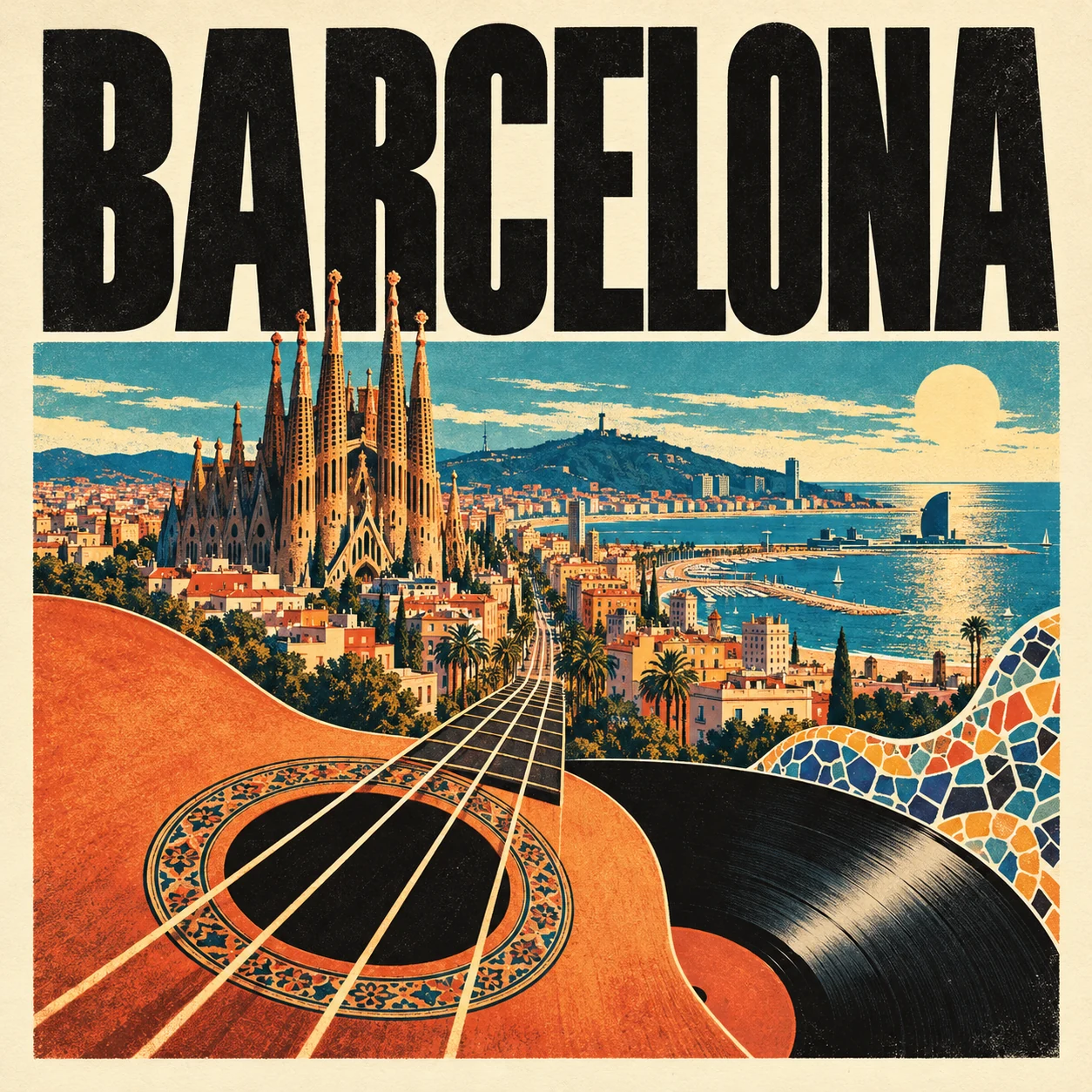
RUMBA · NOVA CANÇÓ · NEW VOICES · 20 SONGS
Barcelona
Barcelona's route brings Catalan rumba, Nova Cançó, counterculture, flamenco projects, indie music and contemporary popular work into one conversation. Some connections belong to the wider Catalan or metropolitan network rather than the city municipality.
The notes identify each selection's specific song, project, scene or reception link and explain its current place in the saved order. They do not claim every song depicts Barcelona or that the source material authenticates a particular audio master.
Listen on SpotifyThe stories in the grooves.
Read in playlist order. Position notes are current editorial readings of the saved order, not a claim about original intent or an audio audition. Sources support specific cultural context; open each track’s qualifications for limits.
The city finds its beat
Begins with Borriquito (A familiar doorway into a specific community history) and reaches Gitanitos y morenos (Rumba returns through a different creative relationship). Open the track notes for the documented connections and the editorial reasons for this order.
Why this track belongs: Peret’s Borriquito brings Catalan rumba into the portrait through a named repertoire and the Barcelona Romani communities from which the practice emerged. Familiarity is an invitation to that history, not a substitute for it.
Sources and limits
- RTVE: Borriquito history
Public source text inspected on 2026-10-26. Work and performer history; not this master.
Scope: exact-work
- RNE: Catalan rumba
Public source text inspected on 2026-10-26. Barcelona Romani origins and changing rumba practice.
Scope: community-scene
- Retained prior guide context
Retained for provenance only; not independently relied on as support for revised claims. Source bundles do not establish exact-master evidence.
Scope: unclassified
Qualifications:
- This catalog ID is preserved, but no claim that it is the original 1971 single master is made.
Why this position in the playlist
Role: A familiar doorway into a specific community history
Proposed editorial rationale: First, begin with a widely circulated song, then immediately offer Serrat’s different songwriting tradition. Returning to rumba at 3 makes the opening an alternation rather than a block that treats one genre as the whole city.
To the next track: Borriquito opens a rumba thread; Paraules D’Amor immediately introduces a different Catalan songwriting history rather than extending one genre block.
- RTVE: Borriquito history
Why this track belongs: Serrat’s official biography places him in the Nova Cançó and Els Setze Jutges movement for Catalan language and culture; Paraules d’Amor is part of that repertoire. This is a creative and linguistic connection, not only a Poble-sec birthplace credit.
Sources and limits
- Serrat official biography
Public source text inspected on 2026-10-26. Nova Cançó/Els Setze Jutges and named repertoire.
Scope: artist-project
- Serrat official discography
Public source text inspected on 2026-10-26. Paraules d’amor listed on the work’s album; no master match.
Scope: exact-work
- Retained prior guide context
Retained for provenance only; not independently relied on as support for revised claims. Source bundles do not establish exact-master evidence.
Scope: unclassified
Qualifications:
- The old sentence about moving from public resistance is not accurate as a description of the immediate predecessor. No tempo or arrangement comparison has been auditioned.
Why this position in the playlist
Role: Catalan songwriting inside the opening alternation
Proposed editorial rationale: Second, place a Catalan songwriter between Peret and Gato Pérez rather than postpone all language-led song until the protest pair. The interruption lets rumba return at 3 as a recurring thread, while Serrat also prepares the later Llach–Bonet comparison.
From the previous track: Borriquito opens a rumba thread; Paraules D’Amor immediately introduces a different Catalan songwriting history rather than extending one genre block.
To the next track: Gitanitos y morenos returns to rumba after Serrat. This is a recurrence across the opening, not a claim that Gato immediately follows Peret.
- Serrat official biography
Why this track belongs: Gato Pérez’s role in renewing Catalan rumba is documented by RNE; Gitanitos y morenos belongs to his Atalaya repertoire. It offers a different participant in the city’s rumba history, not a claim that all of its practitioners share the same origins or viewpoint.
Sources and limits
- RNE: Catalan rumba
Public source text inspected on 2026-10-26. Gato Pérez’s renewal of the practice.
Scope: artist-project
- Apple catalog: Gitanitos y Morenos
Public source text inspected on 2026-10-26. Work listed on Atalaya; parallel catalog only.
Scope: exact-work
- Retained prior guide context
Retained for provenance only; not independently relied on as support for revised claims. Source bundles do not establish exact-master evidence.
Scope: unclassified
Qualifications:
- The older wording “After Peret” should not imply that Peret is the immediately preceding track. No exact-master sound or album-session equivalence is inferred.
Why this position in the playlist
Role: Rumba returns through a different creative relationship
Proposed editorial rationale: Third, return to the rumba thread after Serrat, so Peret and Gato form a separated comparison rather than a misleading claim of direct adjacency. Put this return before Llach so the next pair can focus explicitly on political song.
From the previous track: Gitanitos y morenos returns to rumba after Serrat. This is a recurrence across the opening, not a claim that Gato immediately follows Peret.
To the next track: After the rumba return, L’estaca changes the focus to authored political song; no acoustic rise or drop is assumed.
- RNE: Catalan rumba
A language for singing together
Begins with L'estaca (Political song as a sustained subject) and reaches Qualsevol nit pot sortir el sol (An imagined gathering after the countercultural turn). Open the track notes for the documented connections and the editorial reasons for this order.
Why this track belongs: Llach’s early repertoire and Barcelona performance history situate L’estaca within Catalan authored song. Its collective-effort metaphor makes language and solidarity part of the city portrait, without making one song stand for every political position.
Sources and limits
- Llach official biography
Public source text inspected on 2026-10-26. Barcelona career and censorship history.
Scope: artist-project
- Llach official early album listing
Public source text inspected on 2026-10-26. L’estaca and early political repertoire; compilation reissue history.
Scope: exact-work
- Retained prior guide context
Retained for provenance only; not independently relied on as support for revised claims. Source bundles do not establish exact-master evidence.
Scope: unclassified
- Retained prior guide context
Retained for provenance only; not independently relied on as support for revised claims. Source bundles do not establish exact-master evidence.
Scope: unclassified
- Llach official song text
Official Catalan text inspected on 2026-10-26; supports paraphrased collective-effort metaphor only, not an audience or sound claim. No lyrics reproduced.
Scope: exact-work
Qualifications:
- The collective interpretation concerns the work, not evidence that this recording includes a crowd. The later compilation title is not treated as the original composition date.
Why this position in the playlist
Role: Political song as a sustained subject
Proposed editorial rationale: Fourth, begin a two-track examination of political song after the opening alternation. Keeping Bonet next allows comparison between different works and authors, rather than leaving a single anthem to represent the subject.
From the previous track: After the rumba return, L’estaca changes the focus to authored political song; no acoustic rise or drop is assumed.
To the next track: L’estaca and Que Volen Aquesta Gent? make a two-work political-song comparison, preserving their different authors and stories.
- Llach official biography
Why this track belongs: Bonet presented Què volen aquesta gent? at Barcelona’s Cova del Drac; her own discography documents its ballad construction, censorship and later return on Alenar. The story concerns a student’s death in Madrid, so its Barcelona connection is a creative scene, not the location of every event narrated.
Sources and limits
- Bonet official original release history
Public source text inspected on 2026-10-26. Barcelona presentation, Madrid narrative, authorship and censorship.
Scope: exact-work
- Bonet official Alenar account
Public source text inspected on 2026-10-26. Later return of the censored work on Alenar; no Spotify-master authentication.
Scope: exact-work
- Retained prior guide context
Retained for provenance only; not independently relied on as support for revised claims. Source bundles do not establish exact-master evidence.
Scope: unclassified
Qualifications:
- The song’s Madrid subject must not be relabelled a Barcelona incident. Artist album documentation is not an audio fingerprint of this catalog master.
Why this position in the playlist
Role: A specific ballad history, not a generic protest label
Proposed editorial rationale: Fifth, keep it beside L’estaca to make the protest-song comparison concrete, then let Pau Riba change the route from political song to countercultural record-making. Bonet is a composer and scene participant here, not a token female voice.
From the previous track: L’estaca and Que Volen Aquesta Gent? make a two-work political-song comparison, preserving their different authors and stories.
To the next track: Bonet’s documented ballad history gives way to Riba and Om’s countercultural record project rather than a third similar protest example.
- Bonet official original release history
Why this track belongs: Noia de porcellana appears in Pau Riba’s Dioptria, whose collaboration with Om is documented through the musicians’ recollections and label catalog. Its Barcelona recording context gives countercultural Catalan rock a concrete place in the route.
Sources and limits
- Munster: Dioptria
Public source text inspected on 2026-10-26. Label track listing names Noia de Porcellana.
Scope: exact-work
- El Temps: Om remembers Dioptria
Public source text inspected on 2026-10-26. Musicians’ recollections of the Barcelona recording project; not specific master identification.
Scope: artist-project
- Retained prior guide context
Retained for provenance only; not independently relied on as support for revised claims. Source bundles do not establish exact-master evidence.
Scope: unclassified
- Retained prior guide context
Retained for provenance only; not independently relied on as support for revised claims. Source bundles do not establish exact-master evidence.
Scope: unclassified
Qualifications:
- The older Apple URL path is labelled Taxista, not Noia de porcellana, and is not relied on as exact-track evidence; the page could not be freshly retrieved. Label track listing supports the work/album association, not reissue-to-Spotify-master equivalence.
Why this position in the playlist
Role: Counterculture enters through a named record project
Proposed editorial rationale: Sixth, change the project model after the Llach–Bonet pair, then keep Sisa beside Riba as another countercultural songwriter. This puts experimentation inside the city’s history rather than saving all unusual work for an isolated final annex.
From the previous track: Bonet’s documented ballad history gives way to Riba and Om’s countercultural record project rather than a third similar protest example.
To the next track: Riba and Sisa remain adjacent as distinct countercultural projects: the next selection centers an imagined gathering.
- Munster: Dioptria
Qualsevol nit pot sortir el sol
Sisa
Recording: Qualsevol nit pot sortir el sol
Open exact recording on SpotifyWhy this track belongs: Sisa’s Qualsevol nit pot sortir el sol connects Barcelona songwriting with an imagined gathering of popular-cultural characters. The documented song history ties that invitation to his Poble-sec and underground trajectory rather than treating fantasy as placeless.
Sources and limits
- El País: history of Sisa’s song
Public source text inspected on 2026-10-26. Song’s imagined gathering/popular culture and Poble-sec/underground trajectory.
Scope: exact-work
- Retained prior guide context
Retained for provenance only; not independently relied on as support for revised claims. Source bundles do not establish exact-master evidence.
Scope: unclassified
Qualifications:
- The invitation is a song-level interpretation supported by its documented history. Specific piano, violin-entry or vocal claims from the older guide are not repeated without audition or recording credits.
Why this position in the playlist
Role: An imagined gathering after the countercultural turn
Proposed editorial rationale: Seventh, follow Riba with another countercultural perspective but a different organizing idea: an imagined gathering. Place El Último de la Fila next to move onward to a different band generation, rather than extend this pair into a chronology of one scene.
From the previous track: Riba and Sisa remain adjacent as distinct countercultural projects: the next selection centers an imagined gathering.
To the next track: Insurrección leaves the Riba–Sisa pairing for a different band generation; the change is historical and organizational, not an auditioned energy shift.
- El País: history of Sisa’s song
Streets and crossings
Begins with Insurrección - 2008 Remaster (A different band generation and language) and reaches Tangos de la Repompa (Women’s ensemble-making as a local creative connection). Open the track notes for the documented connections and the editorial reasons for this order.
Insurrección - 2008 Remaster
El Último De La Fila
Recording: Enemigos de lo ajeno (2008 Remaster)
Open exact recording on SpotifyWhy this track belongs: El Último de la Fila emerged from Barcelona’s band networks; Insurrección is a documented work from the García–Portet partnership. The selected catalog title retains its 2008 remaster qualifier, distinguishing the edition label from the work’s earlier history.
Sources and limits
- El País: El Último de la Fila history
Indexed public extract inspected on 2026-10-26. Barcelona formation and named repertoire; no master match.
Scope: artist-project
- Apple: Insurrección 2008 Remaster
Public source text inspected on 2026-10-26. Parallel catalog identifies remaster and earlier album era.
Scope: exact-work
- Retained prior guide context
Retained for provenance only; not independently relied on as support for revised claims. Source bundles do not establish exact-master evidence.
Scope: unclassified
- Retained prior guide context
Retained for provenance only; not independently relied on as support for revised claims. Source bundles do not establish exact-master evidence.
Scope: unclassified
Qualifications:
- The remaster date is not the song’s original release date. No hurried-composition anecdote or exact guitar/vocal arrangement is needed to justify this slot.
Why this position in the playlist
Role: A different band generation and language
Proposed editorial rationale: Eighth, follow the Riba–Sisa pair with a different Barcelona band history before Manu Chao explicitly names the city. This is a generational and project contrast, not an inference that a remaster belongs to a new songwriting era.
From the previous track: Insurrección leaves the Riba–Sisa pairing for a different band generation; the change is historical and organizational, not an auditioned energy shift.
To the next track: Rumba de Barcelona follows a scene-based connection with an explicit city title, while retaining its unresolved performance location.
- El País: El Último de la Fila history
Rumba de Barcelona - Live
Manu Chao
Recording: Radio Bemba Sound System (Live)
Open exact recording on SpotifyWhy this track belongs: Rumba de Barcelona names the city directly, and Manu Chao has a documented long-term Barcelona connection. The selected catalog item is labelled Live; neither that label nor the city in the title proves the recording took place in Barcelona.
Sources and limits
- The Guardian: Manu Chao’s Barcelona connection
Public source text inspected on 2026-10-26. Long-term Barcelona connection only; this is not the selected concert.
Scope: artist-project
- Retained prior guide context
Retained for provenance only; not independently relied on as support for revised claims. Source bundles do not establish exact-master evidence.
Scope: unclassified
Qualifications:
- The performance location is not verified. Live crowd energy and smoothness into the next item are unknown without audition.
Why this position in the playlist
Role: An explicit city reference before collaborative fusion
Proposed editorial rationale: Ninth, make the place explicit after several scene-based connections, then move to Ojos de Brujo’s documented collaborative project. The city title acts as a signpost midway through the route rather than being mistaken for a concert-location certificate.
From the previous track: Rumba de Barcelona follows a scene-based connection with an explicit city title, while retaining its unresolved performance location.
To the next track: Manu Chao’s city signpost leads to Ojos de Brujo’s project of local collaboration; shared geography does not establish matching rhythms.
- The Guardian: Manu Chao’s Barcelona connection
Why this track belongs: Ojos de Brujo’s Barí documents a project joining rumba, flamenco and other urban practices, with self-management and collaboration central to its account. Ventilaor R-80 represents that project in the catalog; the album’s varied influences are not all assigned to this one cut.
Sources and limits
- Marinah: Barí project account
Public source text inspected on 2026-10-26. Artist-controlled album account of collaborations, self-management and varied practices. The artist page also lists Ventilaor R-80 in the track list, establishing work-to-album association, not Spotify-master identity.
Scope: artist-project
- El País: rumba’s changing Barcelona context
Public source text inspected on 2026-10-26. Barcelona scene context naming Ojos de Brujo.
Scope: community-scene
- Retained prior guide context
Retained for provenance only; not independently relied on as support for revised claims. Source bundles do not establish exact-master evidence.
Scope: unclassified
- Retained prior guide context
Retained for provenance only; not independently relied on as support for revised claims. Source bundles do not establish exact-master evidence.
Scope: unclassified
Qualifications:
- The official Barí text is album-level evidence. It does not prove every named influence or instrument is audible on Ventilaor R-80.
Why this position in the playlist
Role: A documented self-managed project of exchange
Proposed editorial rationale: Tenth, place the project after Manu Chao’s city signpost and before Las Migas’ Barcelona-formed ensemble. The pair gives cultural exchange two distinct organizational histories instead of using “fusion” as an unexplained genre bucket.
From the previous track: Manu Chao’s city signpost leads to Ojos de Brujo’s project of local collaboration; shared geography does not establish matching rhythms.
To the next track: Ojos de Brujo and Las Migas offer two separately documented collaborative histories, not interchangeable examples of fusion.
- Marinah: Barí project account
Tangos de la Repompa
Las Migas, Sílvia Pérez Cruz, Marta Robles, Isabelle Laudenbach, Lisa Bause
Recording: Reinas del Matute
Open exact recording on SpotifyWhy this track belongs: Las Migas came together through Barcelona and the Escola Superior de Música de Catalunya; contemporary program documentation identifies the ensemble and its flamenco-based exchanges. Tangos de la Repompa brings that collaborative history into the guide with the full credited lineup retained.
Sources and limits
- Suma Flamenca 2011: Las Migas
Public source text inspected on 2026-10-26. Institutional program documents Barcelona/ESMUC meeting, project and lineup. Not exact-track session credits.
Scope: artist-project
- Retained prior guide context
Retained for provenance only; not independently relied on as support for revised claims. Source bundles do not establish exact-master evidence.
Scope: unclassified
- Retained prior guide context
Retained for provenance only; not independently relied on as support for revised claims. Source bundles do not establish exact-master evidence.
Scope: unclassified
Qualifications:
- The program documents the project and contemporary lineup, not the instrument-by-instrument performance on this exact master. Flamenco tangos must not be confused with Argentine tango solely because of the title.
Why this position in the playlist
Role: Women’s ensemble-making as a local creative connection
Proposed editorial rationale: Eleventh, follow Ojos de Brujo with a differently organized ensemble before Manel turns to the next indie-song cluster. This lets women appear as collaborators and instrumental creators within a documented local project, not as an isolated quota correction.
From the previous track: Ojos de Brujo and Las Migas offer two separately documented collaborative histories, not interchangeable examples of fusion.
To the next track: Las Migas closes this project-comparison stretch; Manel begins a new three-band indie comparison grounded in the local live circuit.
- Suma Flamenca 2011: Las Migas
Many ways to be contemporary
Begins with Al mar! (A local venue-and-debut story starts the indie cluster) and reaches BUENOS AIRES (Migration and more than one place of belonging). Open the track notes for the documented connections and the editorial reasons for this order.
Why this track belongs: Manel’s Al mar! belongs to the debut project presented at Heliogàbal and developed through Barcelona’s live-music circuit. Retrospective testimony links that work to narrative Catalan pop and a participating audience, giving the inclusion more substance than band birthplace alone.
Sources and limits
- ARA: Manel’s debut history
Public source text inspected on 2026-10-26. Named song, Heliogàbal presentation and Barcelona live circuit.
Scope: artist-project
- Retained prior guide context
Retained for provenance only; not independently relied on as support for revised claims. Source bundles do not establish exact-master evidence.
Scope: unclassified
Qualifications:
- A report of audience participation is not a promise that every visitor will find this exact recording immediately accessible. No build, instrumentation or buoyancy claim has been auditioned.
Why this position in the playlist
Role: A local venue-and-debut story starts the indie cluster
Proposed editorial rationale: Twelfth, open the three-band indie comparison after Las Migas, then put Love of Lesbian’s Spanish-language repertoire next. Mishima’s return to Catalan at 14 makes language one visible axis of variety without turning this into a language quota.
From the previous track: Las Migas closes this project-comparison stretch; Manel begins a new three-band indie comparison grounded in the local live circuit.
To the next track: Manel and Love of Lesbian place Catalan and Spanish-language band repertoires alongside one another within a metropolitan portrait.
- ARA: Manel’s debut history
Club de fans de John Boy
Love of Lesbian
Recording: 1999 (o como generar incendios de nieve con una lupa enfocando la luna)
Open exact recording on SpotifyWhy this track belongs: Love of Lesbian’s Sant Vicenç dels Horts origins and Barcelona performance history place Club de fans de John Boy in a metropolitan indie context. The song’s documented reception at the Palau de la Música offers a creative and audience connection beyond an administrative city boundary.
Sources and limits
- Palau press archive: Love of Lesbian
Indexed public extract inspected on 2026-10-26. Indexed report identifies the metropolitan band and named song at the Palau; not the selected performance.
Scope: artist-project
- Sant Joan Despí civic bulletin
Indexed public extract inspected on 2026-10-26. Indexed civic program identifies Sant Vicenç origins, Spanish-language shift and 1999 project.
Scope: artist-project
- Retained prior guide context
Retained for provenance only; not independently relied on as support for revised claims. Source bundles do not establish exact-master evidence.
Scope: unclassified
- Retained prior guide context
Retained for provenance only; not independently relied on as support for revised claims. Source bundles do not establish exact-master evidence.
Scope: unclassified
Qualifications:
- Sant Vicenç dels Horts is not Barcelona municipality. The cited concert is not the selected studio/catalog recording, and no vocal delivery or hook quality is asserted.
Why this position in the playlist
Role: Spanish-language metropolitan indie within the comparison
Proposed editorial rationale: Thirteenth, sit between Manel and Mishima so the indie cluster does not imply that the city’s bands work in only one language. Keeping the three adjacent makes the comparison legible before Rosalía reopens the rumba thread.
From the previous track: Manel and Love of Lesbian place Catalan and Spanish-language band repertoires alongside one another within a metropolitan portrait.
To the next track: Mishima returns the indie sequence to Catalan after Love of Lesbian without implying that any one language is the only authentic voice of the city.
- Palau press archive: Love of Lesbian
Why this track belongs: Mishima’s L’última ressaca is documented as the lead single from L’amor feliç within Catalan pop’s local scene. The album was recorded in Cádiz, showing why a creative scene connection need not mean that every recording session occurred in Barcelona.
Sources and limits
- Catalan News/ACN: L’amor feliç
Public source text inspected on 2026-10-26. Named single, Catalan scene and Cádiz album recording.
Scope: exact-work
- Retained prior guide context
Retained for provenance only; not independently relied on as support for revised claims. Source bundles do not establish exact-master evidence.
Scope: unclassified
- Retained prior guide context
Retained for provenance only; not independently relied on as support for revised claims. Source bundles do not establish exact-master evidence.
Scope: unclassified
Qualifications:
- The Cádiz recording location concerns the album project; no selected-master session match is asserted. Literary-mindedness or singability alone would not be adequate place evidence.
Why this position in the playlist
Role: Catalan indie returns before rumba is revisited
Proposed editorial rationale: Fourteenth, complete the Manel–Love of Lesbian–Mishima comparison by returning to Catalan, then place Milionària at the hinge to contemporary pop. This retains continuity of language while changing the project’s relationship to inherited forms.
From the previous track: Mishima returns the indie sequence to Catalan after Love of Lesbian without implying that any one language is the only authentic voice of the city.
To the next track: Mishima keeps Catalan in view before Milionària changes the project and revives the rumba thread from the opening.
- Catalan News/ACN: L’amor feliç
Why this track belongs: Rosalía described Milionària as her first Catalan-language release inspired by Catalan rumba. That specific language-and-practice connection, rather than international fame, warrants its place in this Barcelona portrait.
Sources and limits
- Catalan News/ACN: Milionària
Public source text inspected on 2026-10-26. Artist’s Catalan-rumba inspiration and Catalan language for this work.
Scope: exact-work
- Retained prior guide context
Retained for provenance only; not independently relied on as support for revised claims. Source bundles do not establish exact-master evidence.
Scope: unclassified
- Retained prior guide context
Retained for provenance only; not independently relied on as support for revised claims. Source bundles do not establish exact-master evidence.
Scope: unclassified
- Retained prior guide context
Retained for provenance only; not independently relied on as support for revised claims. Source bundles do not establish exact-master evidence.
Scope: unclassified
Qualifications:
- This other-location guide permits culturally connected popular music; the Iran non-pop rule is not silently applied here. No equivalence to Peret’s recording style is implied.
Why this position in the playlist
Role: A contemporary return to the opening rumba thread
Proposed editorial rationale: Fifteenth, return to rumba long after Peret and Gato so the practice is not confined to the opening’s historical examples. Keep Bad Gyal next to show a different metropolitan artist engaging a different set of dance-music references rather than presenting both as the same tradition.
From the previous track: Mishima keeps Catalan in view before Milionària changes the project and revives the rumba thread from the opening.
To the next track: Milionària’s specific Catalan-rumba reference is followed by Bad Gyal’s different transnational working network; the two are not collapsed into one tradition.
- Catalan News/ACN: Milionària
Why this track belongs: Bad Gyal’s documented Barcelona working context and engagement with Caribbean dance music place Fiebre in the metropolitan contemporary scene. Her official release credits name King DouDou, making a specific production relationship visible rather than reducing the track to a birthplace connection.
Sources and limits
- Pitchfork artist interview: Bad Gyal
Public source text inspected on 2026-10-26. Barcelona working context and project-level Caribbean dance-music relationship; not Fiebre sound analysis.
Scope: artist-project
- Bad Gyal official Fiebre release
Indexed public extract inspected on 2026-10-26. Official artist-channel release description credits King DouDou; no playback.
Scope: exact-work
- Retained prior guide context
Retained for provenance only; not independently relied on as support for revised claims. Source bundles do not establish exact-master evidence.
Scope: unclassified
Qualifications:
- The artist interview describes her project, not an exact sonic analysis of Fiebre. Vilassar de Mar is outside Barcelona municipality; the metropolitan scope is explicit.
Why this position in the playlist
Role: A different metropolitan dance-music network
Proposed editorial rationale: Sixteenth, follow Milionària with a different creative network, then put Peluso next as another artist whose connection to Barcelona includes movement between places. The sequence distinguishes regional-reference pop from transnational collaboration without ranking either as more authentic.
From the previous track: Milionària’s specific Catalan-rumba reference is followed by Bad Gyal’s different transnational working network; the two are not collapsed into one tradition.
To the next track: After Bad Gyal’s credited production relationship, Peluso introduces a career shaped by multiple places of belonging.
- Pitchfork artist interview: Bad Gyal
Why this track belongs: Buenos Aires is selected through Peluso’s Barcelona-linked career and Calambre project, not because its named city is in Catalonia. Contemporary artist interviews describe a life across Argentina and several Spanish cities, preserving multiple attachments rather than appropriating the song as exclusively Barcelona’s.
Sources and limits
- Apple editorial: Calambre
Public source text inspected on 2026-10-26. Project-level Barcelona career context and named work; not local song subject.
Scope: artist-project
- El País: Peluso interview on movement and home
Indexed public extract inspected on 2026-10-26. Indexed artist interview confirms multiple places of belonging; no claim of exclusive Barcelona residence.
Scope: artist-project
Qualifications:
- This is a career/project connection, not a verified claim that Buenos Aires was written or recorded in Barcelona. The catalog and Apple project text do not alone establish a local song subject.
Why this position in the playlist
Role: Migration and more than one place of belonging
Proposed editorial rationale: Seventeenth, place this account of multiple belongings after Bad Gyal’s transnational network and before Tarta Relena’s encounter with texts from elsewhere. This makes the late section about kinds of exchange, not simply a row of contemporary women artists.
From the previous track: After Bad Gyal’s credited production relationship, Peluso introduces a career shaped by multiple places of belonging.
To the next track: Peluso’s plural attachments are followed by Tarta Relena’s literary transmission from another culture; migration and interpretation remain different relationships.
- Apple editorial: Calambre
Listen more closely
Begins with El suïcidi i el cant (Contemporary voices and an explicitly external textual source) and reaches Música callada, Vol. 1: I. Angelico (A final change of scale without an invented fade-out). Open the track notes for the documented connections and the editorial reasons for this order.
Why this track belongs: Barcelona duo Tarta Relena’s El suïcidi i el cant draws on a book of verses improvised by Pashtun women in Afghanistan. It belongs through the duo’s documented contemporary practice; naming the source preserves the distinction between local creation and the cultures it engages.
Sources and limits
- Tarta Relena / La Castanya: Fiat Lux
Public source text inspected on 2026-10-26. Artist/label project description and Barcelona location; not cut-level sonic analysis.
Scope: artist-project
- RNE: Tarta Relena
Public source text inspected on 2026-10-26. Program synopsis identifies the exact song and its literary source. No audio played.
Scope: exact-work
- Retained prior guide context
Retained for provenance only; not independently relied on as support for revised claims. Source bundles do not establish exact-master evidence.
Scope: unclassified
Qualifications:
- The song is not presented as indigenous Barcelona folklore or as direct field audio from Afghanistan. Broad claims about all Pashtun women’s freedoms are not adopted. No vocal-layer or electronic-detail analysis of the selected master is claimed.
Why this position in the playlist
Role: Contemporary voices and an explicitly external textual source
Proposed editorial rationale: Eighteenth, follow Peluso with a different kind of cross-border relationship, then turn to Juny’s Catalan composed dance repertoire. The placement prevents inherited material from appearing only as a museum-like beginning: contemporary interpretation comes before the historical-form coda.
From the previous track: Peluso’s plural attachments are followed by Tarta Relena’s literary transmission from another culture; migration and interpretation remain different relationships.
To the next track: Tarta Relena’s contemporary encounter with inherited texts precedes Juny’s named composed dance repertoire, avoiding a simple old-to-new history.
- Tarta Relena / La Castanya: Fiat Lux
Juny
Cobla Sant Jordi - Ciutat de Barcelona
Recording: La Sardana / Sardanes - Grans Èxits
Open exact recording on SpotifyWhy this track belongs: Juny is Juli Garreta’s sardana, documented by its publisher within Catalan cobla repertoire; the performing ensemble has a continuing civic and concert role in Barcelona. Composer, practice and local institution therefore all contribute to its inclusion.
Sources and limits
- Dinsic: Juny score
Public source text inspected on 2026-10-26. Publisher identifies Garreta’s sardana and cobla repertoire.
Scope: exact-work
- Palau: Cobla Sant Jordi
Indexed public extract inspected on 2026-10-26. Institutional profile documents civic title and continuing Barcelona performances.
Scope: artist-project
- Retained prior guide context
Retained for provenance only; not independently relied on as support for revised claims. Source bundles do not establish exact-master evidence.
Scope: unclassified
- Retained prior guide context
Retained for provenance only; not independently relied on as support for revised claims. Source bundles do not establish exact-master evidence.
Scope: unclassified
Qualifications:
- The publisher’s general account supports the work, not specific reed/brass entrances or a dance event captured in this exact recording. Juny is not asserted to be anonymous folk music.
Why this position in the playlist
Role: A composed dance work before the piano coda
Proposed editorial rationale: Nineteenth, put the cobla work after Tarta Relena so inherited practice and contemporary creation meet near the end rather than forming an old-to-new hierarchy. Its position before Mompou leaves one final change of musical format: from ensemble repertoire to a piano work.
From the previous track: Tarta Relena’s contemporary encounter with inherited texts precedes Juny’s named composed dance repertoire, avoiding a simple old-to-new history.
To the next track: Juny’s ensemble repertoire gives way to the documented piano work for the ending; this is a format change, not proof of an acoustic fade or lower energy.
- Dinsic: Juny score
Música callada, Vol. 1: I. Angelico
Federico Mompou
Recording: Mompou: Musica callada
Open exact recording on SpotifyWhy this track belongs: Mompou’s Música callada is piano repertoire embedded in Barcelona’s cultural life through performance, archives and the foundation at his former home. That living institutional connection is stronger than a birthplace credit alone; the catalog names the selected movement and credited artist.
Sources and limits
- Catalan Heritage: Mompou foundation
Public source text inspected on 2026-10-26. Piano repertoire, foundation in former Barcelona home, local archives and museum.
Scope: artist-project
- La Pedrera / Palau: Música callada
Indexed public extract inspected on 2026-10-26. Named work in Barcelona cultural programming; not selected performance.
Scope: exact-work
- Apple catalog: Mompou Música callada
Public source text inspected on 2026-10-26. Parallel album catalog credit only; no audio authentication.
Scope: exact-work
- Retained prior guide context
Retained for provenance only; not independently relied on as support for revised claims. Source bundles do not establish exact-master evidence.
Scope: unclassified
Qualifications:
- The catalog credit and parallel album listing are not an independent audio authentication of Mompou’s own performance. No specific touch, tempo, ambience or silence duration has been auditioned.
Why this position in the playlist
Role: A final change of scale without an invented fade-out
Proposed editorial rationale: Twentieth and last, close after the cobla work with a different documented performance format. The piano coda offers a clear endpoint after the city’s many communal and collaborative histories, without claiming a measured fall in energy, a particular silence or a seamless acoustic resolution.
From the previous track: Juny’s ensemble repertoire gives way to the documented piano work for the ending; this is a format change, not proof of an acoustic fade or lower energy.
- Catalan Heritage: Mompou foundation
Follow the threads.
These earlier reading lists offer broader context. The per-track source notes identify what each reference supports and where verification remains open.
- RTVE: the Romani roots of Catalan rumba
- Lluís Llach: official Nova Cançó biography
- Rtve: context for Borriquito
- Music: context for Borriquito
- Jmserrat: context for Paraules D'Amor
- Music: context for Paraules D'Amor
- Music: context for Gitanitos y morenos
- Elpais: context for Gitanitos y morenos
- Lluisllach: context for L'estaca
- Lluisllach: context for L'estaca
- Mariadelmarbonet: context for Que Volen Aquesta Gent?
- Music: context for Que Volen Aquesta Gent?
- Mariadelmarbonet: context for Que Volen Aquesta Gent?
- Music: context for Noia de porcellana
- Elpais: context for Noia de porcellana
- Music: context for Qualsevol nit pot sortir el sol
- Elpais: context for Qualsevol nit pot sortir el sol
- Music: context for Insurrección - 2008 Remaster
- Allmusic: context for Insurrección - 2008 Remaster
- Elpais: context for Insurrección - 2008 Remaster
- Music: context for Rumba de Barcelona - Live
- Theguardian: context for Rumba de Barcelona - Live
- Music: context for Ventilaor R-80
- Marinah Ojosdebrujo: context for Ventilaor R-80
- Elpais: context for Ventilaor R-80
- Music: context for Tangos de la Repompa
- Music: context for Tangos de la Repompa
- Music: context for Al mar!
- Diumenge: context for Al mar!
- Music: context for Club de fans de John Boy
- Allmusic: context for Club de fans de John Boy
- Music: context for L'última ressaca
- Mondosonoro: context for L'última ressaca
- Rosalia: context for Milionària
- Enciclopedia: context for Milionària
- 3Cat: context for Milionària
- Music: context for Fiebre - Prod. King DouDou
- Pitchfork: context for Fiebre - Prod. King DouDou
- Music: context for BUENOS AIRES
- Tartarelena: context for El suïcidi i el cant
- Crazyminds: context for El suïcidi i el cant
- Music: context for Juny
- Web: context for Juny
- Dinsic: context for Juny
- Music: context for Música callada, Vol. 1: I. Angelico
- Allmusic: context for Música callada, Vol. 1: I. Angelico